Geometric Sequence Calculator
Find any term of a geometric sequence, add up the first n terms, and check the infinite sum when the sequence converges. Enter the first term, the common ratio and how many terms you want.
Formula: nth term a_n = a1 x r^(n-1). Sum of the first n terms S_n = a1 x (1 - r^n) / (1 - r) when r is not 1, and n x a1 when r is 1. Infinite sum S = a1 / (1 - r) when the absolute value of r is below 1.

Formulas verified against standard references. Calculator logic tested with verified worked examples. Published: November 11, 2026 | Last updated: November 11, 2026. Fact-checked: November 11, 2026. Our methodology
How to Use the Geometric Sequence Calculator
Enter three numbers and the calculator does the rest. The first term sets where the sequence starts, the common ratio sets how fast it grows or shrinks, and the number of terms sets how far it goes.
- Enter the first term. It can be positive, negative or a decimal.
- Enter the common ratio. Use a number above 1 to grow, a number between 0 and 1 to shrink, or a negative number for terms that alternate in sign.
- Enter how many terms you want. The nth term is the last one in the list.
- Leave the term list box ticked to see each term from the first to the nth.
- Press Calculate, or press Enter. The nth term appears first and large, with the sum, the infinite sum and the ratio below.

The Geometric Sequence Formula
A geometric sequence multiplies by the same number at every step. That number is the common ratio, written r. The first term is a1, and the term at position n is a_n = a1 x r^(n-1). The exponent is n - 1 because the first term needs zero multiplications to reach itself.
The sum of the first n terms is S_n = a1 x (1 - r^n) / (1 - r). When r is 1, every term equals a1, so the sum is n x a1. When the absolute value of r is below 1, the terms shrink toward zero and the infinite sum is S = a1 / (1 - r). Our arithmetic sequence calculator covers sequences that grow by adding instead of multiplying.
Worked Example: First Term 2, Ratio 3, Five Terms
Take a sequence that starts at 2 with a common ratio of 3, and find the 5th term and the sum of the first five terms.
- List the terms. Multiply by 3 at each step. The terms are 2, 6, 18, 54, 162.
- Find the 5th term. a5 = 2 x 3^(5-1) = 2 x 81 = 162.
- Add the first five terms. S5 = 2 x (1 - 3^5) / (1 - 3) = 2 x (1 - 243) / (-2) = 2 x 121 = 242.
- Check the infinite sum. The absolute value of 3 is above 1, so the series diverges and has no finite infinite sum.
As a second check, try a shrinking sequence. With a first term of 100 and a ratio of 0.5, the 4th term is 12.5, the first four terms add to 187.5, and the infinite sum is 100 / (1 - 0.5) = 200. The same steps work for any first term and ratio, so try your own numbers in the tool above.
When a Geometric Sequence Converges
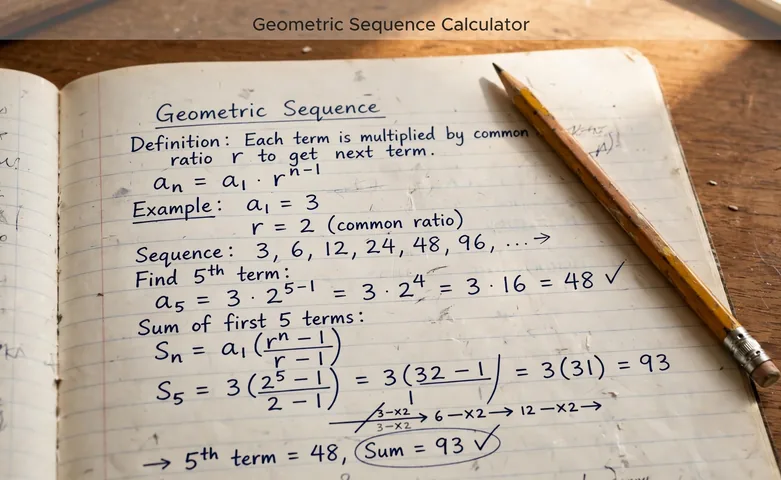
A geometric sequence converges only when the absolute value of the common ratio is below 1. Then each term is smaller than the one before it, the terms close in on zero, and the total of all the terms settles on a finite number. The formula is S = a1 / (1 - r).
Take 100, 50, 25, 12.5 and so on. The ratio is 0.5, so the infinite sum is 100 / (1 - 0.5) = 200. Adding more terms gets closer to 200 but never passes it. The first ten terms already add to about 199.8, which shows how fast a converging series settles down.
When the absolute value of r is 1 or more, the series diverges. A ratio of 1 gives a flat sequence that grows without bound as you add terms. A ratio above 1 grows faster at every step, and a ratio below -1 swings wider in both directions. In each case there is no finite infinite sum, and the calculator says so instead of giving a misleading number.
Common Mistakes to Avoid
The most common mistake is using r^n instead of r^(n-1) for the nth term. The first term is a1, not a1 x r, so the exponent is always one less than the position. For the 5th term of a sequence with a ratio of 3, the exponent is 4, not 5.
A second mistake is forgetting the r = 1 case in the sum formula. Plugging r = 1 into S_n = a1 x (1 - r^n) / (1 - r) divides by zero. When the ratio is 1, every term equals the first term, so the sum is simply n x a1. The calculator handles this case for you.
A third mistake is reading the sign of a negative ratio wrong. With a ratio of -2 and a first term of 3, the terms are 3, -6, 12, -24, so the signs alternate and the 4th term is -24, not 24. Check the sign of each term in the term list before you trust the answer.
Geometric Sequences in Real Life
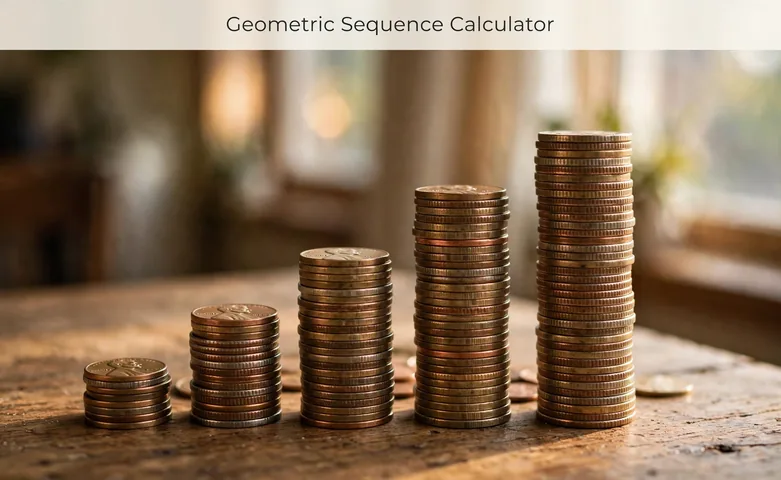
Compound interest is the most familiar geometric sequence. Money that grows by 5 percent a year multiplies by 1.05 at each step, so a balance of $1,000 becomes $1,050, then $1,102.50, then $1,157.63. The ratio is 1.05 and the nth term formula gives the balance after any number of years. Our compound interest calculator runs the same math with deposits and monthly compounding.
Populations, bacteria and viral spread follow the same pattern while growth stays steady. A quantity that doubles every hour has a ratio of 2, so it grows from 1 to 2 to 4 to 8 and on. Decay works the other way. A medicine that halves in the body every 6 hours has a ratio of 0.5, and the infinite sum formula tells you the total exposure over time. Our exponent calculator helps with the powers that show up in these problems.
Frequently asked questions
What is the nth term of a geometric sequence?
Use a_n = a1 x r^(n-1), where a1 is the first term, r is the common ratio and n is the position. For 2, 6, 18, 54, 162, the 5th term is 2 x 3^4 = 162.
How do you find the sum of a geometric sequence?
Use S_n = a1 x (1 - r^n) / (1 - r) for any ratio except 1. When r is 1, every term equals a1, so the sum is n x a1. For 2, 6, 18, 54, 162, the sum of the first five terms is 242.
When does a geometric sequence have an infinite sum?
Only when the absolute value of the common ratio is below 1. Then S = a1 / (1 - r). For 100, 50, 25 and so on, the infinite sum is 100 / (1 - 0.5) = 200.
What is the common ratio of 2, 6, 18, 54?
Divide any term by the one before it. 6 / 2 = 3, 18 / 6 = 3 and 54 / 18 = 3, so the common ratio is 3.
What happens when the common ratio is 1?
Every term equals the first term, so the sequence is flat. The nth term is a1 and the sum of the first n terms is n x a1. There is no finite infinite sum.
What is the difference between a geometric and an arithmetic sequence?
A geometric sequence multiplies by the same ratio at each step, while an arithmetic sequence adds the same difference. Geometric sequences grow exponentially, and arithmetic sequences grow in a straight line.
Related calculators

Arithmetic Sequence Calculator
Find the nth term and sum of an arithmetic sequence.
Use calculatorSummation Calculator
Add a series of numbers with a formula.
Use calculatorExponent Calculator
Raise a number to a power.
Use calculatorFibonacci Calculator
Generate Fibonacci numbers and find the nth term.
Use calculatorPercentage Calculator
Find what a percentage of any number is.
Use calculatorScientific Calculator
A full scientific calculator for everyday math.
Use calculator