Arithmetic Sequence Calculator
Find any term of an arithmetic sequence and the sum of its terms. Enter the first term, the common difference and how many terms to count, and you get the nth term, the sum and the list of terms, with every step shown. Free, no sign-up, everything runs in your browser.
Formulas: nth term a(n) = a1 + (n - 1) x d. Sum S(n) = n / 2 x (a1 + a(n)).

Formulas verified against standard references. Calculator logic tested with verified worked examples. Published: November 9, 2026 | Last updated: November 9, 2026. Fact-checked: November 9, 2026. Our methodology
How to Use the Arithmetic Sequence Calculator
Getting an answer takes three quick steps. The tool needs only the starting value, the fixed step and the position you want.
- Enter the first term in the first field. This is where the sequence starts.
- Enter the common difference in the second field. This is the amount added to get from one term to the next. Use a negative number when the sequence goes down.
- Enter how many terms to count, then press Calculate, or press Enter. The nth term appears first and large, with the sum, the average of the terms and the list of terms below. Press Reset to clear the form and start over.
The term count must be a whole number. Term 10 means the tenth number in the sequence, not a position part way between two terms.
The Arithmetic Sequence Formulas
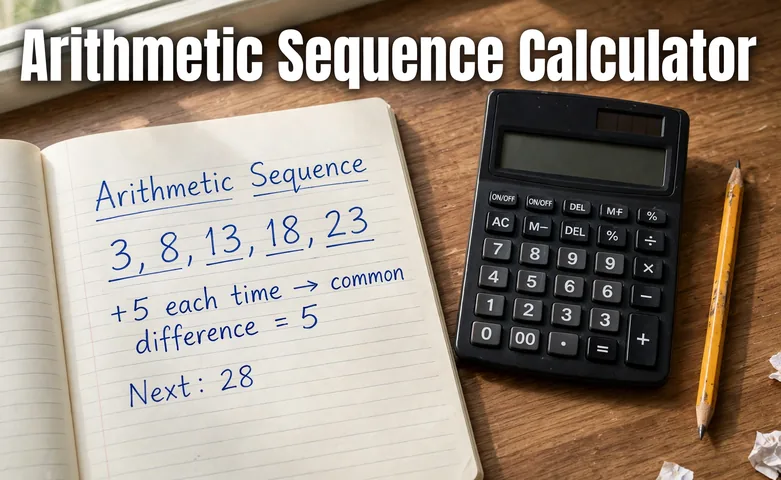
An arithmetic sequence is a list of numbers where each term differs from the one before it by the same fixed amount, called the common difference and written d. The sequence 3, 8, 13, 18, 23 has a common difference of 5.
The nth term formula is a(n) = a1 + (n - 1) x d, where a1 is the first term, d is the common difference and n is the position you want. You add d exactly n - 1 times, because the first term needs no additions, the second needs one, and so on. The sum of the first n terms is S(n) = n / 2 x (a1 + a(n)), which is the number of terms times the average of the first and last term. An equal form is S(n) = n / 2 x (2 x a1 + (n - 1) x d).
You can also work the other way. If you know a later term, the common difference is d = (a(n) - a1) / (n - 1), and the first term is a1 = a(n) - (n - 1) x d. Our average calculator is handy when you want the average of a list first and then want to check it against the sequence average here.
Worked Example: First Term 3, Difference 5
A sequence starts at 3 and adds 5 each time. Find the 10th term and the sum of the first 10 terms. Here is exactly what the calculator does.
- Count the steps: term 10 needs 10 - 1 = 9 additions of the difference.
- Nth term = 3 + 9 x 5 = 3 + 45 = 48.
- Sum = 10 / 2 x (3 + 48) = 5 x 51 = 255. The terms are 3, 8, 13, 18, 23, 28, 33, 38, 43, 48.
As a second check, a sequence that starts at 2 with a difference of 3 gives a 10th term of 2 + 9 x 3 = 29 and a sum of 10 / 2 x (2 + 29) = 155. The same steps work for any starting value and any difference.

How the Sum Formula Works
The sum formula comes from pairing terms. Take the first 10 terms of our example, 3 through 48. Pair the first term with the last, 3 + 48 = 51. Pair the second with the second to last, 8 + 43 = 51. Every pair adds to the same total, 51, and there are 5 such pairs, so the sum is 5 x 51 = 255.
That pairing is why the sum equals the number of terms times the average of the first and last term. The average of 3 and 48 is 25.5, and 10 x 25.5 = 255. This shortcut is often credited to the young Carl Friedrich Gauss, who is said to have added the numbers 1 to 100 the same way by pairing 1 with 100, 2 with 99, and so on to get 50 pairs of 101.
The pairing works for any number of terms. With an odd count, the middle term is left on its own, and it equals the average of the first and last term, so the same formula still holds. Our summation calculator adds a plain list of numbers when your numbers do not follow a pattern and you just need their total.
Decreasing Sequences and a Zero Difference
A negative common difference makes a decreasing sequence, and the same formulas still work. Start at 10 with a difference of -2, and the first 6 terms are 10, 8, 6, 4, 2, 0. The 6th term is 10 + 5 x (-2) = 0, and the sum is 6 / 2 x (10 + 0) = 30. The terms cross zero and keep going down, so term 7 is -2.
A difference of 0 makes a constant sequence where every term equals the first term. Start at 100 with a difference of 0, and the 5th term is 100 and the sum of the first 5 terms is 500. The formula still gives the right answer, because a(n) = a1 + (n - 1) x 0 = a1.
Decimal differences work the same way. Start at 1.5 with a difference of 0.5, and the 20th term is 1.5 + 19 x 0.5 = 11, with a sum of 20 / 2 x (1.5 + 11) = 125. Money problems often use decimals like this, for example a weekly saving plan that rises by $2.50 each week.
Common Arithmetic Sequence Mistakes
Multiplying by n instead of n - 1 is the most common error. The first term has zero differences added, so the 10th term uses 9 steps, not 10. Using 10 steps gives 53 instead of 48 in our worked example, which is one whole difference too far.
Mixing up the term position and the term value is next. In the sequence 3, 8, 13, 18, the number 13 is term 4, not term 13. The position n counts terms from the start, and the value a(n) is the number sitting at that position.
Assuming the difference is constant when it is not is the third mistake. Check at least three gaps before you trust the pattern. If the gaps are 5, 5 and 6, the sequence is not arithmetic, and the formulas on this page do not apply. A geometric sequence, where each term is multiplied by the same number instead of added to, needs different formulas too.

Frequently asked questions
What is an arithmetic sequence?
It is a list of numbers where each term differs from the one before it by the same fixed amount, called the common difference. The sequence 3, 8, 13, 18, 23 adds 5 each time, so its common difference is 5.
How do I find the nth term?
Use a(n) = a1 + (n - 1) x d. With a first term of 3, a difference of 5 and n = 10, the 10th term is 3 + 9 x 5 = 48.
How do I find the sum of an arithmetic sequence?
Use S(n) = n / 2 x (a1 + a(n)). With 10 terms from 3 to 48, the sum is 10 / 2 x (3 + 48) = 255.
What if the common difference is negative?
The sequence decreases, and the same formulas still work. Start at 10 with a difference of -2, and the 6th term is 0 and the sum of the first 6 terms is 30.
What is the difference between an arithmetic and a geometric sequence?
An arithmetic sequence adds the same amount each step, while a geometric sequence multiplies by the same amount each step. The sequence 2, 6, 18, 54 multiplies by 3 each time, so it is geometric, not arithmetic.
Can n be a decimal?
No. The position n must be a whole number, because it counts terms. Term 10 is the tenth number in the sequence, and there is no term 10.5.
Related calculators

Average Calculator
Work out the average of a list of numbers.
Use calculatorSummation Calculator
Add a list of numbers with the steps shown.
Use calculatorPercentage Calculator
Find what P% of any number is, instantly.
Use calculatorFraction Calculator
Add, subtract, multiply and divide fractions.
Use calculatorMean Median Mode Calculator
Find the mean, median and mode of any list.
Use calculatorStandard Deviation Calculator
Find how spread out a set of numbers is.
Use calculator