Fuel Consumption Converter
Convert fuel economy between miles per gallon, liters per 100 km and kilometers per liter. Enter one figure to see the same economy in all four units.
Formula: L/100km = 235.215 / MPG (US) = 282.481 / MPG (UK) = 100 / km/L. The factors come from the exact definitions of the gallon and the mile.

Formulas verified against standard references. Calculator logic tested with verified worked examples. Published: November 11, 2026 | Last updated: November 11, 2026. Fact-checked: November 11, 2026. Our methodology
How to Use the Fuel Consumption Converter
Converting fuel economy takes three quick entries. The tool converts your figure to liters per 100 km first, then to every other unit.
- Enter your fuel consumption figure, such as 30 from a US car review or 8 from a European spec sheet.
- Pick the unit your figure is in. US and UK gallons are different sizes, so pick the right one.
- Pick the unit you want the answer in, then press Calculate, or press Enter. The converted value appears first and large, with all four units below. Press Reset to clear the form and start over.
The Fuel Consumption Formulas
Fuel consumption is stated two ways. Liters per 100 km gives the fuel used for a set distance, so a lower number is better. Miles per gallon and kilometers per liter give the distance covered with a set amount of fuel, so a higher number is better. Converting between the two families needs a reciprocal, not a plain multiplication.
The exact formulas are L/100km = 235.215 / MPG (US), L/100km = 282.481 / MPG (UK), and km/L = 100 / L/100km. The constants come from the exact unit definitions. One mile is 1.609344 km, one US gallon is 3.785411784 liters, and one UK gallon is 4.54609 liters, as listed in NIST Special Publication 811. Our speed converter turns miles per hour into kilometers per hour, and our volume converter turns gallons into liters.
Worked Example: 30 MPG (US)
A car is rated at 30 miles per US gallon. Here is exactly what the converter does.
- L/100km: 235.215 / 30 = 7.84 L/100km.
- km/L: 100 / 7.84 = 12.75 km/L.
- MPG (UK): 282.481 / 7.84 = 36.03 MPG (UK).
As a second check, a car rated at 8 L/100km converts to 235.215 / 8 = 29.40 MPG (US) and 282.481 / 8 = 35.31 MPG (UK). The same steps work for any figure, so try your own numbers in the tool above.
US Gallons, UK Gallons and Why MPG Differs
The US gallon holds 3.785411784 liters and the UK gallon holds 4.54609 liters, so the UK gallon is about 20 percent larger. The same car therefore shows a bigger MPG number in the UK than in the US. Multiply a US MPG figure by 1.20095 to get the UK figure, so 30 MPG (US) is 36.03 MPG (UK).
A figure from an American source, such as a US review or the US government, is US MPG. A figure from a British source, or an older Canadian brochure, is usually imperial MPG. Mixing them up makes a car look about 20 percent more efficient than it is, so always check which gallon the source uses.
Why You Cannot Average MPG Directly
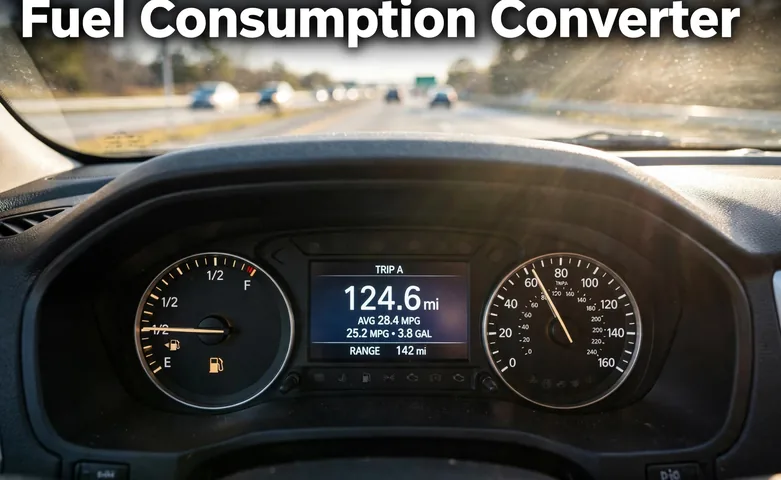
MPG is a reciprocal, so averaging MPG figures directly gives the wrong answer. Two trips at 20 MPG and 40 MPG do not average 30 MPG. Convert each to L/100km first, which is 11.76 and 5.88, average those to 8.82, and convert back to get 26.67 MPG.
The same rule applies to any average of fuel economy, including a whole year of fill ups. Average the L/100km figures, or work out the total fuel used and the total distance driven, and divide. Averaging MPG directly always overstates the true economy.
Typical Fuel Use by Car Type
A compact city car often uses 5 to 7 L/100km on the combined cycle, which is 14 to 20 km/L, 33 to 47 MPG (US), or 40 to 56 MPG (UK). A mid size family car often uses 7 to 9 L/100km, and a large SUV often uses 10 to 14 L/100km. Hybrids sit well below these figures on city driving, because the electric motor does much of the low speed work.
Real driving rarely matches the lab figure. Short trips, cold starts, air conditioning, roof loads and fast highway driving all raise fuel use. Use the converter to compare cars on the same unit, then check real world reports for the model you are looking at. Our length converter turns miles into kilometers for trip planning.
Frequently asked questions
How do I convert MPG to L/100km?
Divide 235.215 by the US MPG figure, or 282.481 by the UK MPG figure. 30 MPG (US) is 7.84 L/100km, and 30 MPG (UK) is 9.42 L/100km.
What is the difference between US and UK MPG?
The UK gallon is larger than the US gallon, 4.54609 liters against 3.78541 liters, so the same car shows a bigger MPG number in the UK. Multiply US MPG by 1.20095 to get UK MPG.
Is a higher MPG always better?
For MPG and km/L, yes, a higher number means the car goes further on the same fuel. For L/100km it is the other way round, and a lower number means the car uses less fuel.
What is a good L/100km figure?
A compact car at 5 to 7 L/100km is good, a family car at 7 to 9 L/100km is typical, and a large SUV at 10 to 14 L/100km is normal. Hybrids often do much better in city driving.
How do I convert km/L to MPG?
Multiply km/L by 2.352146 to get US MPG, or by 2.824809 to get UK MPG. 15 km/L is 35.28 MPG (US) and 42.37 MPG (UK).
Can I average two MPG figures?
No, not directly. Convert each figure to L/100km first, average those, and convert back. Two trips at 20 and 40 MPG average 26.67 MPG, not 30 MPG.
Related calculators
Speed Converter
Convert between mph, km/h and other speed units.
Use calculatorLength Converter
Convert between miles, kilometers and other lengths.
Use calculatorVolume Converter
Convert between gallons, liters and other volumes.
Use calculatorArea Converter
Convert between square feet, acres and other areas.
Use calculatorEnergy Converter
Convert between joules, calories and other energy units.
Use calculatorTemperature Converter
Convert between Celsius, Fahrenheit and Kelvin.
Use calculator