Period Calculator
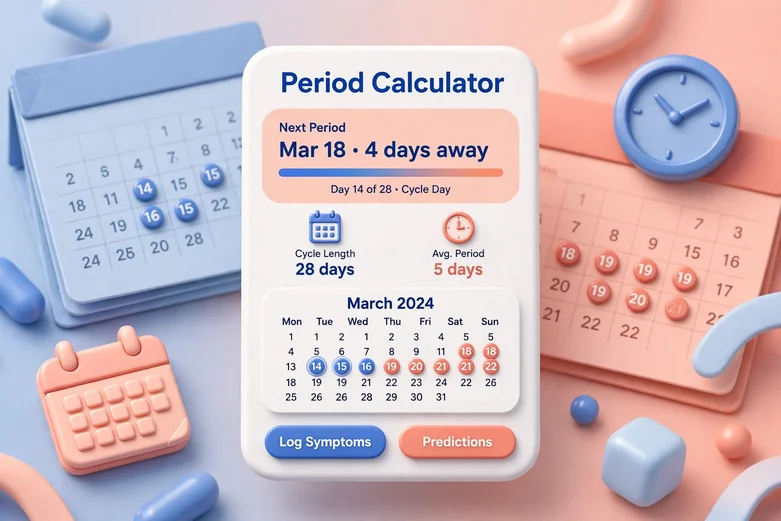
Predict your next period with this period calculator. Enter the first day of your last period and your average cycle length, and get your next 3 predicted period dates, your estimated ovulation day and your fertile window, with every step shown. Free, no sign-up, everything runs in your browser.
Formula: next period start = first day of last period + average cycle length. Ovulation is estimated 14 days before the next period starts.

Formulas verified against standard references. Calculator logic tested with verified worked examples. Published: November 5, 2026 | Last updated: November 5, 2026. Fact-checked: November 5, 2026. Our methodology
How to Use the Period Calculator
Getting a prediction takes three quick entries. The tool needs only your last period start date and your average cycle length.
- Tap the "First day of your last period" field and pick the date your most recent period began. Count day 1 as the first day of real bleeding, not spotting.
- Type your average cycle length in days. If you usually cycle every 28 days, keep 28. The field accepts whole numbers from 15 to 45.
- Optionally type how many days you usually bleed, from 2 to 8. Leave this blank and the tool uses 5.
- Press Calculate, or press Enter. Your next 3 predicted period dates appear first, then your estimated ovulation day, your fertile window and the step-by-step math.
- Press Reset to clear the form and try different numbers.
How the Period Prediction Works
A menstrual cycle runs from the first day of one period to the first day of the next. That definition is the same one the NHS, ACOG and the US Office on Women's Health use. Your cycle length is the number of days between those two day 1 marks. Once you know that number, the prediction is simple addition.
The Next Period Rule
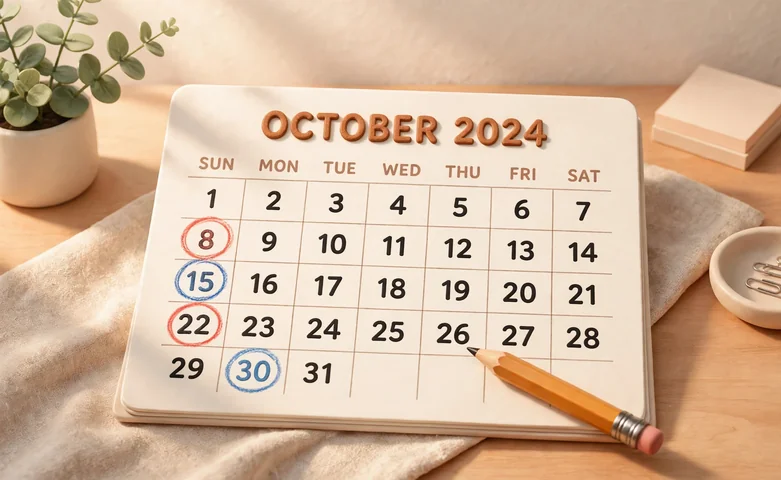
The next period starts on the first day of your last period plus your average cycle length. If your last period started on October 8, 2026 and your average cycle is 28 days, the next one is predicted for November 5, 2026. The tool repeats the same addition to predict the two periods after that, December 3 and December 31, 2026. Small timing errors add up with each cycle, so update the start date after each period begins instead of trusting the far predictions.
The Ovulation Estimate
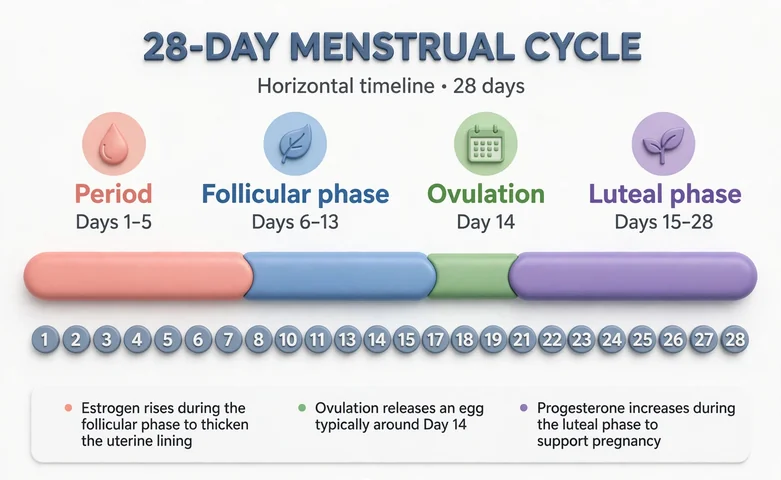
Ovulation is estimated 14 days before the next period starts. That 14-day gap is the luteal phase, and it stays fairly steady even when total cycle length changes, which is why counting backward from the next period beats counting forward from the last one. For the November 5, 2026 example, ovulation lands around October 22, 2026. The NHS puts ovulation about 12 to 16 days before the next period, so 14 is the standard middle estimate. Want that day in more detail? Try the ovulation calculator.
The Fertile Window Rule
The fertile window is the 6 days ending on ovulation day, the 5 days before ovulation plus the day itself. Sperm can survive in the body for up to about 5 days while the egg lives for roughly 1 day, so these are the days when conception is most likely. In the example, the window runs October 17 to October 22, 2026.
How to Read the Fertile Window
The fertile window is not a yes or no answer. It is a 6-day stretch that ends on the estimated ovulation day, and the days closest to ovulation carry the highest chance. The 5 earlier days are in the window because sperm can survive up to about 5 days, so intercourse a few days before ovulation can still lead to conception.
Read the window from the outside in. The first day, 5 days before ovulation, marks where the window opens. The last day is the ovulation estimate itself. If you are trying to conceive, the middle and later days of the window matter most. If you are trying to avoid pregnancy, remember that the window is only an estimate and ovulation can shift a day or two either way.
The window also moves with your cycle length. A 24-day cycle with a period starting October 8, 2026 predicts the next period for November 1, 2026 and ovulation around October 18, 2026, so the fertile window runs October 13 to October 18. A 32-day cycle shifts everything later. The next period lands around November 9, ovulation around October 26, and the fertile window runs October 21 to October 26. The calculator repositions the whole window automatically whenever you change the cycle length.
What the Calculator Cannot Know
This tool uses averages, not your body's real-time signals. It cannot see the things that shift a real cycle. Stress, travel, illness, heavy exercise, big weight changes, hormonal contraception and thyroid or hormone conditions can all move your period by several days, and the calculator has no way to know any of them happened.
It also assumes your luteal phase is 14 days. Research puts the average closer to 12 to 14 days and individual cycles vary, so the ovulation estimate is rough by design. The calculator does not track hormone levels, temperature or cervical mucus, and it cannot diagnose why a period is late.
Do not use this tool as a contraceptive method. The fertile window is an estimate and sperm survival plus shifting ovulation make calendar timing unreliable on its own. If you want to time a pregnancy or avoid one, talk to a clinician about methods that fit your situation.
When to Talk to a Clinician
An estimated date is fine for planning, but some patterns deserve a professional opinion. The NHS suggests speaking to a GP if your cycles are often shorter than 21 days or longer than 35 days, if periods stop for more than 3 months, if bleeding is very heavy or lasts much longer than usual, or if you bleed between periods or after sex.
Tracking helps the appointment too. The NHS and the US Office on Women's Health both say that a few months of real logged dates beat any single estimate. Mark day 1 of each period, count the cycle lengths, and note the shortest and longest. Bringing that record, or your estimate from the pregnancy due date calculator when it applies, gives your clinician real data to work with instead of a guess.
Disclaimer
This calculator gives estimates for planning and is for informational purposes only, not medical advice. Cycle timing varies from person to person and month to month, and these dates must not be used as a contraceptive method or as a substitute for professional care. See our disclaimer.
Sources
- Office on Women's Health: Your Menstrual Cycle — U.S. Department of Health and Human Services, how the menstrual cycle is counted and what is typical.
Frequently asked questions
How does a period calculator predict my next period?
It adds your average cycle length to the first day of your last period. With a 28-day cycle starting October 8, 2026, the next period is predicted for November 5, 2026. The tool repeats the same addition to predict the periods after that.
When do I ovulate in a 28-day cycle?
Around day 14 of the cycle, about 14 days before the next period starts. With a period starting October 8, 2026 and a 28-day cycle, ovulation is estimated around October 22, 2026. Real timing can shift a day or two either way.
What is the fertile window?
The 6 days ending on the estimated ovulation day, made up of the 5 days before ovulation plus ovulation day. Sperm can survive in the body for up to about 5 days while the egg lives for roughly 1 day, which is why those 6 days count.
Can I use this calculator to avoid pregnancy?
No. The fertile window is only an estimate, and shifting ovulation plus sperm survival make calendar timing unreliable as contraception. Talk to a clinician about reliable methods of birth control.
What if my periods are irregular?
Predictions work best with regular cycles. Track 3 to 6 cycles and average them, and update the date after each period starts. If your cycles vary by more than about a week from month to month, talk to a clinician, because this tool cannot model irregular timing.
What is a normal cycle length?
The NHS says most cycles run 21 to 35 days, with around 28 days the most common average, and bleeding usually lasts 2 to 7 days. Talk to a GP if your cycles are often shorter than 21 days or longer than 35 days.
Related calculators

Ovulation Calculator
Free ovulation calculator: enter your last period and cycle length to find your ovulation date, fertile window and next period. Clear dates with a disclaimer.
Use calculatorPregnancy Due Date Calculator
Estimate your due date from your last period.
Use calculatorAge Calculator
Find your exact age in years, months and days from your birth date.
Use calculatorBMI Calculator
Check your Body Mass Index from height and weight, with your healthy range.
Use calculatorWater Intake Calculator
Find out how much water to drink each day from your body weight, exercise and climate. See your target in liters, US cups and fluid ounces, free and instant.
Use calculatorSleep Cycle Calculator
Find ideal bedtimes or wake-up times in complete 90-minute sleep cycles, so you wake up refreshed instead of groggy.
Use calculator