Ovulation Calculator: Find Your Ovulation Date and Fertile Window
Enter the first day of your last period and your average cycle length to estimate your ovulation date, your 7-day fertile window, and your next expected period.
The ovulation formula
This calculator uses the calendar method. Ovulation happens a fairly fixed number of days before your next period (the luteal phase, usually 14 days). So we count backwards from your expected period:
Ovulation date = first day of last period + (cycle length − luteal phase)
Fertile window = ovulation day − 5 days through ovulation day + 1 day
Next period = first day of last period + cycle length
The fertile window opens five days before ovulation because sperm can survive inside the reproductive tract for several days. It closes one day after ovulation because a released egg lives roughly 24 hours.
Worked example
Your last period started on October 1, 2026, your cycle is 28 days, and your luteal phase is 14 days:
- Ovulation day of cycle: 28 − 14 = day 14
- Ovulation date: Oct 1 + 14 days = Thursday, Oct 15, 2026
- Fertile window: Oct 15 − 5 days through Oct 15 + 1 day = Oct 10 – Oct 16, 2026
- Next period: Oct 1 + 28 days = Thursday, Oct 29, 2026
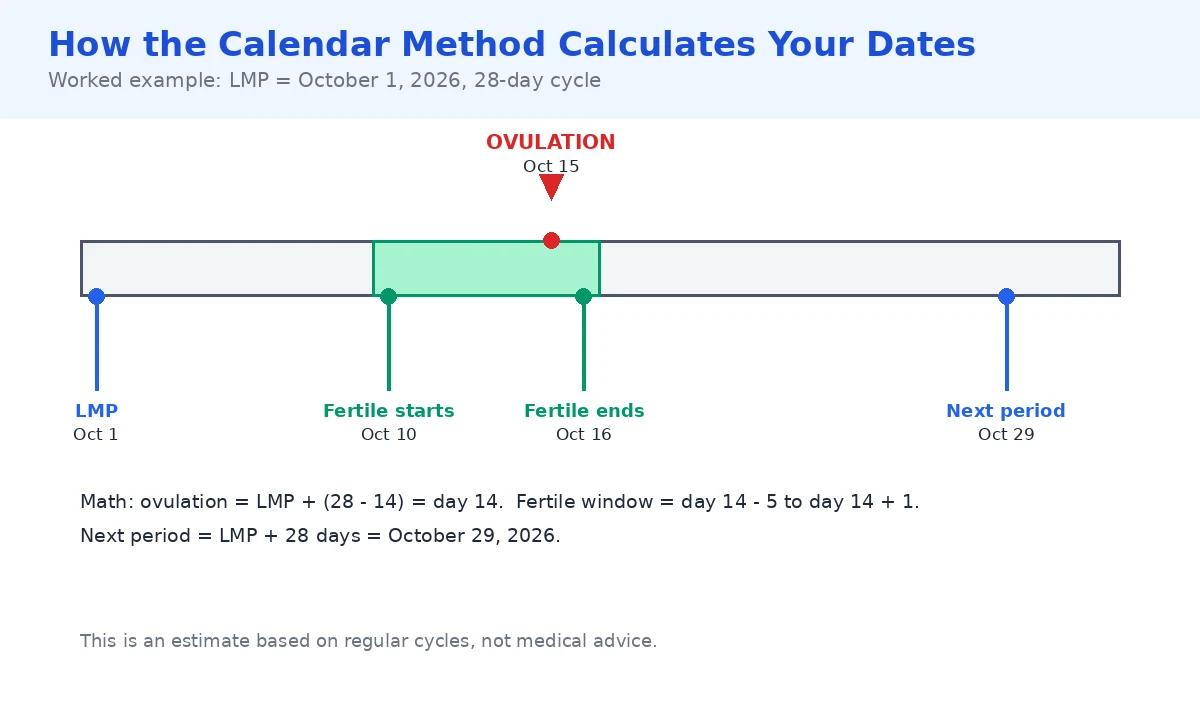
The worked example on a timeline: ovulation falls in the middle of a 28-day cycle, and the fertile window covers seven days around it.
How to use the ovulation calculator
- Enter the first day of your last period. Day 1 is the first day of bleeding, not spotting.
- Enter your average cycle length. Count from the first day of one period to the first day of the next. If you do not track, 28 is the most common value. Cycle lengths between 21 and 35 days are considered normal.
- Check the luteal phase. Leave 14 days unless you track yours with ovulation tests or temperature charting and know it differs.
- Press Calculate and read your ovulation date, fertile window, and next expected period.
For the best input, average your last three cycle lengths instead of guessing. A cycle that swings by more than about a week from month to month makes the estimate noticeably less reliable — see the section on irregular cycles below.
Understanding your menstrual cycle
A menstrual cycle has four broad phases. The key insight for ovulation timing is that the second half of the cycle (after ovulation) is much more stable than the first half. That is why counting backwards from your next period works better than counting forwards from your last one.
| Phase | Days (28-day cycle) | What happens |
|---|---|---|
| Menstrual | 1–5 | The uterine lining sheds; this is your period. |
| Follicular | 1–13 | Follicles develop in the ovary; estrogen rises. This phase varies the most in length. |
| Ovulation | 14 | A mature egg is released from the ovary. |
| Luteal | 15–28 | Progesterone prepares the lining; if no pregnancy occurs, hormone levels fall and the next period begins. |
The UK National Health Service notes that ovulation typically happens about 10 to 16 days before the next period, and that regular cycles of 21 to 35 days are normal — see the NHS guide to periods and fertility in the menstrual cycle.
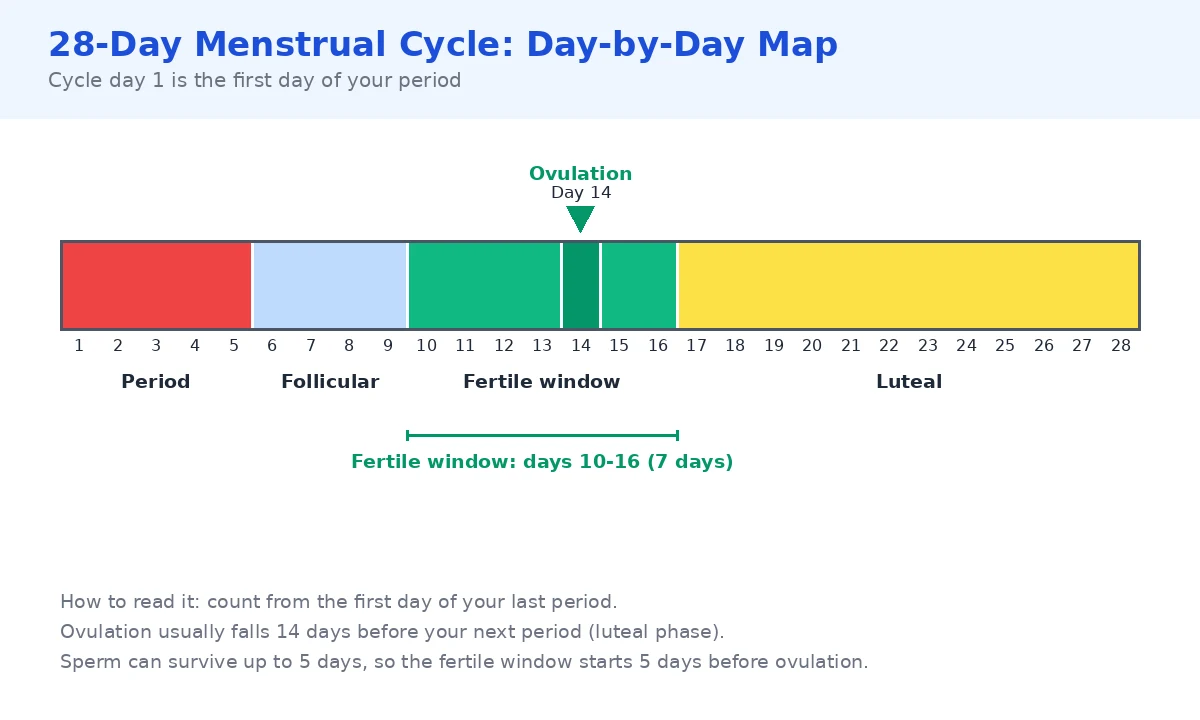
The day-by-day map of a 28-day cycle. Note how the fertile window straddles ovulation: five days before it, the day itself, and one day after.
The fertile window, explained
Although pregnancy can only start on ovulation day, conception is possible from intercourse up to five days earlier. Sperm can survive in the reproductive tract for several days, waiting for the egg. An egg, once released, stays viable for roughly 24 hours. That is why the fertile window is seven days long, not one.
Within the window, the days closest to ovulation matter most. The two days before ovulation and ovulation day itself are the most likely to lead to conception, while the earliest days of the window are much less likely. This is worth knowing if you are timing intercourse — frequency during the middle of the window matters more than hitting the very first fertile day.
A common mistake is assuming the fertile window is always mid-cycle. It is mid-cycle only for a 28-day cycle. In a 35-day cycle, ovulation lands around day 21 — a full week later — so a calendar that assumes day 14 will be wrong by a week.
When your cycle is not 28 days
The calendar method assumes your luteal phase is constant and only the first half of the cycle stretches or shrinks. In practice that is a good approximation: ovulation day = cycle length − luteal phase. Here is what that means for different cycle lengths, using a last period of October 1, 2026 and a 14-day luteal phase:
| Cycle length | Ovulation day | Ovulation date | Fertile window | Next period |
|---|---|---|---|---|
| 21 days | Day 7 | Oct 8, 2026 | Oct 3 – Oct 9 | Oct 22, 2026 |
| 28 days | Day 14 | Oct 15, 2026 | Oct 10 – Oct 16 | Oct 29, 2026 |
| 35 days | Day 21 | Oct 22, 2026 | Oct 17 – Oct 23 | Nov 5, 2026 |
Notice that with a short 21-day cycle, the fertile window opens almost immediately after the period ends — something the "day 14" myth gets badly wrong. Cycles also change with age: they typically become less predictable in the years approaching menopause, which makes calendar estimates less reliable. To see your exact age from your date of birth, try our age calculator.
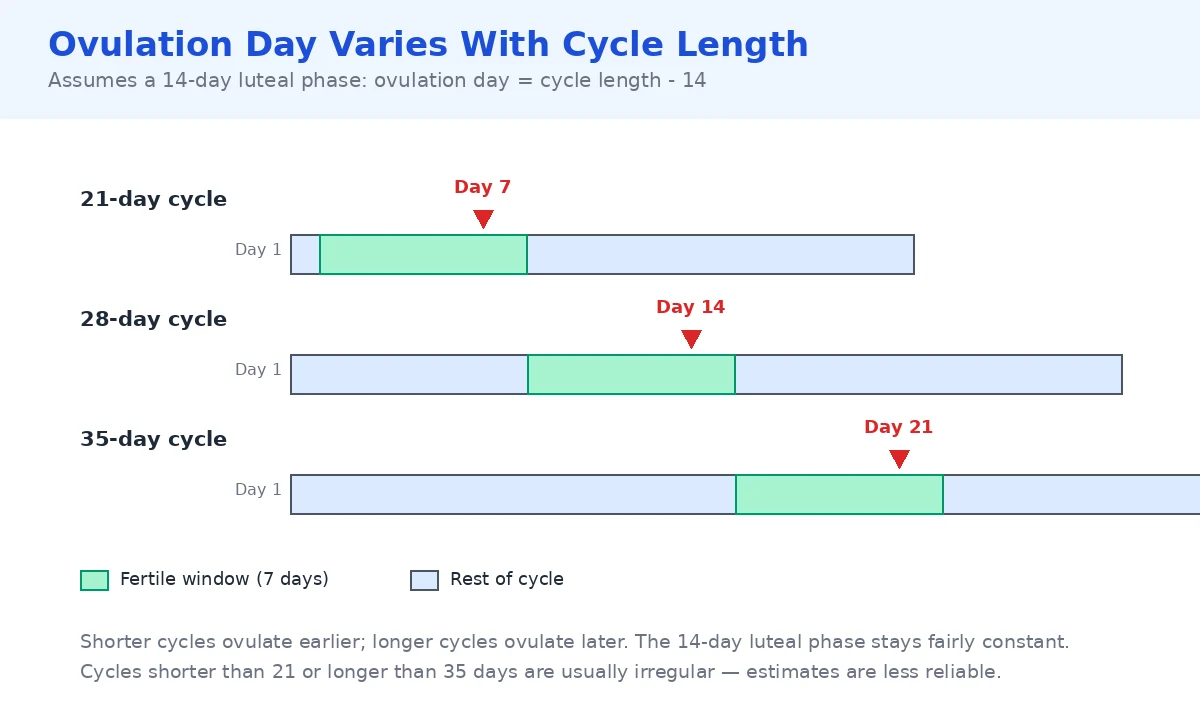
Shorter cycles ovulate earlier and longer cycles ovulate later, because the 14-day luteal phase stays roughly constant while the first half of the cycle changes.
Planning a pregnancy, and the limits of this calculator
If you are trying to conceive, the fertile window is your practical guide: timing intercourse within it gives each cycle its best chance. Tracking for two or three cycles first makes your average cycle length — and therefore the estimate — more trustworthy. If conception happens, our pregnancy due date calculator estimates your due date from the first day of your last period.
Be aware of what this tool cannot do. It assumes regular cycles and an average luteal phase. Stress, illness, travel, coming off hormonal contraception, breastfeeding, and conditions such as PCOS can all shift ovulation. The calendar method is not reliable as contraception: the American College of Obstetricians and Gynecologists discusses fertility-awareness methods and their limitations in its FAQ on fertility awareness-based methods of family planning.
Disclaimer: this calculator gives estimates based on average cycle timing. It is not medical advice, and it cannot diagnose or treat any condition. If your cycles are irregular, or you have been trying to conceive without success, speak to a healthcare provider.
Frequently asked questions
How accurate is an ovulation calculator?
An ovulation calculator is an estimate, not a measurement. It assumes your cycles are regular and your luteal phase is average. It works best when your cycle length varies by only a few days from month to month. Ovulation predictor kits and basal body temperature tracking measure your body directly and are more reliable for confirming ovulation.
How many days is my fertile window?
The fertile window is about seven days: the five days before ovulation, ovulation day itself, and the day after. It opens five days early because sperm can survive in the reproductive tract for several days, and it closes a day after ovulation because a released egg stays viable for roughly 24 hours.
Can I get pregnant outside my fertile window?
Pregnancy requires ovulation, so conception happens only around ovulation day. However, ovulation can arrive earlier or later than the calendar estimate, especially with irregular cycles. The calendar method is not reliable as birth control — use a proven contraceptive method if you want to avoid pregnancy.
What is the luteal phase and why does it matter?
The luteal phase is the time from ovulation to the start of your next period. It is the most stable part of the cycle — usually around 14 days — which is why ovulation calculators count backwards from your expected period rather than forwards from your last one. You can leave it at 14 unless you track yours and know it differs.
Does this calculator work for irregular cycles?
Only roughly. If your cycle length swings by a week or more between months, the calendar estimate can be off by several days, because ovulation timing varies with it. For irregular cycles, ovulation predictor kits or fertility tracking apps that combine multiple signs give better guidance than a calculator alone.
When should I take a pregnancy test?
Wait until the first day of your missed period — around 14 days after ovulation. Testing earlier often gives a false negative because the pregnancy hormone hCG may not yet be high enough to detect. The calculator shows your next expected period, which is your testing date.
Is ovulation always on day 14?
No — that is only true for a 28-day cycle. Ovulation day equals your cycle length minus your luteal phase, so a 21-day cycle ovulates around day 7 and a 35-day cycle around day 21. Day 14 is a common myth that only fits the textbook cycle.
Why does my cycle length matter more than my period length?
Ovulation timing depends on the full cycle — the gap from one period's first day to the next — not on how many days you bleed. Two people can both bleed for 5 days yet ovulate a week apart if one has a 21-day cycle and the other a 35-day cycle.