Pregnancy Due Date Calculator
Enter the first day of your last menstrual period to estimate your due date, conception date, and current week of pregnancy. Based on Naegele's rule (280 days from LMP).
How the pregnancy due date calculator works
A pregnancy due date calculator estimates when your baby will arrive using the first day of your last menstrual period (LMP). It applies Naegele's rule: add 280 days (40 weeks) to the LMP date. This is the standard method used by doctors and midwives worldwide.
The calculation assumes a regular 28-day cycle with ovulation on day 14. If your cycle is longer or shorter, the calculator adjusts the due date accordingly. For a quick check of how many days are between two dates, our age calculator can help with date math.
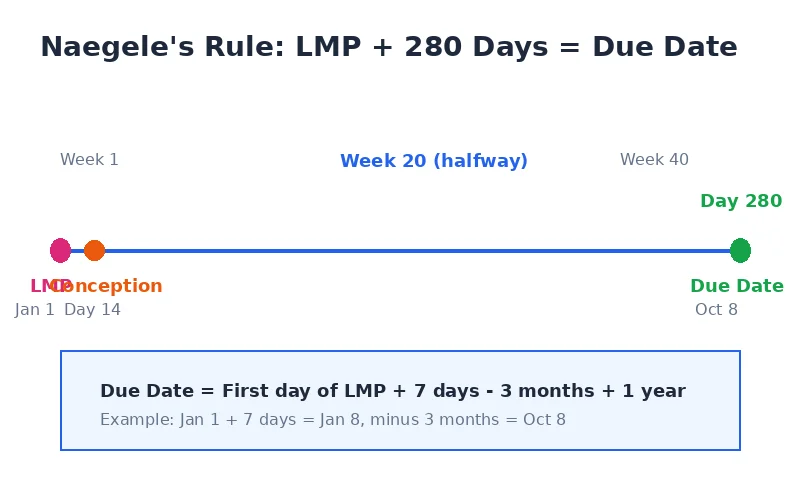
The due date formula (Naegele's rule)
Naegele's rule is the standard formula for estimating a due date. It assumes pregnancy lasts 280 days (40 weeks) from the first day of the last menstrual period:
Due Date = LMP + 280 days
There is also a shortcut version that gives the same result:
Due Date = LMP + 7 days − 3 months + 1 year
The conception date is estimated as 14 days after the LMP (the typical ovulation day in a 28-day cycle). If your cycle differs from 28 days, add the difference: for a 30-day cycle, add 2 extra days to the due date.
| Cycle length | Adjustment | Example (LMP Jan 1) |
|---|---|---|
| 21 days | Minus 7 days | Oct 1, 2026 |
| 28 days | No change | Oct 8, 2026 |
| 35 days | Plus 7 days | Oct 15, 2026 |
Worked example
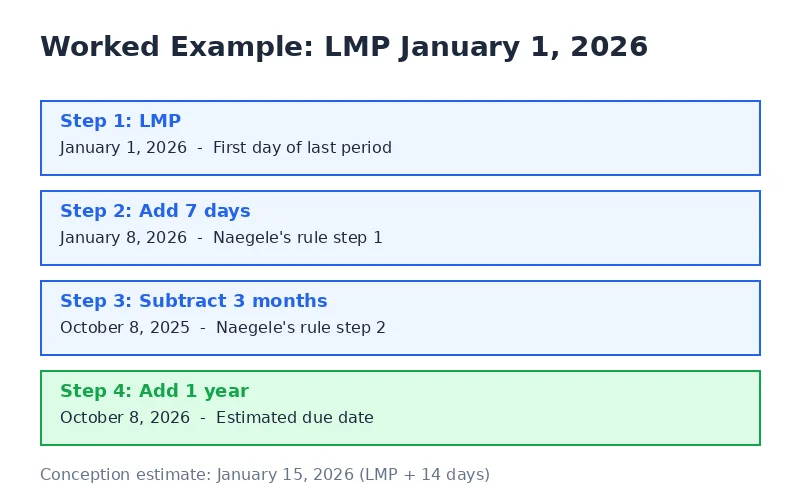
Say the first day of your last period was January 1, 2026, with a regular 28-day cycle:
| Step | Calculation | Result |
|---|---|---|
| 1. Start with LMP | January 1, 2026 | Jan 1, 2026 |
| 2. Add 7 days | Jan 1 + 7 days | Jan 8, 2026 |
| 3. Subtract 3 months | Jan 8 minus 3 months | Oct 8, 2025 |
| 4. Add 1 year | Oct 8, 2025 + 1 year | Oct 8, 2026 |
The estimated due date is October 8, 2026. The estimated conception date is January 15, 2026 (LMP + 14 days).
Pregnancy trimesters explained
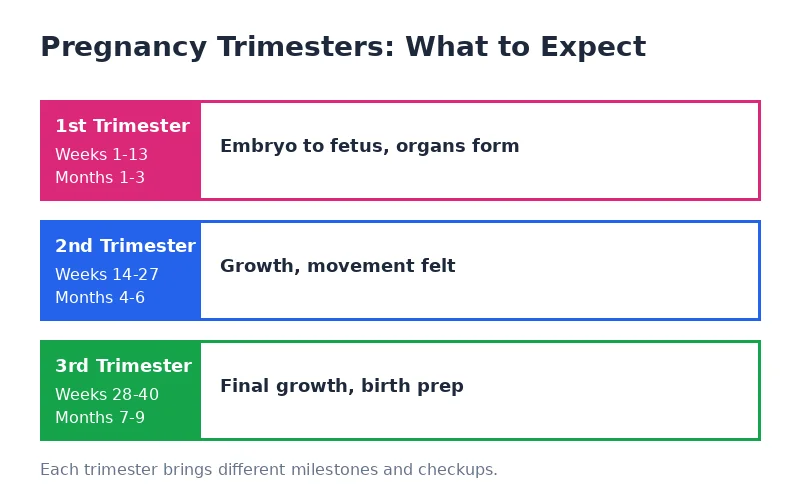
Pregnancy is divided into three trimesters, each about 13 weeks long. Each stage brings different developments and milestones:
| Trimester | Weeks | Months | Key developments |
|---|---|---|---|
| First | 1–13 | 1–3 | Embryo becomes fetus; brain, spine, and organs form |
| Second | 14–27 | 4–6 | Rapid growth; movement felt; anatomy scan |
| Third | 28–40 | 7–9 | Final weight gain; lungs mature; birth preparation |
Knowing your current week helps you track which checkups and screenings are due. Most prenatal appointments follow a schedule tied to your gestational week. To convert between weeks and months precisely, the age calculator handles date differences accurately.
5 tips for tracking your pregnancy
- Confirm with an early ultrasound. A first-trimester dating scan (weeks 8–12) gives the most accurate due date, especially if your cycles are irregular.
- Track your cycle length honestly. If your cycles are consistently longer or shorter than 28 days, enter your real average — it shifts the due date by the exact difference.
- Count from the LMP, not conception. Doctors date pregnancy from the last period, so week 1 starts before you actually conceive. This is standard worldwide.
- Remember only 5% arrive on the due date. Most babies come within two weeks before or after. Think of it as a due month, not a due day.
- Keep a symptom and appointment log. Noting each week's milestones makes prenatal visits more productive and helps spot anything unusual early.
Frequently asked questions
How is the due date calculated?
The due date is estimated with Naegele's rule: add 280 days (40 weeks) to the first day of your last menstrual period. This assumes a 28-day cycle. If your cycle is longer or shorter, the date shifts by the difference.
How accurate is a due date calculator?
It is an estimate. Only about 5% of babies arrive on their due date; most come within two weeks before or after. An early ultrasound (weeks 8 to 12) gives the most accurate dating, especially with irregular cycles.
What is the conception date?
Conception is estimated as 14 days after the first day of your last period, which is the typical ovulation day in a 28-day cycle. Sperm can survive up to 5 days, so the actual conception window spans several days around ovulation.
Why do doctors count from the last period instead of conception?
Because the LMP is a date most people know, while the exact conception day is rarely known. Counting from the LMP is the worldwide standard, so week 1 of pregnancy actually starts about two weeks before conception.
What if I have irregular periods?
Naegele's rule is less reliable with irregular cycles. An early dating ultrasound is the best option — it measures the embryo directly and can date the pregnancy within a few days of accuracy in the first trimester.
Can the due date change later?
Yes. Your provider may adjust it after an early ultrasound if the scan dating differs from the LMP-based date by more than a few days. After the first trimester, the due date is rarely changed.
What does it mean if I am overdue?
Going past 40 weeks is common — about 30% of pregnancies continue past the due date. Most providers discuss induction options between 41 and 42 weeks. Your provider will monitor you closely during this time.