Moving Cost Calculator
Estimate what your move will cost before you call a mover. Pick a local move or a long-distance move, choose your home size to fill in typical crew hours or shipment weight, then adjust the rates to match your quotes. The calculator shows the labor or transport cost, packing and extras, and the total, step by step. Free, no sign-up, everything runs in your browser.
Formulas: Local total = (Movers × Hours × Hourly rate) + Truck fee + Packing + Other. Long-distance total = (Weight × Rate per pound) + (Distance × Rate per mile) + Packing + Other.

Formulas verified against standard references. Calculator logic tested with verified worked examples. Published: November 6, 2026 | Last updated: November 6, 2026. Fact-checked: November 6, 2026. Our methodology
How to Use the Moving Cost Calculator
Getting an answer takes five quick steps. The tool prices local and long-distance moves differently, because movers bill them differently, so start by picking the kind of move you are making.
- Choose "Local move" for a move under 100 miles, or "Long-distance move" for 100 miles or more.
- Choose your home size. The calculator fills in typical crew hours or shipment weight, and you can change any number after.
- For a local move, type the number of movers, the hours, the hourly rate per mover and the truck fee. For a long-distance move, type the shipment weight, the rate per pound, the distance and the rate per mile.
- Type what packing help costs, and any other costs such as special items or stairs. Enter 0 where nothing applies.
- Press Calculate, or press Enter. The total appears first and large, with the labor or transport cost, packing and extras, and the step-by-step math below. Press Reset to clear the form and start over.
The Moving Cost Formulas
Two formulas price the two kinds of move. Each one matches how movers actually build a quote, so you can check every line against what a company tells you.
Local move: Total = (Movers × Hours × Hourly rate) + Truck fee + Packing + Other. Local movers bill by the hour, so the crew size and the hours drive the price. Typical hourly rates run $25 to $50 per mover per hour.
Long-distance move: Total = (Weight × Rate per pound) + (Distance × Rate per mile) + Packing + Other. Long-distance carriers charge mainly by the weight of your shipment and the distance it travels, and typical per-pound rates run $0.50 to $0.70 depending on distance.
Packing and Other are the same in both formulas. Packing covers help and materials when the movers pack for you, and Other covers special items, stairs and storage. If a quote bundles one of these into another line, enter 0 for it here so you do not count it twice.
Worked Example: A Local 2-Bedroom Move
You move a 2-bedroom home across town with 3 movers for 5 hours at $40 per mover per hour. The truck fee is $100 and packing help costs $150. Here is exactly what the calculator does.
- Labor = 3 movers × 5 hours × $40.00 = $600.00.
- Add the truck fee: $600.00 + $100.00 = $700.00.
- Add packing: $700.00 + $150.00 = $850.00.
As a check, take a 7,400-pound household moving 1,000 miles at $0.50 per pound and $0.50 per mile, with $300 of packing. The weight charge is $3,700.00, the mileage charge is $500.00, transport is $4,200.00 and the total is $4,500.00. Allied Van Lines puts the average at about $4,300 for the same load, so this estimate sits close to the published average.
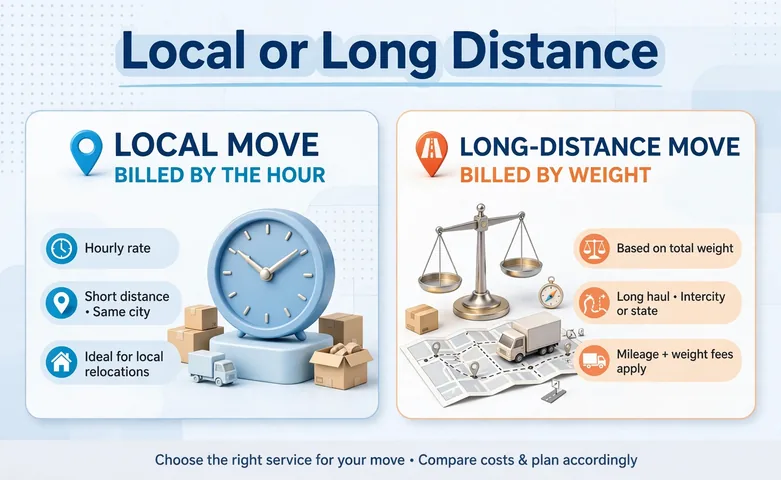
Local vs Long-Distance: How the Price Is Built
Distance changes the pricing model completely. A local move is a labor job with a truck, while a long-distance move is a freight job priced on weight. The table below shows the typical ranges MiniWebtool publishes for 2026, so you can see where your own estimate lands.
| Home size | Local move | Long-distance move |
|---|---|---|
| Studio | $400 to $800 | $1,200 to $2,500 |
| 2 Bedrooms | $800 to $1,800 | $2,500 to $5,000 |
| 3 Bedrooms | $1,200 to $2,800 | $3,500 to $7,500 |
Our worked example at $850 sits at the low end of the 2-bedroom local range, which makes sense for a 5-hour job with a small crew. If your estimate lands far outside the range for your home size, check the hours and the weight first, because those two numbers move the total more than anything else.
What Pushes the Price Up
Season is the biggest lever after size and distance. The industry peaks from May through September, when demand and prices spike, while a mid-month weekday in the October to April off-peak season can cost much less. Holiday weekends and month-end dates carry surcharges of their own.
Packing is next. Full packing service can add $500 to $2,000 or more depending on home size, while partial packing for fragile items only costs about half. Packing yourself costs only supplies, typically $50 to $200, so this line is where many people save the most.
Special items and access add the rest. Pianos typically add $300 to $600, pool tables $250 to $450, hot tubs $400 to $800 and safes $200 to $500, and each flight of stairs typically adds $50 to $150. Basic coverage, called released value protection, is included free but covers only $0.60 per pound per item, so a 50-pound television is covered for $30. Full value protection typically costs about 3% of your declared shipment value.
Common Moving Cost Mistakes
Comparing quotes that include different things is the most common mistake. One quote may include packing and another may not, so the cheaper number can be the more expensive move. Ask every mover for the same list, which is crew size, hours, truck fee, packing, special items and coverage, then run each quote through this calculator to compare like with like.
Underestimating the weight is the long-distance version of the same error. A 3-bedroom home averages about 8,000 pounds, and every extra 1,000 pounds at $0.50 a pound adds $500. Declutter before you move, because every pound you do not move is money saved.
Finally, plan the move inside your wider budget. A move has costs beyond the movers, such as deposits and travel, so check the total with our budget calculator and confirm the arithmetic with our percentage calculator when a quote adds a peak-season surcharge.
Disclaimer
This calculator gives an estimate for planning and is for informational purposes only, not financial advice. Actual moving prices depend on your mover, your route, your shipment weight and the season. See our disclaimer.

Sources
- MiniWebtool: Moving Cost Estimator. Local and long-distance formulas, typical rates and cost ranges by home size.
- Agoyu: Moving Cost Calculator. Allied Van Lines average of about $4,300 to move a 7,400-pound household more than 1,000 miles.
Frequently asked questions
How much does a local move cost?
A local move typically costs $400 to $3,000, and a 2-bedroom home usually runs $800 to $1,800 before extras. The price is driven by crew size, hours and the hourly rate, plus a truck fee.
How much does a long-distance move cost?
A long-distance move for a 2 to 3-bedroom home typically costs $2,500 to $7,500. The price is driven by shipment weight and distance, so a heavier load over more miles costs more.
How do movers charge for a local move?
By the hour. The formula is movers times hours times the hourly rate per mover, plus a truck fee, packing and extras. With 3 movers for 5 hours at $40 an hour, labor is $600.
How is a long-distance move priced?
By weight and distance. The formula is shipment weight times the rate per pound, plus distance times the rate per mile, plus packing and extras. Typical per-pound rates run $0.50 to $0.70 depending on distance.
What does basic moving insurance cover?
Basic coverage, called released value protection, is included free and covers $0.60 per pound per item. A 50-pound television damaged in the move would be covered for $30, whatever its real value. Full value protection typically costs about 3% of your declared shipment value.
When is the cheapest time to move?
The off-peak season from October through April, especially mid-month on a weekday. Moving in the May to September peak season can cost 25% more, and holiday weekends and month-end dates carry surcharges too.
Related calculators

Budget Calculator
Fit the move into your monthly budget before moving day.
Use calculatorSalary to Hourly Calculator
Work out what your time is worth if you take days off to move.
Use calculatorHourly to Salary Calculator
Turn an hourly rate into a yearly salary for comparison.
Use calculatorTip Calculator
Work out a fair tip for your moving crew.
Use calculatorSavings Goal Calculator
Save toward moving costs with a monthly target.
Use calculatorPercentage Calculator
Find what P% of any number is, instant answers with the formula shown.
Use calculator