Long Division Calculator
Divide any two whole numbers with this long division calculator. Type a dividend and a divisor, press Calculate, and get the quotient, the remainder, the decimal answer, and the mixed number, with every divide, multiply, subtract, and bring down step shown. Free, no sign-up, everything runs in your browser.
Formula: Dividend = Divisor × Quotient + Remainder.

Formulas verified against standard references. Calculator logic tested with verified worked examples. Published: November 5, 2026 | Last updated: November 5, 2026. Our methodology
How to Use the Long Division Calculator
Getting an answer takes four quick steps. The tool needs two whole numbers.
- Type the dividend in the "Dividend" field. Use 875 for the example below. The field accepts whole numbers up to 15 digits.
- Type the divisor in the "Divisor" field. It must be a whole number other than zero.
- Choose how many decimal places the decimal answer should show. Three is the default.
- Press Calculate, or press Enter. The answer appears with the quotient, the remainder, the decimal result, the mixed number, a check of the answer, and the full working. Press Reset to clear the form and try another pair.
How Long Division Works
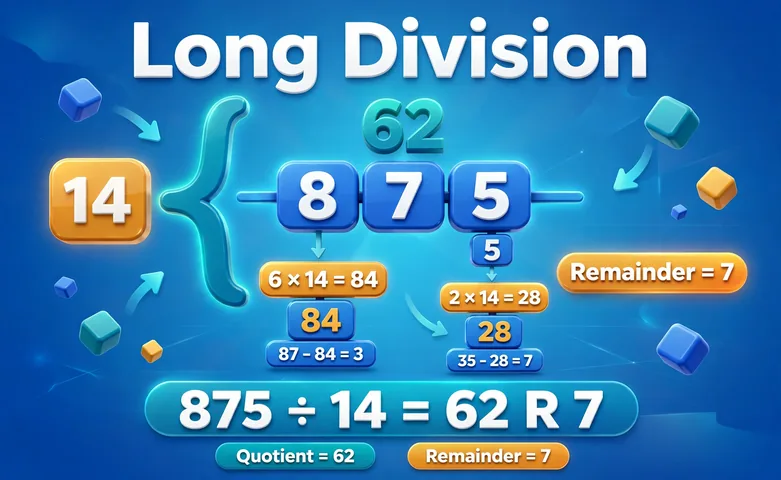
Long division breaks one big division into small repeated steps. Four names matter. The dividend is the number being divided. The divisor is the number you divide by. The quotient is the whole-number answer. The remainder is what is left over.
The method repeats four actions until no digits are left. You divide, then multiply, then subtract, then bring down the next digit. Here is the full working for 875 ÷ 14.
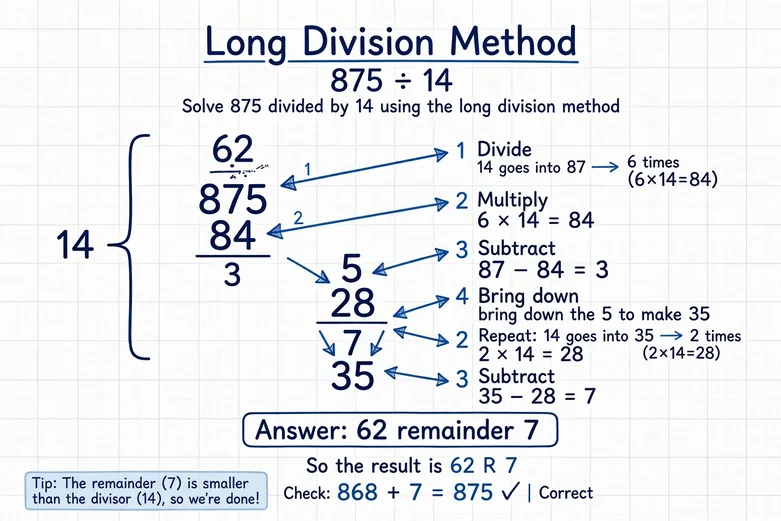
Start with the first digits of the dividend. 14 does not go into 8, so look at 87. Divide: 14 goes into 87 six times. Write 6 in the quotient. Multiply: 6 × 14 = 84. Subtract: 87 − 84 = 3. Bring down the next digit, 5, to make 35. Repeat the four actions. Divide: 14 goes into 35 two times. Write 2 in the quotient. Multiply: 2 × 14 = 28. Subtract: 35 − 28 = 7. No digits are left, so the quotient is 62 and the remainder is 7.
The method can also continue past the whole number. Bring down a 0 to make 70, and 14 goes into 70 exactly five times. That gives the decimal answer 62.5. The calculator on this page carries on this way for as many decimal places as you choose.
Reading Your Result
The calculator gives the same answer in four forms, using 875 ÷ 14 as the running example.
The quotient is 62. It says how many whole times the divisor fits into the dividend. The remainder is 7. It is the amount left over, and it is always smaller than the divisor. If you only need the remainder, our modulo calculator answers that question directly with its own working.
The decimal result is 62.5. It comes from bringing down zeros after the whole-number part and keeps going for the number of decimal places you chose. The mixed number is 62 1/2. It writes the answer as the quotient plus the fraction remainder over divisor, 7/14, simplified by dividing the top and bottom by 7. Try the decimal to fraction converter to practice that simplification step on its own, or the fraction calculator for the arithmetic behind it.
Every answer follows one rule. Dividend = Divisor × Quotient + Remainder. For the example, 14 × 62 + 7 = 868 + 7 = 875, which matches the dividend. The calculator shows this check with your numbers, so you can trust the working at a glance.
Common Mistakes to Avoid
Dividing by zero is the first trap. The tool blocks it, but on paper the answer is undefined, so check the divisor before you start.
Stopping early is the next trap. If the remainder is as big as the divisor or bigger, the quotient can go higher, so keep working until the remainder is smaller than the divisor.
Skipping a zero in the quotient is common with larger numbers. 906 ÷ 3 is 302, not 32. Every brought-down digit earns its own place in the quotient, even when that digit is 0.
Rounding the decimal too early is the last trap. Carry full digits through the working and round only the final answer, or the last places drift.
Quick Checks That Your Answer Is Right
Multiply back. 14 × 62 + 7 = 875, and your answer must pass the same check. The calculator prints this check under every answer.
Compare the remainder with the divisor. A remainder of 7 against a divisor of 14 is valid. If the remainder is ever larger than the divisor, the quotient is too small.
Estimate before you trust the digits. 875 ÷ 14 is close to 900 ÷ 15 = 60, so 62 sits in the right neighborhood. A wildly different answer means a step went wrong.
Frequently asked questions
What is long division?
Long division is a method for dividing large numbers by working one digit at a time. It repeats four steps, divide, multiply, subtract, and bring down the next digit, until no digits are left.
What are the steps of long division?
Divide the working number by the divisor and write the digit in the quotient. Multiply the digit by the divisor, subtract the product, then bring down the next digit and repeat. The calculator on this page shows each of these steps with your numbers.
What is the remainder in long division?
The remainder is the amount left over after the divisor has been taken out as many whole times as possible. In 875 ÷ 14 the remainder is 7, and it is always smaller than the divisor.
Can you divide by zero?
No. Division by zero has no defined answer, so the calculator asks for a non-zero divisor. There is no number that multiplied by zero gives a non-zero dividend.
What is the difference between long division and short division?
Short division is a compact mental version of the same process and suits small divisors. Long division writes every step out, which makes it easier to check and better for larger divisors.
How do you check a long division answer?
Multiply the quotient by the divisor and add the remainder. The result must equal the dividend. For 875 ÷ 14 the check is 14 × 62 + 7 = 875.
Related calculators

Fraction Calculator
Add, subtract, multiply and divide fractions with this free fraction calculator. Get simplified answers, mixed...
Use calculatorModulo Calculator
Remainder of any division, with full working steps.
Use calculatorDecimal to Fraction Converter
Decimals to simplified fractions and mixed numbers, with GCD shown.
Use calculatorRatio Calculator
Simplify ratios, scale them up or down, or split an amount by ratio.
Use calculatorPercentage Calculator
Find what P% of any number is, instant answers with the formula shown.
Use calculatorAverage Calculator
Free average calculator: paste your numbers to get the mean, median, mode, range, min, max and sorted list...
Use calculator