Current Converter
Convert electric current between amps, milliamps, microamps and more. Enter a value, pick the units, and see the result with the factor used. Free, no sign-up, everything runs in your browser.
Formula: Result = Value × (From unit in amps ÷ To unit in amps). The ampere is the SI base unit of electric current.

Formulas verified against standard references. Calculator logic tested with verified worked examples. Published: November 9, 2026 | Last updated: November 9, 2026. Fact-checked: November 9, 2026. Our methodology
How to Use the Current Converter
Converting a current takes four quick choices. The tool only changes the unit, so the current itself stays exactly the same.
- Enter the current value in the first field.
- Pick the unit it is in now, then pick the unit you want to convert to.
- Choose how many decimal places to show in the result.
- Press Calculate to see the converted value, the factor used, and the steps. Use Swap units to reverse the conversion.
The Current Conversion Formula
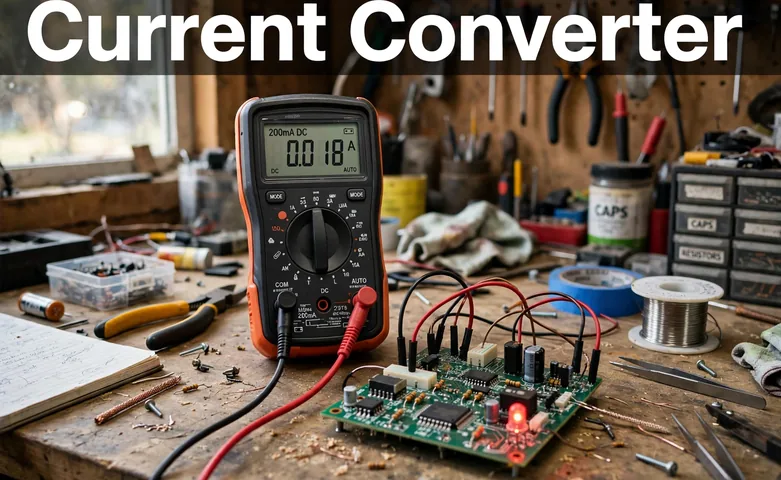
Result = Value times (From unit in amps divided by To unit in amps). Every current unit is defined by its size in amps, so each conversion is a single multiplication. The ampere, written A, is the SI base unit of electric current. A milliampere is one thousandth of an amp, a microampere is one millionth, and a kiloampere is one thousand amps.
The prefixes follow the metric system, so each step up or down the scale is a factor of 1,000. That is why 1 amp equals 1,000 milliamps, 1 milliamp equals 1,000 microamps, and 1 microamp equals 1,000 nanoamps. The conversion is exact, because the prefixes are definitions, not measurements.
Worked Example: 2.5 Amps to Milliamps
Convert 2.5 amps to milliamps. First write the factor. 1 amp = 1,000 milliamps. Then multiply the value by the factor. 2.5 times 1,000 = 2,500 milliamps. The current is the same in both units, only the number changes, because milliamps are smaller units.
Going the other way uses division. 750 milliamps divided by 1,000 = 0.75 amps. The tool shows the factor for your own units every time, so you can check the step yourself.

Common Current Conversions to Remember
| Conversion | Result |
|---|---|
| 1 amp (A) | 1,000 milliamps (mA) |
| 1 milliamp (mA) | 1,000 microamps (µA) |
| 1 microamp (µA) | 1,000 nanoamps (nA) |
| 1 kiloamp (kA) | 1,000 amps (A) |
| 500 milliamps (mA) | 0.5 amps (A) |
| 20 milliamps (mA) | 0.02 amps (A) |
Most everyday currents sit in the milliamp range. A phone charger delivers around 500 milliamps to 3,000 milliamps, an LED draws about 20 milliamps, and a household circuit breaker is usually rated at 15 or 20 amps. Picking the unit that fits the size keeps the number easy to read.
Amps, Milliamps and Watts Are Not the Same
Current and power are different quantities, and they need different units. Amps measure how much electric charge flows each second. Watts measure power, which is how fast energy is used. You cannot convert amps to watts with a fixed factor, because watts also depend on voltage.
The link between them is watts = amps times volts. A current of 2 amps at 120 volts is 240 watts, while the same 2 amps at 12 volts is only 24 watts. If you need power, measure or enter the voltage too. The power converter handles watts, and the voltage converter handles volts.
Rounding and Precision
Because current conversion is exact decimal shifting, the only place error can creep in is rounding. Converting 1 amp to milliamps gives exactly 1,000, with no rounding at all. Converting 1 amp to megaamps gives 0.000001, so a short decimal setting would round it to 0.00 and hide the answer.
Use more decimals when the result is very small or very large, and fewer when the number is a round one. The decimals selector on this tool lets you match the precision to the job, and the step by step breakdown always shows the unrounded factor so you can see what was multiplied.
Frequently asked questions
How many milliamps are in 1 amp?
1,000. A milliampere is one thousandth of an amp, so multiply amps by 1,000 to get milliamps. 2.5 amps is 2,500 milliamps.
How do I convert milliamps to amps?
Divide by 1,000. 750 milliamps divided by 1,000 is 0.75 amps. The tool does this for you when you pick milliamps as the from unit and amps as the to unit.
What is the SI unit of electric current?
The ampere, written A. It is one of the seven SI base units. Since 2019 it has been defined by the elementary charge, the charge of a single electron.
Can I convert kiloamps and picoamps too?
Yes. The converter covers picoamps, nanoamps, microamps, milliamps, centiamps, amps, kiloamps and megaamps, so it handles currents from tiny sensor signals to large power lines.
Why do small devices use milliamps instead of amps?
Because the numbers stay readable. A phone charging at 0.5 amps is easier to read as 500 milliamps, and an LED at 0.02 amps is easier to read as 20 milliamps.
Does converting change the current?
No. Converting only changes the unit used to describe the same current. 2.5 amps and 2,500 milliamps are the same flow of charge, written two ways.
Related calculators
Power Converter
Convert watts, kilowatts and horsepower.
Use calculatorVoltage Converter
Convert volts, millivolts and kilovolts.
Use calculatorEnergy Converter
Convert joules, calories and kilowatt hours.
Use calculatorForce Converter
Convert newtons, pounds force and more.
Use calculatorTemperature Converter
Convert Celsius, Fahrenheit and Kelvin.
Use calculatorLength Converter
Convert metres, feet, inches and miles.
Use calculator