Carpet Calculator: How Much Carpet Does a Room Need?
Enter a room length and width in feet, a waste allowance, and an optional price per square yard to get the area, the order quantity in square yards, and the cost.
Formulas verified against standard references. Calculator logic tested with verified worked examples. Last reviewed: October 2026. Our methodology
Why Carpet Is Sold by the Square Yard
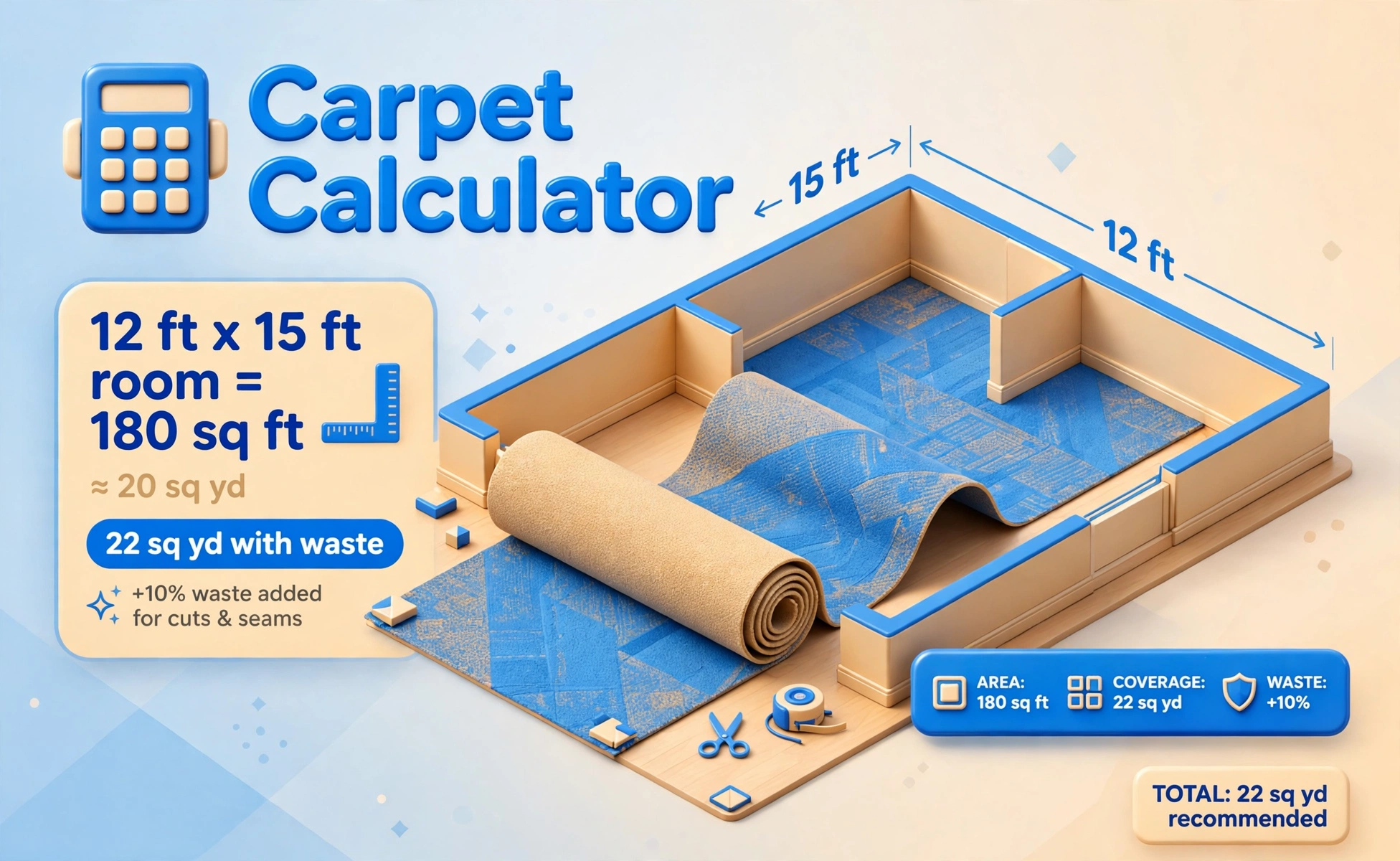
Carpet is priced and sold by the square yard, not the square foot, and one square yard equals nine square feet. A room of 180 square feet is therefore 20 square yards before waste, and that is the number a retailer quotes against. Forgetting the division by nine is the most expensive unit error in carpet shopping, because it makes every price look nine times larger than it is.
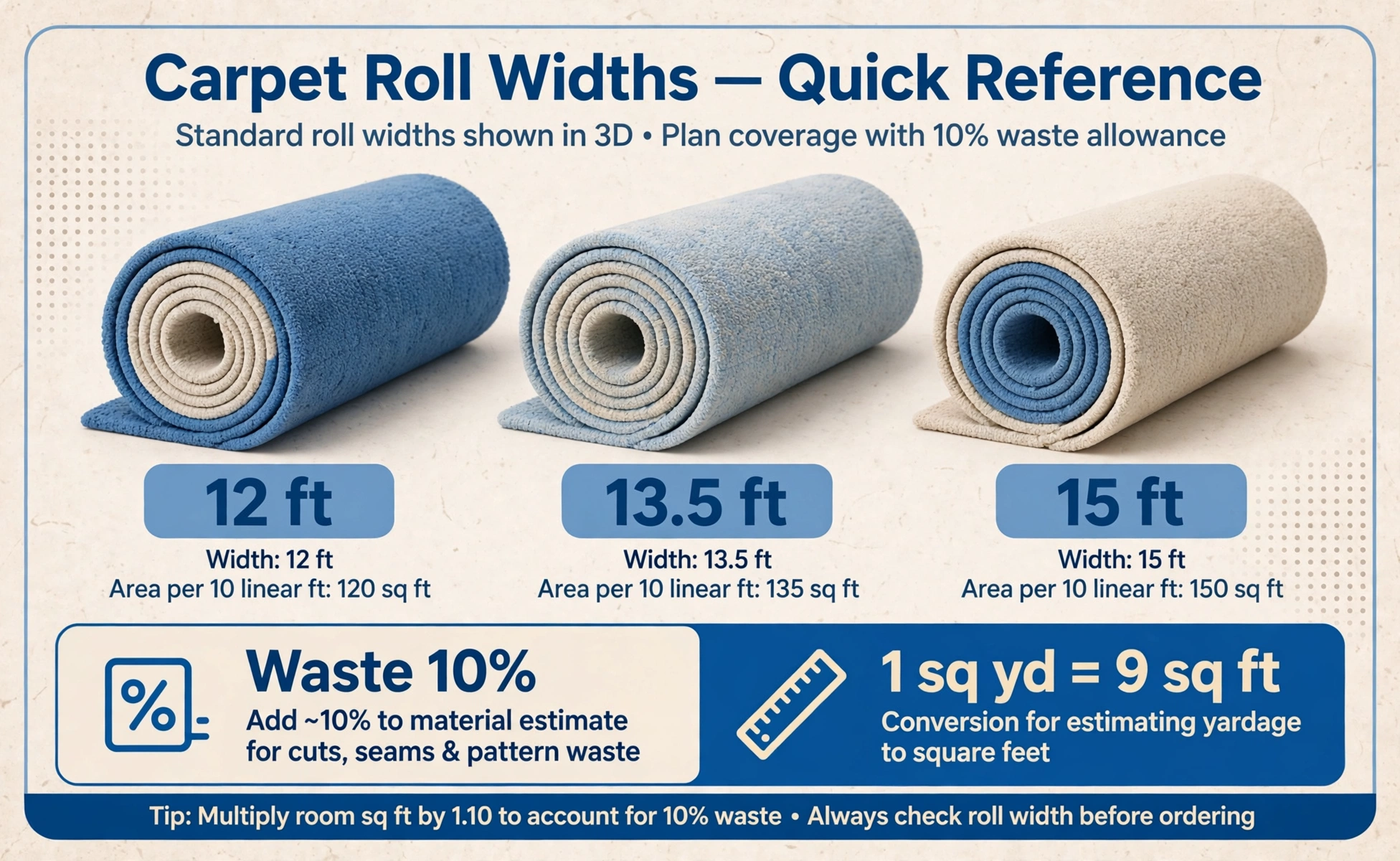
Carpet also comes on rolls, most commonly 12 feet wide, with 13.5-foot and 15-foot rolls available for wider rooms. If a room dimension exceeds the roll width, the installer needs a seam, and seams need extra material for overlap and pattern alignment. That is why an order quantity always includes a waste allowance on top of the room area.
For the room area itself, a square footage calculator handles rooms of any shape.
The Calculation
Area in square feet equals length times width, both in feet. Order area equals room area times one plus the waste fraction: with 10 percent waste, multiply by 1.10. Square yards equal order area divided by 9. Roll length in running feet equals order area divided by roll width, which tells you how many linear feet of the roll to buy. Material cost equals square yards times price per square yard.
Waste allowances follow the room, not a fixed number. Simple rectangular rooms need at least 10 percent. Rooms with closets, angles, or stairs need 15 to 20 percent, and patterned carpet can need 10 to 25 percent extra on top, depending on the pattern repeat, because each cut section must align with the pattern at every seam.
| Step | Formula | Example (12 x 15 ft, 10%) |
|---|---|---|
| Room area | Length x width | 180 sq ft |
| Order area | Area x (1 + waste) | 198 sq ft |
| Square yards | Order area / 9 | 22 sq yd |
| Roll length | Order area / roll width | 16.5 ft at 12 ft |
| Material cost | Square yards x price | $550 at $25 per sq yd |
Worked Examples
Example 1: a 12 by 15 foot bedroom at 10 percent waste. Area is 180 square feet, order area is 198 square feet, square yards are 22, roll length at a 12-foot roll is 16.5 feet, and at 25 dollars per square yard the material costs 550 dollars. Example 2: a 14 by 12 foot bedroom at 10 percent waste. Area is 168 square feet, order area is 184.8 square feet, and square yards are about 20.53.
Example 3: a 20 by 18 foot living room at 15 percent waste on a 15-foot roll. Area is 360 square feet, order area is 414 square feet, square yards are 46, and roll length is 27.6 feet. Because 20 feet exceeds the 15-foot roll width, a seam is needed, and the installer should confirm the seam map before ordering.
| Room | Area | Order area | Square yards | Cost at $25 per sq yd |
|---|---|---|---|---|
| 12 x 15 ft, 10% | 180 sq ft | 198 sq ft | 22 | $550 |
| 14 x 12 ft, 10% | 168 sq ft | 184.8 sq ft | 20.53 | $513.33 |
| 20 x 18 ft, 15% | 360 sq ft | 414 sq ft | 46 | $1150 |
Roll Widths and Seams
Roll width decides the seam layout. A room narrower than the roll in both dimensions needs no width seam, though it still needs trimming. A room wider than the roll needs at least two runs with a seam, and the better orientation is usually the one that minimizes total linear footage and seam count, though pattern repeat and pile direction can override the shortest option.
Pile direction matters as much as seams: carpet nap must sweep the same way across a seam, or the two sides shade differently under light. Patterned carpet adds another constraint, because the pattern must match at the seam, which can consume a full repeat per cut. Confirm the seam map with the installer or retailer before ordering, since a planning estimate cannot see the room.
| Roll width | Best for | Seam note |
|---|---|---|
| 12 ft | Standard rooms up to 12 ft wide | Most common in the US |
| 13.5 ft | Metric rolls, wider rooms | Fewer seams than 12 ft |
| 15 ft | Large rooms | Least seaming, check availability |
Common Mistakes
Ordering the exact room area with no waste is the classic error: seams, pattern matching, and trimming around doorways and closets always consume material, so even a simple room needs the 10 percent minimum. A second mistake is pricing by the square foot against a per-yard quote, which understates or overstates the job by a factor of nine.
A third mistake is measuring only the main rectangle in an L-shaped room, or forgetting closets, which then need a patched piece. Measure each rectangular section separately and add them. A fourth is ignoring stairs: stairs need their own calculation by tread and riser, and should not be folded into the room area.
Ordering Checklist
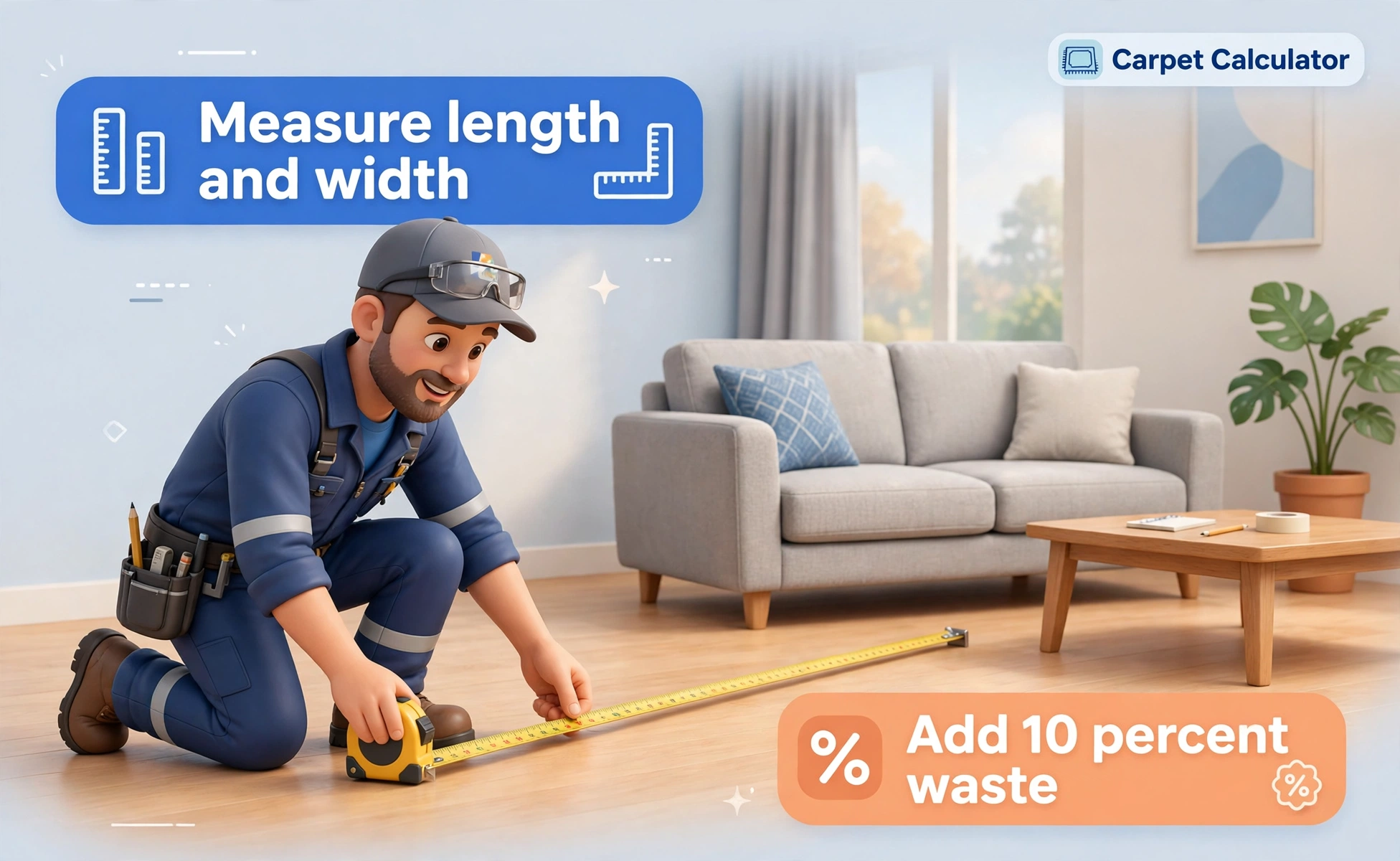
Measure length and width in feet for each rectangular section, add the sections, choose a waste allowance for the room shape and pattern, and convert to square yards. Check the roll width against the room dimensions for seams, confirm the seam map with the installer, and only then price the order at the per-yard rate.
For the flooring around the carpet, such as tile in an entry or a bathroom, a flooring calculator estimates those materials separately. Keep carpet and hard flooring orders apart, because their waste rules and sales units differ.
Frequently asked questions
How much carpet do I need for a 12 x 15 room?
180 square feet, or 20 square yards before waste. With the standard 10 percent waste allowance, order 198 square feet, which is 22 square yards.
Why is carpet sold by the square yard?
It is the trade convention, and one square yard equals nine square feet. Divide square feet by nine to get square yards, and multiply a per-yard price by square yards for the cost.
How much waste should I allow?
At least 10 percent for a simple rectangular room, 15 to 20 percent for rooms with closets or angles, and extra for patterned carpet, depending on the pattern repeat.
What is a standard carpet roll width?
12 feet is the most common, with 13.5-foot and 15-foot rolls available. If a room dimension exceeds the roll width, a seam is needed.
How do I calculate carpet cost?
Multiply square yards, including waste, by the price per square yard. A 22 square yard order at 25 dollars per square yard costs 550 dollars for material.
Do I need to include closets?
Yes. Measure each closet as its own rectangle and add it to the room area, or the carpet will run short at the edges.
Can I use this calculator for stairs?
No. Stairs need a separate calculation by tread and riser, and should not be folded into the room area.