Backyard Chicken Calculator
Work out what your backyard eggs really cost with this backyard chicken calculator. Enter your hens, laying rate and feed price to see cost per dozen, monthly feed cost, savings against store eggs and payback on your setup, with every step shown. Free, no sign-up, everything runs in your browser.
Formulas: Eggs per month = Hens × eggs per hen per week × 52 ÷ 12. Feed per month = Hens × feed per hen per day × 30.44. Cost per dozen = Monthly running cost ÷ dozens per month. Payback = Setup cost ÷ monthly savings.

Formulas verified against standard references. Calculator logic tested with verified worked examples. Published: November 6, 2026 | Last updated: November 6, 2026. Fact-checked: November 6, 2026. Our methodology
How to Use the Backyard Chicken Calculator
Getting an answer takes nine quick entries, and every one of them is a number you already know or can check. The calculator works out your eggs, your feed, your cost per dozen and whether the flock pays for itself.
- Type how many laying hens you keep.
- Type how many eggs each hen lays in a week. A good laying breed averages 4 to 5 in its first two years.
- Type the feed each hen eats per day in pounds, the size of the bag you buy, and what one bag costs.
- Type your other monthly costs, your setup cost and how many months to spread it over, and the store price of a dozen eggs.
- Press Calculate, or press Enter. The cost per dozen appears first and large, with monthly feed cost, savings and payback below. Press Reset to clear the form and start over.
The Backyard Chicken Formula
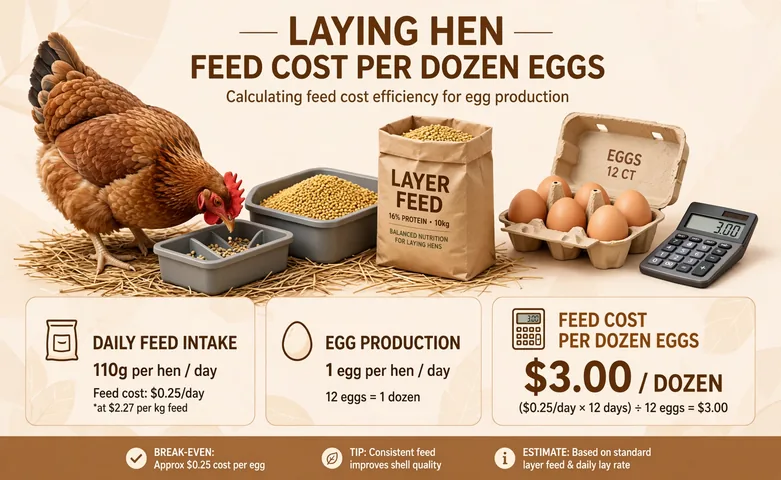
Three formulas run the calculator. Eggs per month = Hens times eggs per hen per week times 52, divided by 12. Feed per month = Hens times feed per hen per day times 30.44, which is the average number of days in a month. Feed cost per month = Feed per month divided by bag size, times bag price.
Cost per dozen = Monthly running cost divided by dozens per month, where monthly running cost is feed cost plus other monthly costs. Cost per dozen with setup adds the setup cost divided by the spread in months, before dividing by dozens. Monthly savings = Dozens per month times store egg price, minus monthly running cost. Payback = Setup cost divided by monthly savings.
The feed figure of 0.25 lb per hen per day is the standard cited by Alabama Cooperative Extension and the University of Kentucky, and Penn State Extension puts egg type birds at roughly 200 to 260 eggs a year, which is about 4 to 5 a week. Both numbers are planning figures, so enter your own flock numbers when you know them. Our budget calculator can help you fit the monthly feed bill into your household budget.
Worked Example: Six Hens, Four Eggs a Week Each
You keep 6 hens. Each hen lays 4 eggs a week, eats 0.25 lb of feed a day, and you pay $25 for a 50 lb bag. Other monthly costs are $10, setup cost $600 spread over 36 months, and store eggs cost $5 a dozen. Here is exactly what the calculator does.
- Eggs per month = 6 times 4 times 52, divided by 12 = 104 eggs, which is 8.67 dozen.
- Feed per month = 6 times 0.25 times 30.44 = 45.66 lb.
- Feed cost per month = 45.66 divided by 50, times $25 = $22.83.
- Monthly running cost = $22.83 + $10.00 = $32.83.
- Cost per dozen = $32.83 divided by 8.67 = $3.79.
- Setup per month = $600 divided by 36 = $16.67, so cost per dozen with setup = ($32.83 + $16.67) divided by 8.67 = $5.71.
- Monthly savings = 8.67 times $5.00, minus $32.83 = $10.50. Payback = $600 divided by $10.50 = about 57 months.
Feed alone is $2.63 a dozen in this example, which shows why the bag price matters so much. A $5 rise in the bag price adds about $0.53 to the cost of every dozen.
Feed Price Moves the Answer Most
Feed is the biggest running cost, so the bag price is the number to watch. The table below uses the worked example flock, 6 hens laying 4 eggs a week each, with $10 of other monthly costs.
| Feed price, 50 lb bag | Feed cost per month | Cost per dozen |
|---|---|---|
| $20 | $18.26 | $3.26 |
| $25 | $22.83 | $3.79 |
| $30 | $27.40 | $4.31 |
Every $5 on the bag adds about $0.53 to the cost per dozen for this flock. Buying in bulk, cutting waste with a good feeder, and letting hens forage in the growing season all push the number down, but none of them change the math. Only the price you actually pay and the eggs you actually collect count.
Why Payback Takes Years
The worked example pays back in about 57 months, which surprises most new keepers. The reason is simple. The flock saves only $10.50 a month against store eggs, and the $600 setup cost is nearly five years of those savings. The eggs are cheap once the coop is paid for, but the coop is not free.
Two things shorten payback. A cheaper setup is the first, because every $100 off the coop cuts about 10 months from payback. A better laying rate is the second, because 5 eggs a week instead of 4 lifts the monthly savings.
Production also falls as hens age. A flock lays best in its first two years, then drops a little each year after that. If you spread setup over 48 months but the hens slow down in year three, the later months save less than the calculator shows. Keep the spread honest, and re-run the numbers each year with the eggs you actually collect. Our break-even calculator uses the same idea for a business, dividing a fixed cost by the monthly gain.
Common Backyard Chicken Mistakes
Counting only feed is the most common mistake. Feed alone is $2.63 a dozen in the worked example, but running costs are $3.79 and the full cost with setup is $5.71. Quoting the feed-only number makes the eggs look cheaper than they are.
Forgetting winter is next. Hens lay fewer eggs in winter, when daylight shortens, so a yearly average hides a slow season. If you use a spring laying rate all year, the calculator will overstate your eggs and understate your cost per dozen.
The last mistake is leaving out your time. The calculator counts money, not hours. Feeding, cleaning and collecting take time every day, and that time has value even when it never shows on a receipt.
Disclaimer
This calculator gives an estimate for planning and is for informational purposes only, not financial advice. Actual feed use, laying rates and prices vary by breed, season and location. See our disclaimer.

Sources
- FlockMath: Chicken Feed Cost Calculator A standard laying hen eats about 0.25 lb of feed a day, the figure published by Alabama Cooperative Extension and the University of Kentucky (ASC-233).
- BarnRoot: Backyard Egg Cost Calculator Cost per dozen worked out from feed, other monthly costs and setup spread over the laying life, with the same method used on this page.
Frequently asked questions
How many eggs will 6 hens lay?
A good laying breed averages 4 to 5 eggs per hen per week in its first two years, so 6 hens give about 24 to 30 eggs a week, or about 104 to 130 eggs a month. Production drops in winter and as the hens age.
How much feed does a laying hen eat per day?
A standard laying hen eats about 0.25 lb, or 113 grams, of layer feed a day. Heavy breeds eat around 0.30 lb and bantams around 0.13 lb. Free ranging can cut bought feed by roughly 15 to 30% in the growing season.
What does it cost per dozen to keep backyard chickens?
It depends on your feed price and laying rate. In the worked example, 6 hens on $25 feed cost $3.79 a dozen in running costs and $5.71 a dozen once a $600 setup is spread over 36 months.
When do backyard chickens pay for themselves?
Divide the setup cost by the monthly savings against store eggs. In the worked example the flock saves $10.50 a month, so a $600 setup takes about 57 months to pay back. A cheaper coop or a better laying rate shortens that time.
Do I need to count the coop in the cost?
Yes, if you want the true cost per dozen. The coop, feeders, waterers and birds are real money. Spread them over the laying life of the flock, usually 24 to 48 months, and add that monthly share to the running cost.
How many hens do I need for a dozen eggs a week?
At 4 eggs per hen per week, 3 hens give about 12 eggs a week. At 5 eggs a week, 3 hens give about 15. Start with the eggs you want each week, then divide by the laying rate of your breed.
Related calculators

Budget Calculator
Plan monthly income and spending and see what is left over.
Use calculatorBreak-Even Calculator
Find how many units you must sell to break even from fixed costs, variable cost and price.
Use calculatorPercentage Calculator
Find what P% of any number is, instant answers with the formula shown.
Use calculatorROI Calculator
Measure investment returns with ROI, gain or loss and annualized growth.
Use calculatorDiscount Calculator
Calculate sale price, discount amount and total savings on any purchase.
Use calculatorCompound Interest Calculator
See how savings or debt grows with compound interest over time.
Use calculator