Time Converter: Convert Any Time Unit Instantly
How many seconds are in a year? How many hours in 45 days? Enter any time value, pick the units to convert from and to, and this free time converter handles seconds through years — and shows the value in every other unit too.
Formulas verified against standard references. Calculator logic tested with verified worked examples. Last reviewed: October 2026. Our methodology
How time conversion works
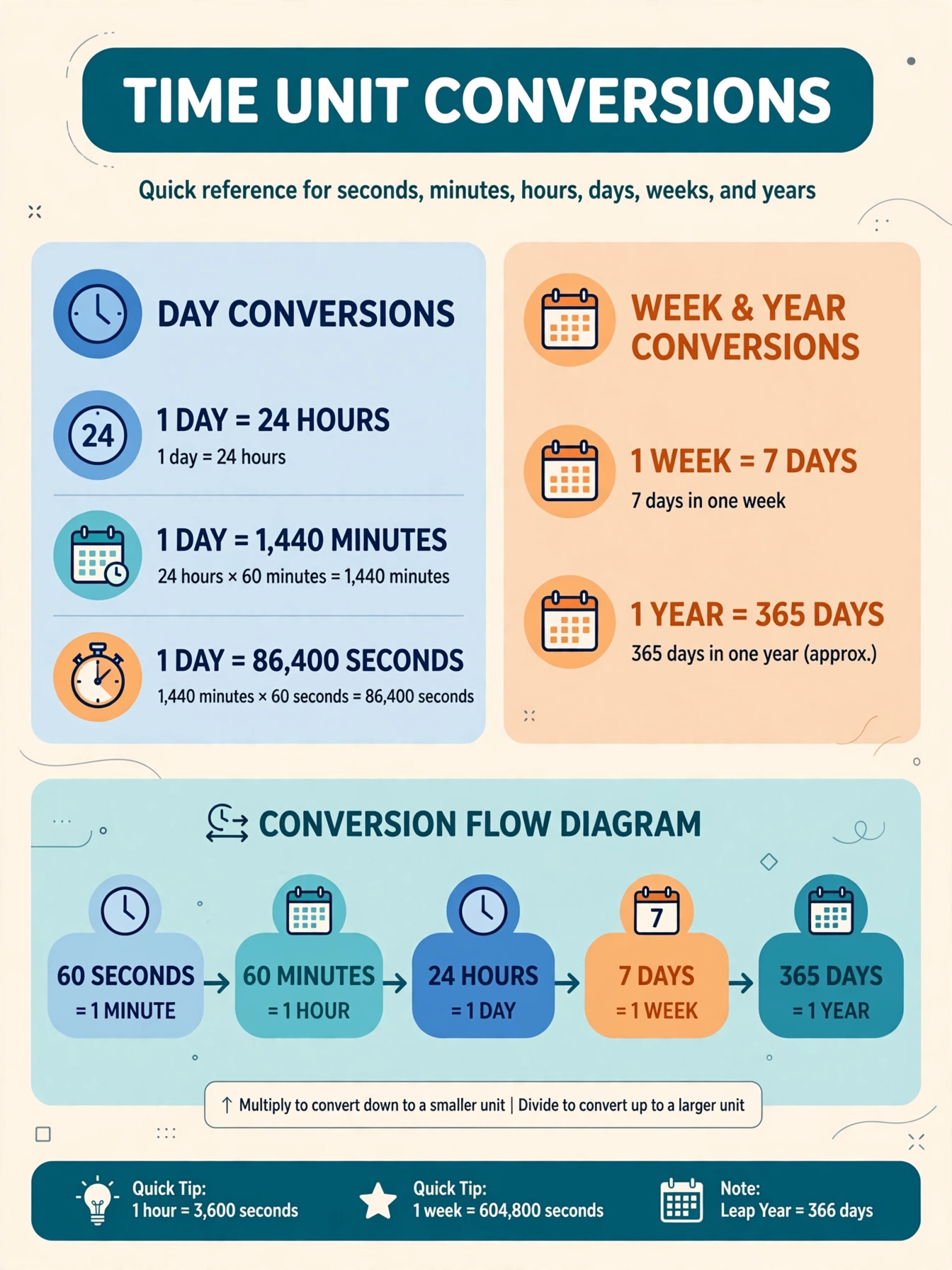
Every time unit is a fixed multiple of a second — convert to seconds first, then divide into the target unit:
- Value in seconds = value × (seconds per "from" unit).
- Result = seconds ÷ (seconds per "to" unit).
- Months and years use averages (30.44 days/month, 365.25 days/year) because calendar months vary.
| 1 unit equals | In seconds |
|---|---|
| 1 minute | 60 |
| 1 hour | 3,600 |
| 1 day | 86,400 |
| 1 week | 604,800 |
| 1 month (avg) | 2,629,746 |
| 1 year (avg) | 31,556,952 |
The month and year figures bake in leap years (365.25 days). For exact calendar math between two dates, use a date difference tool instead.
Worked example
Convert 2.5 weeks to hours. One week = 604,800 seconds, so 2.5 weeks = 1,512,000 seconds. One hour = 3,600 seconds: 1,512,000 ÷ 3,600 = 420 hours.
Or convert 1 year to seconds: 31,556,952 seconds — the famous "31.5 million seconds in a year" figure, which assumes the average 365.25-day year.
How to use the time converter
Type a number, choose the units, and read the answer — the calculator also lists the value in every other unit for free.
Step by step
- Enter the time value. Decimals work: 1.5 hours, 0.25 days.
- Pick the "from" unit. The unit your value is currently in.
- Pick the "to" unit. The unit you want the answer in.
- Press Calculate. The converted value appears, plus the full unit breakdown.

Seconds, minutes, hours: the conversions you actually need
A few anchor conversions cover most real questions:
| Question | Answer |
|---|---|
| Seconds in a day | 86,400 |
| Seconds in a year | 31,556,952 (~31.6 million) |
| Hours in a week | 168 |
| Hours in a 40-hour work year | 2,080 |
| Minutes in a day | 1,440 |
Memorize 86,400 (seconds/day) and 168 (hours/week) and you can sanity-check almost any time conversion mentally.
Why months and years are "average" units
A minute is always 60 seconds. A month is not always 30 days:
- Calendar months run 28–31 days, so "3 months" is ambiguous without dates.
- The average month = 365.25 ÷ 12 = 30.44 days — what this converter uses.
- The average year = 365.25 days, folding leap years into the math.
- For exact spans (deadlines, ages, contracts), convert between two calendar dates instead — a date difference calculator counts real days.
Use this converter for durations and estimates; use calendar math when the exact day counts.
Time math in everyday life
Unit conversion quietly powers better decisions:
- Billing: freelancers convert 45-minute tasks to 0.75 hours for invoices.
- Media: video editors think in seconds and frames; a 2-hour film is 7,200 seconds.
- Fitness: pace per mile converts to speed in mph through time-unit math — a pace calculator does it automatically.
- Sleep: 8 hours is exactly one-third of a day — framing it that way changes how "a full night's sleep" feels against 16 waking hours.

Frequently asked questions
How many seconds are in a day?
86,400 — that is 24 × 60 × 60. In a year (average 365.25 days), about 31,556,952 seconds.
How many hours are in a week?
168 — 24 × 7. A standard 40-hour work week is less than a quarter of all the hours in a week.
Why does the converter say 'average' for months and years?
Calendar months are 28–31 days, so a month has no fixed length. The converter uses the average month (30.44 days) and average year (365.25 days, including leap years).
How do I convert minutes to hours?
Divide by 60: 90 minutes = 1.5 hours. Multiply hours by 60 to go the other way.
What is 1,000,000 seconds in days?
About 11.57 days (1,000,000 ÷ 86,400). A million seconds is under two weeks; a billion seconds is about 31.7 years.
How do I convert between time zones?
That is clock time, not duration — converting hours does not shift zones. Use a time zone converter for meeting planning across zones.
Can I convert milliseconds too?
This converter starts at seconds. Divide milliseconds by 1,000 to get seconds first, then convert normally.