Sand Calculator: How Much Sand Do You Need
Enter your area shape, dimensions, and depth, plus a waste allowance, to get sand volume in cubic yards, weight in tons, and how many bags to buy.
Formulas verified against standard references. Calculator logic tested with verified worked examples. Last reviewed: October 2026. Our methodology
How Sand Quantities Work
Sand is sold by volume, by weight, or by the bag, and those three measures are linked by density. Dry sand weighs about 100 pounds per cubic foot, which is 2,700 pounds, or 1.35 US tons, per cubic yard. So a volume in cubic yards times 1.35 gives tons, and weight divided by bag size gives the number of bags, rounded up, since you cannot buy part of a bag.
The volume itself is area times depth, with depth converted from inches to feet by dividing by 12. A 10 by 10 foot area at 6 inches deep is 100 square feet times 0.5 feet, which is 50 cubic feet, or 1.85 cubic yards. That chain, area, depth, volume, weight, bags, is all this calculator does, with a waste allowance added at the end for uneven ground and compaction.
For loose aggregate of a different kind, a gravel calculator uses the same volume chain with gravel densities.
The Sand Formulas
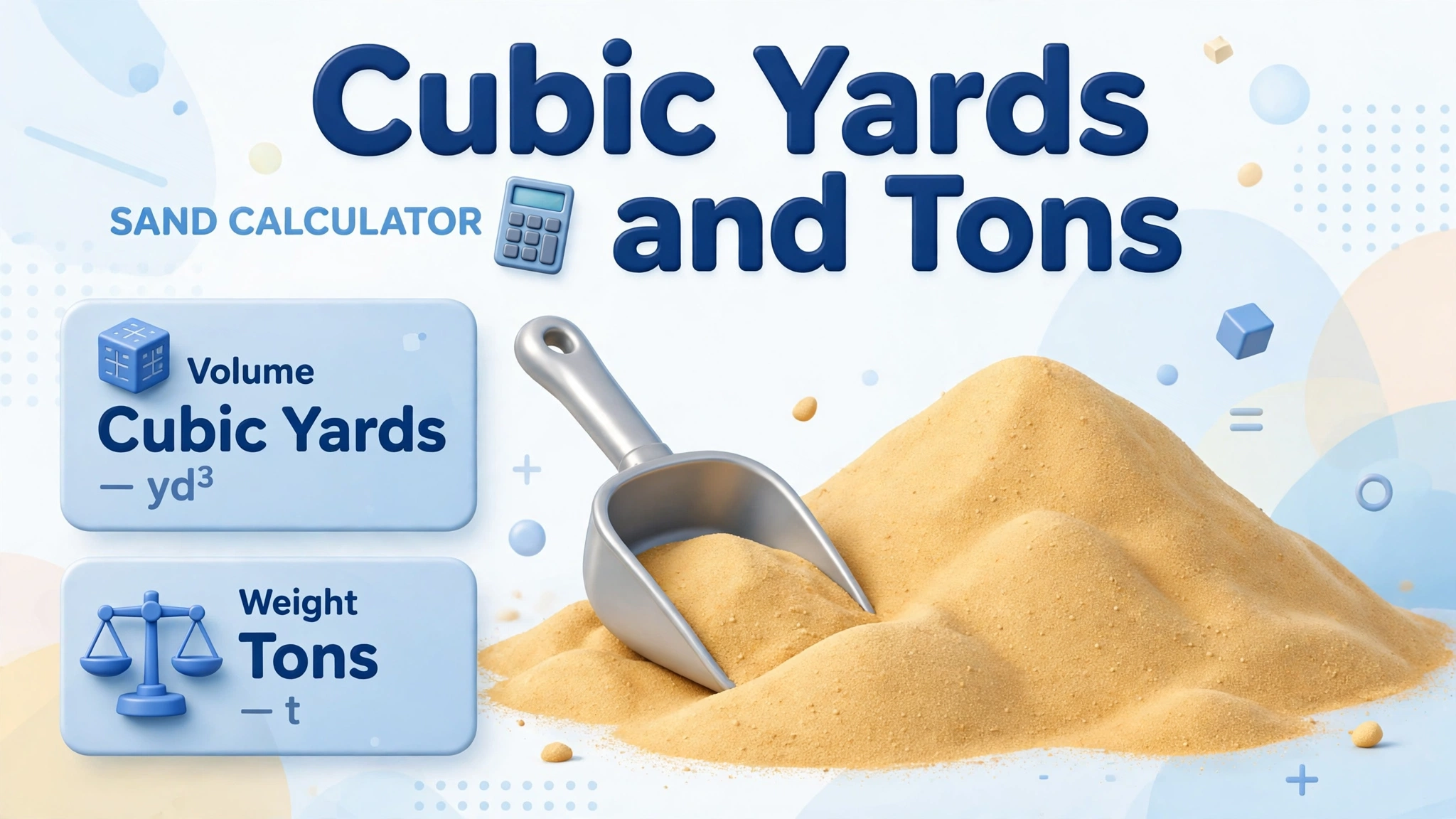
For a rectangle, volume in cubic feet equals length times width times depth in feet. For a circle, area is pi times radius squared, and volume is that area times depth in feet. Cubic yards equal cubic feet divided by 27, since a cubic yard is 3 feet on each side. Order volume equals measured volume times 1 plus waste percent divided by 100.
Weight in pounds equals order volume in cubic feet times 100, the dry sand density. Tons equal pounds divided by 2,000. Bags equal weight divided by bag size, rounded up. A useful shortcut: cubic yards equal length in feet times width in feet times depth in inches, divided by 324, since 27 times 12 is 324.
| Step | Formula | Example 10 x 10 ft, 6 in |
|---|---|---|
| Area | Length x width | 100 sq ft |
| Volume cu ft | Area x (depth / 12) | 50 cu ft |
| Volume cu yd | Cu ft / 27 | 1.85 cu yd |
| Weight | Cu ft x 100 lb | 5,000 lb, 2.5 tons |
| Bags 50 lb | Weight / 50, rounded up | 100 bags |
Worked Examples
Example 1: 10 by 10 feet at 6 inches deep, no waste. Volume is 50 cubic feet, or 1.85 cubic yards, weight is 5,000 pounds, or 2.5 tons, and bags are 100 bags of 50 pounds. With 10 percent waste, order volume rises to 2.04 cubic yards, weight to 5,500 pounds, and bags to 110.
Example 2: 20 by 15 feet at 2 inches deep. Volume is 20 times 15 times 2 divided by 12, which is 50 cubic feet, or 1.85 cubic yards, the same as example 1, since the larger area and shallower depth cancel out. Example 3: a 4 by 4 foot sandbox at 8 inches deep. Volume is about 10.67 cubic feet, or 0.40 cubic yards, which is about 22 bags of 50 pounds.
| Project | Volume | Weight | 50 lb bags |
|---|---|---|---|
| 10 x 10 ft, 6 in | 1.85 cu yd | 2.5 tons | 100 |
| 10 x 10 ft, 6 in, 10% waste | 2.04 cu yd | 2.75 tons | 110 |
| 20 x 15 ft, 2 in | 1.85 cu yd | 2.5 tons | 100 |
| 4 x 4 ft sandbox, 8 in | 0.40 cu yd | 0.53 tons | 22 |
Sand Types and Depths
Play sand suits sandboxes and playgrounds, with rounded grains that feel soft but drain slowly. Paver bedding sand, ideally concrete sand meeting ASTM C33, has angular grains that lock together under pavers. Mason sand suits mortar and stucco. Fill sand suits general leveling where appearance does not matter. The density differences are modest, a few percent, but wet sand can weigh 3,200 to 3,500 pounds per cubic yard, well above the dry 2,700 used here.
Typical depths: paver base leveling sand 1 inch, lawn top-dressing 0.25 to 0.5 inch, sandbox fill 6 to 8 inches, playground fall zones 9 inches or more for falls up to 4 feet, and volleyball courts 12 inches for recreational play and 18 inches for competition. Always check local guidance for playground depths, since safety standards set them, not convenience.
| Use | Typical depth | Sand type |
|---|---|---|
| Paver base | 1 inch | Concrete sand, ASTM C33 |
| Lawn top-dressing | 0.25 to 0.5 inch | Sharp or horticultural sand |
| Sandbox | 6 to 8 inches | Play sand |
| Playground fall zone | 9 inches or more | Play sand |
| Volleyball court | 12 to 18 inches | Washed masonry or silica sand |
Common Mistakes
The most common mistake is entering depth in inches as if it were feet: 6 inches is 0.5 feet, not 6 feet, and the error multiplies volume by 12. Another mistake is ordering the measured volume with no waste allowance, then running short on uneven ground or after compaction, which is why 10 percent waste is a sensible default, and 15 percent suits excavated or very uneven bases.
A third mistake is using play sand for a paver base, where its rounded grains do not lock together and can rut under traffic. A fourth is comparing bag prices without comparing weight: a 60 pound bag and a 50 pound bag differ by 20 percent, so bags needed and cost per ton are the fair comparisons.
Ordering and Delivery Tips
Bulk delivery suits large jobs and is priced by the cubic yard or ton, while bags suit small jobs and tight access where a truck cannot dump. Confirm with the supplier whether the price is for dry or wet sand, whether delivery is included, and where the truck can dump without damaging a driveway or lawn.
For concrete work that follows a sand base, a concrete calculator estimates the pour itself. Order sand first, level it, compact it where the job needs compaction, and re-measure depth before ordering concrete or pavers on top of it.
Frequently asked questions
How much sand do I need for a 10 by 10 area at 6 inches?
50 cubic feet, or 1.85 cubic yards, weighing 2.5 tons, which is 100 bags of 50 pounds, before any waste allowance.
How many cubic feet are in a cubic yard?
27. A cubic yard is 3 feet long, 3 feet wide, and 3 feet deep, so 3 times 3 times 3 equals 27 cubic feet.
How much does a cubic yard of sand weigh?
About 2,700 pounds, or 1.35 US tons, for dry sand. Wet or compacted sand weighs about 3,200 to 3,500 pounds per cubic yard.
How many 50 lb bags make a cubic yard?
54 bags, since 2,700 pounds divided by 50 is 54. For 60 lb bags, it is 45 bags per cubic yard.
Should I add a waste allowance?
Yes, 10 percent is a sensible default, and 15 percent suits uneven or excavated ground, since real bases are rarely perfectly flat and sand compacts.
What depth of sand do I need for pavers?
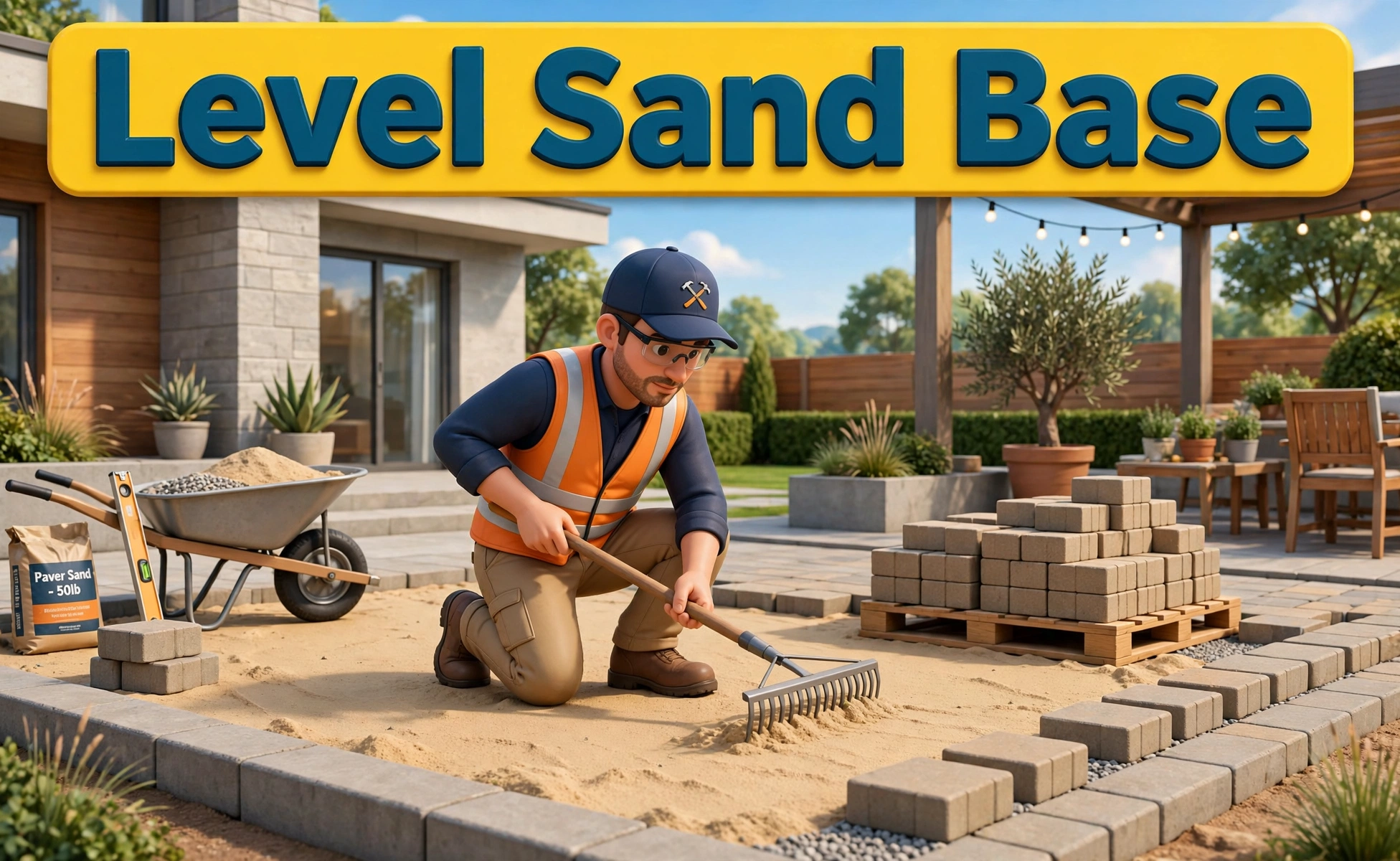
About 1 inch of bedding sand over a compacted gravel base. Thicker bedding sand can rut under traffic, so do not overfill.
Can I use play sand under pavers?
No. Play sand has rounded grains that do not lock together. Use angular concrete sand meeting ASTM C33 for paver bedding.