Pages to Words Converter: How Many Words Are in Pages
Enter a page count and a words-per-page rate to get the word count, plus an approximate character count and reading time at 200 words per minute.
Formulas verified against standard references. Calculator logic tested with verified worked examples. Last reviewed: October 2026. Our methodology
How Pages Become Words
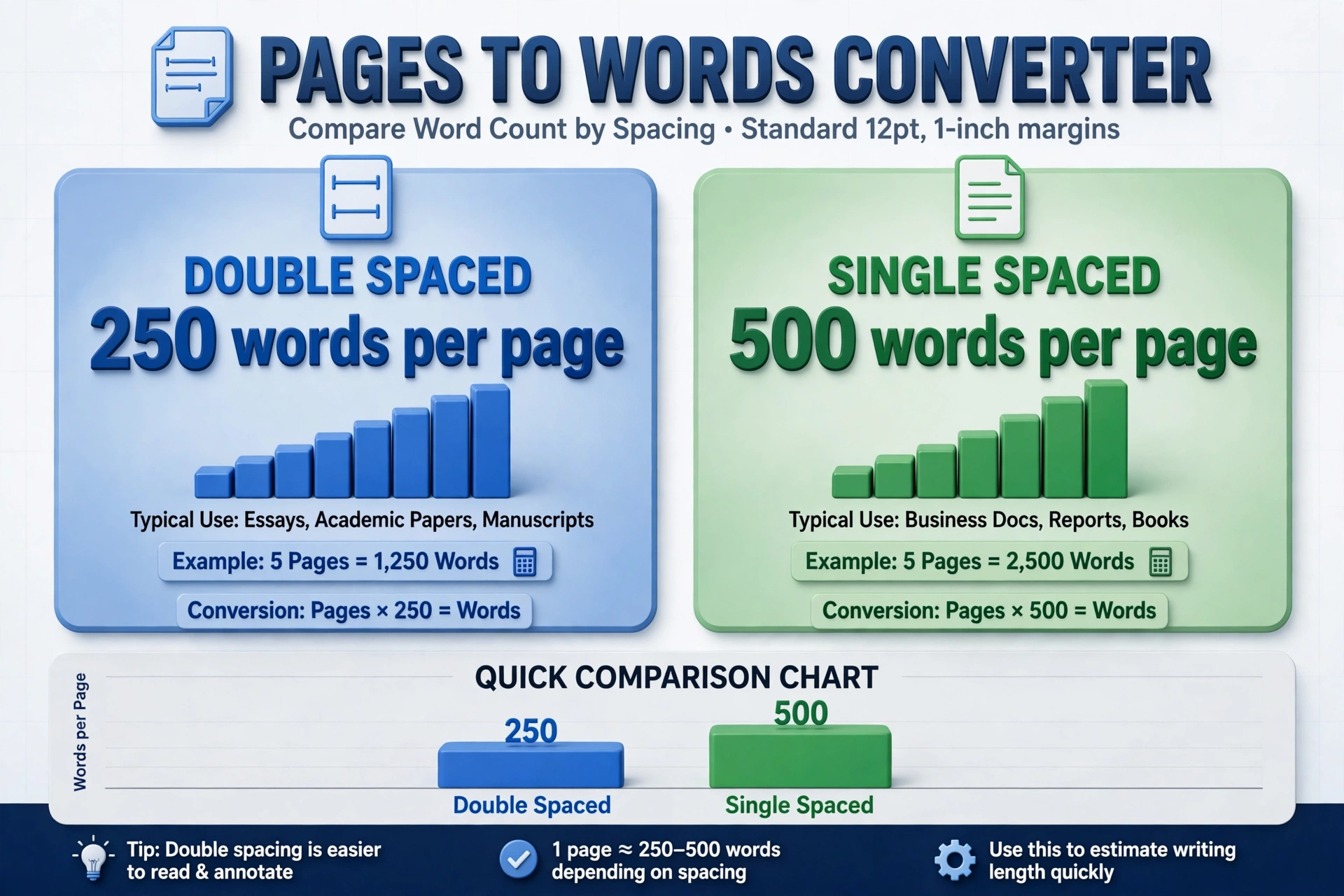
A page does not hold a fixed number of words, because font, font size, margins, and spacing all change how much text fits. Publishers and teachers therefore use standard rates: about 250 words per page for double-spaced text in a standard 12 point font with 1 inch margins, and about 500 words per page for the same text single-spaced. Those rates are conventions for estimating length, not exact counts for any particular document.
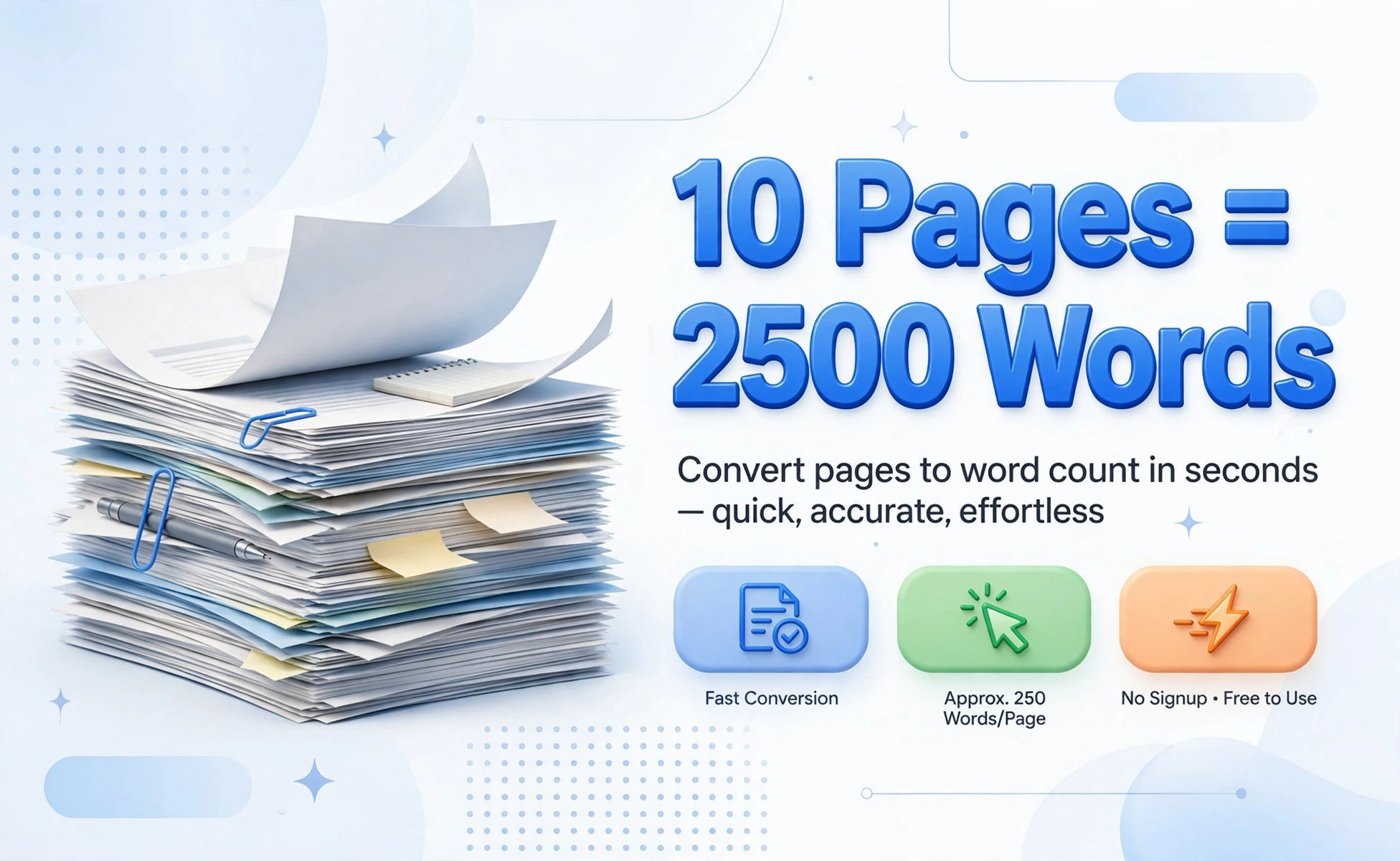
The conversion itself is simple multiplication: pages times words per page equals words. So 10 double-spaced pages are about 2,500 words, and 10 single-spaced pages are about 5,000 words. The hard part is choosing the right rate for your document, which is why this calculator offers the standard rates plus a custom rate for a known document style.
For the reverse conversion, a words to pages converter turns a word count into pages.
Words Per Page by Format
Double-spaced, 12 point Times New Roman, 1 inch margins: about 250 words per page. Single-spaced, same settings: about 500 words per page. Those are the two rates most assignment briefs and publishers mean when they give a page length. A 275 or 300 word rate suits slightly smaller fonts, narrower margins, or denser layouts, and a custom rate suits a document whose actual words per page you have measured.
To measure your own rate, count the words on three full pages of your document and take the average. That average beats any standard rate for that document, because it captures your exact font, margins, and paragraph spacing. For a manuscript with headings, tables, or images, the average varies more, so use a range rather than a single number.
| Format | Words per page | 10 pages |
|---|---|---|
| Double-spaced, 12 pt, 1 in margins | 250 | 2,500 words |
| Single-spaced, 12 pt, 1 in margins | 500 | 5,000 words |
| Denser layout | 275 to 300 | 2,750 to 3,000 words |
| Custom rate | Your measured average | Pages x your rate |
Worked Examples
Example 1: 10 double-spaced pages at 250 words per page. Word count is 2,500, character count is about 15,000, and reading time at 200 words per minute is 12.5 minutes. Example 2: 5 single-spaced pages at 500 words per page. Word count is also 2,500, which shows why spacing matters as much as page count.
Example 3: 20 pages at a custom rate of 400 words per page. Word count is 8,000, character count is about 48,000, and reading time is 40 minutes. Example 4: a 250 page novel manuscript at 250 words per page. Word count is about 62,500, which is a typical novel length range for many genres.
| Pages | Rate | Words | Reading time |
|---|---|---|---|
| 10 | 250 | 2,500 | 12.5 minutes |
| 5 | 500 | 2,500 | 12.5 minutes |
| 20 | 400 custom | 8,000 | 40 minutes |
| 250 | 250 | 62,500 | 312.5 minutes |
Common Page Lengths
School essays are often 2 to 5 pages, or about 500 to 1,250 words double-spaced. College essays are often 5 to 10 pages, or about 1,250 to 2,500 words double-spaced. A short story is often 10 to 30 pages, a novella about 100 to 200 pages, and a novel about 250 to 400 pages, depending on genre and formatting.
Academic journals usually specify word counts rather than pages, precisely because pages vary, so convert the word limit to pages only as a rough guide, and check the journal's formatting rules before submitting. When a brief says pages, it usually assumes the standard double-spaced format unless it says otherwise.
| Document | Typical pages | Typical words (double-spaced) |
|---|---|---|
| School essay | 2 to 5 | 500 to 1,250 |
| College essay | 5 to 10 | 1,250 to 2,500 |
| Short story | 10 to 30 | 2,500 to 7,500 |
| Novel | 250 to 400 | 62,500 to 100,000 |
Common Mistakes
The most common mistake is treating pages as exact: a page with a large heading, a table, or an image holds far fewer words than a full text page, so a document with many such elements comes in shorter than the page estimate suggests. Another mistake is mixing single and double spacing: 10 pages single-spaced is twice the words of 10 pages double-spaced, and confusing them doubles or halves the estimate.
A third mistake is counting the title page, contents, or references as text pages. Those pages usually hold few words or no words at all, so count only full text pages, or adjust the rate downward for a document with many such pages.
Practical Uses
Use this converter to plan writing: a 2,500 word essay is 10 double-spaced pages, so a daily target of 500 words is 2 pages a day, or 5 days of drafting. Use it to check a brief: if an assignment asks for 5 pages, you now know it means about 1,250 words double-spaced, and you can plan sections against that total.
For reading and speaking time from a word count, a reading time calculator uses speed in words per minute. Use this pages converter first to get the word count, then plan reading or speaking time from it.
Frequently asked questions
How many words are in a page?
About 250 words double-spaced or 500 words single-spaced, in a standard 12 point font with 1 inch margins. Font, size, margins, and spacing change the actual count.
How many words is 10 pages?
About 2,500 words double-spaced, or 5,000 words single-spaced, at the standard rates.
How do I count words per page for my document?
Count the words on three full pages of your document and take the average. That measured rate beats any standard rate for that document.
Do title pages and references count?
Usually not as text pages. Title, contents, and reference pages hold few words, so count only full text pages or adjust the rate downward.
How long does it take to read 2,500 words?
About 12.5 minutes at 200 words per minute, the average adult reading speed used here.
Is the character count exact?
No, it is an estimate assuming about 6 characters per word including spaces. Actual character counts vary with word length and punctuation.
What is the difference between single and double spacing?
Double spacing puts a blank line between lines of text, so a page holds about half as many words as a single-spaced page with the same font and margins.