Home Equity Loan Calculator: Equity, Payments and Borrowing Power
Your home equity is the part of your home you actually own — market value minus mortgage balance. Enter your numbers and this free home equity loan calculator finds your available equity, how much a lender would let you borrow under a combined loan-to-value cap, and what that loan would cost each month.
Formulas verified against standard references. Calculator logic tested with verified worked examples. Last reviewed: October 2026. Our methodology
How home equity and borrowing power are calculated
Three numbers drive everything — your equity, your current loan-to-value, and the lender's cap:
- Available equity = home value − mortgage balance — the stake you own outright.
- Current LTV = mortgage balance ÷ home value × 100 — how leveraged the home is today.
- Max new loan = (home value × max CLTV) − mortgage balance, floored at $0 — the lender's combined loan-to-value cap applied to your situation.
- Monthly payment = P·r(1+r)n ÷ ((1+r)n − 1), where r is the monthly rate and n is the number of payments — standard loan amortization.
| CLTV cap ($450,000 home, $280,000 balance) | Max new loan |
|---|---|
| 80% | $80,000 |
| 85% | $102,500 |
| 90% | $125,000 |
The same $170,000 of equity supports very different loan sizes depending on the cap — a looser cap borrows deeper into your equity cushion, which is why rate quotes usually get worse above 80%.
Worked example
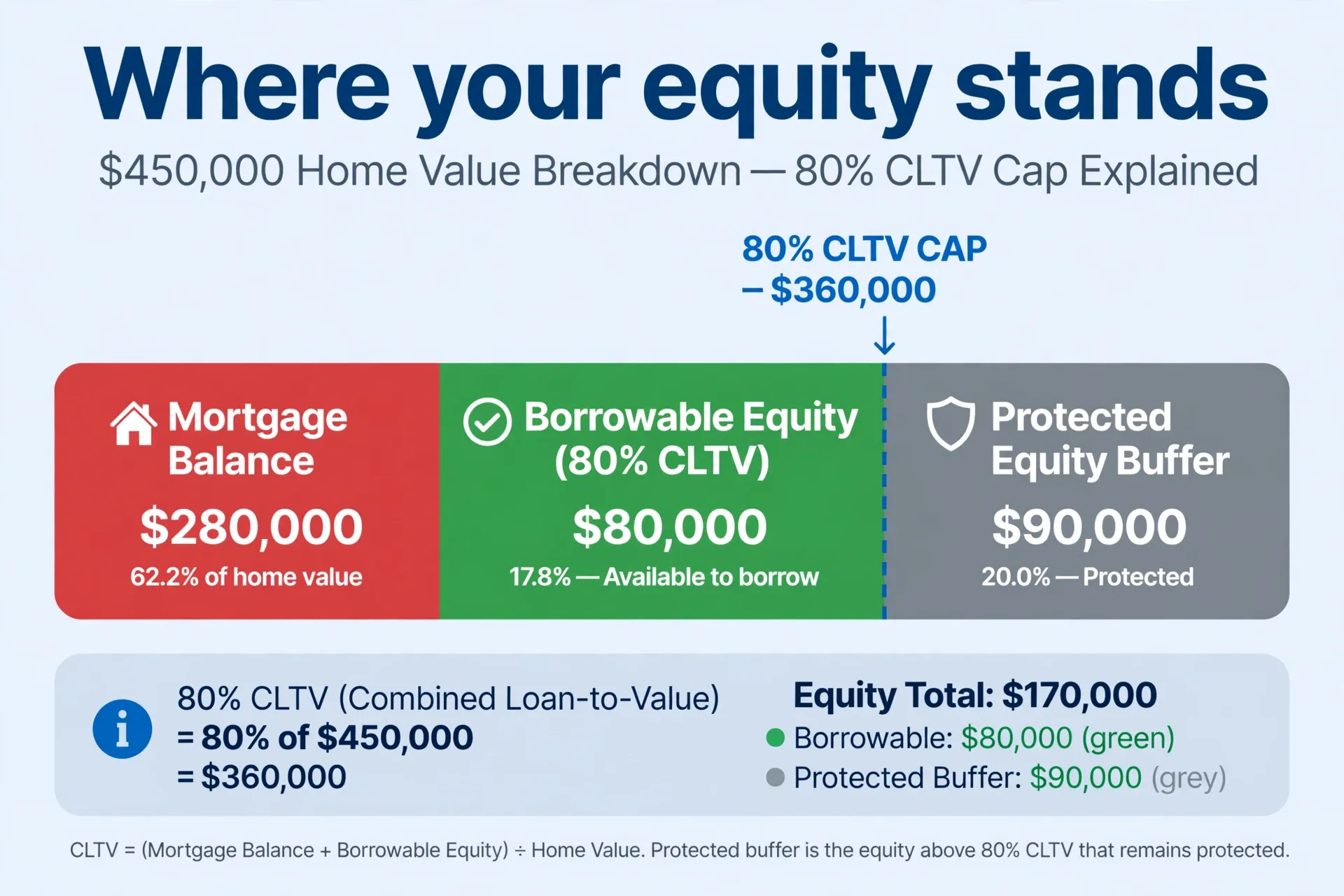
Your home is worth $450,000 and your mortgage balance is $280,000, with an 80% CLTV cap.
Equity: $450,000 − $280,000 = $170,000. Current LTV: $280,000 ÷ $450,000 = 62.2%. Max new loan: ($450,000 × 80%) − $280,000 = $360,000 − $280,000 = $80,000. Borrow the full $80,000 at 7% APR for 15 years and the amortization formula gives $719.06 per month, for $49,431.27 of total interest over the life of the loan.
How to use the home equity loan calculator
Get your latest mortgage statement and a realistic home value estimate before you start.
Step by step
- Enter your home value. A recent appraisal or a comparable-sales estimate — not the price you paid years ago.
- Enter your current mortgage balance. The remaining principal from your latest statement, not the original loan amount.
- Set the max CLTV. 80% is the common lender ceiling; raise it only to model more lenient lenders.
- Enter the loan amount, APR and term. The amount you want to borrow, the quoted fixed rate, and the repayment period.
- Press Calculate. Review equity, borrowing limit, monthly payment and total interest — and heed the warning if your request exceeds the cap.

Equity is not the same as borrowing power
Headline equity is simple subtraction, but lenders never let you borrow all of it. The CLTV cap forces a buffer to stay in the property — on a $450,000 home at 80%, $90,000 of equity must remain untouched even though you own it. That buffer is the lender's protection against price drops, and it is why "available equity" and "max borrowable" are two different answers.
If you are still shopping for your first mortgage rather than borrowing against one, a mortgage calculator estimates that monthly payment on its own — this page is for the second-lien math that comes after.
The 80% CLTV rule and the payment math
Eighty percent is the default because it is the most common ceiling lenders quote for home equity products — some go to 85–90% with stronger credit, usually at higher rates. The calculator lets you move the cap so you can see exactly what a stricter or looser lender would offer. Once the loan amount is set, term length is the lever that trades payment size against total interest:
| Term ($80,000 at 7% APR) | Monthly payment | Total interest |
|---|---|---|
| 5 years | $1,584.10 | $15,046.00 |
| 10 years | $928.87 | $31,464.40 |
| 15 years | $719.06 | $49,431.27 |
| 20 years | $620.24 | $68,857.60 |
| 30 years | $532.24 | $111,606.40 |
Borrowing against equity is the reverse of buying power — a house affordability calculator frames the purchase side, while this page frames what you can pull back out. Note the 0% APR edge case: with no interest, the payment is simply the loan amount divided by the number of months.
Home equity loan vs. HELOC vs. cash-out refinance
Three products tap the same equity three different ways:
| Home equity loan | HELOC | Cash-out refinance | |
|---|---|---|---|
| How you get the money | One lump sum | Revolving line, draw as needed | New bigger first mortgage |
| Interest rate | Fixed | Usually variable | Fixed or adjustable |
| Payments | Fixed monthly from day one | Interest-only draw period, then amortizing | One new mortgage payment |
| Best for | One-time expense (renovation, debt payoff) | Ongoing or phased spending | When current mortgage rates beat your old rate |
| Effect on first mortgage | Unchanged — separate second lien | Unchanged — separate lien | Replaced entirely |
This calculator models the fixed home equity loan: one amount, one rate, one amortizing payment. A HELOC's interest-only draw phase needs a different schedule, so do not use these payment numbers for a line of credit.

Frequently asked questions
How much equity do I have in my home?
Subtract your current mortgage balance (and any other liens) from your home's current market value. A $450,000 home with a $280,000 mortgage balance has $170,000 of equity.
How much of my home equity can I borrow?
Usually less than all of it. Lenders cap total secured debt with a combined loan-to-value (CLTV) ratio — commonly 80% of the home's value. Max new loan = (home value × CLTV) − current mortgage balance, floored at zero.
What is combined loan-to-value (CLTV)?
CLTV = (all loans secured by the home ÷ home value) × 100. It includes your first mortgage plus the new loan. A $280,000 mortgage plus an $80,000 new loan on a $450,000 home is a CLTV of 80%.
What is the monthly payment on a $50,000 home equity loan?
At 8% APR over 10 years, about $606.64 per month, with $22,796.56 of total interest. Enter your own rate and term in the calculator above for an exact figure.
Does a home equity loan change my existing mortgage?
No. A home equity loan is a separate second lien with its own rate and payment; your first mortgage stays as it is. Missing payments on either loan can put the home at risk.
Should I choose a home equity loan or a HELOC?
A home equity loan gives a lump sum at a fixed rate and fixed payment — good for a one-time expense. A HELOC is a revolving line with a usually variable rate — better for ongoing draws. This calculator models the fixed loan.
Can I get a home equity loan if I owe more than my home is worth?
Almost certainly not — with zero or negative equity the max borrowable is $0 at any CLTV cap. Lenders also weigh credit score, income and debt-to-income ratio.