Density Converter: Convert Density Units Instantly
Enter a density value, choose its unit and the unit you want, and get the converted value plus its equivalents in the other common density units.
Formulas verified against standard references. Calculator logic tested with verified worked examples. Last reviewed: October 2026. Our methodology
What Density Means
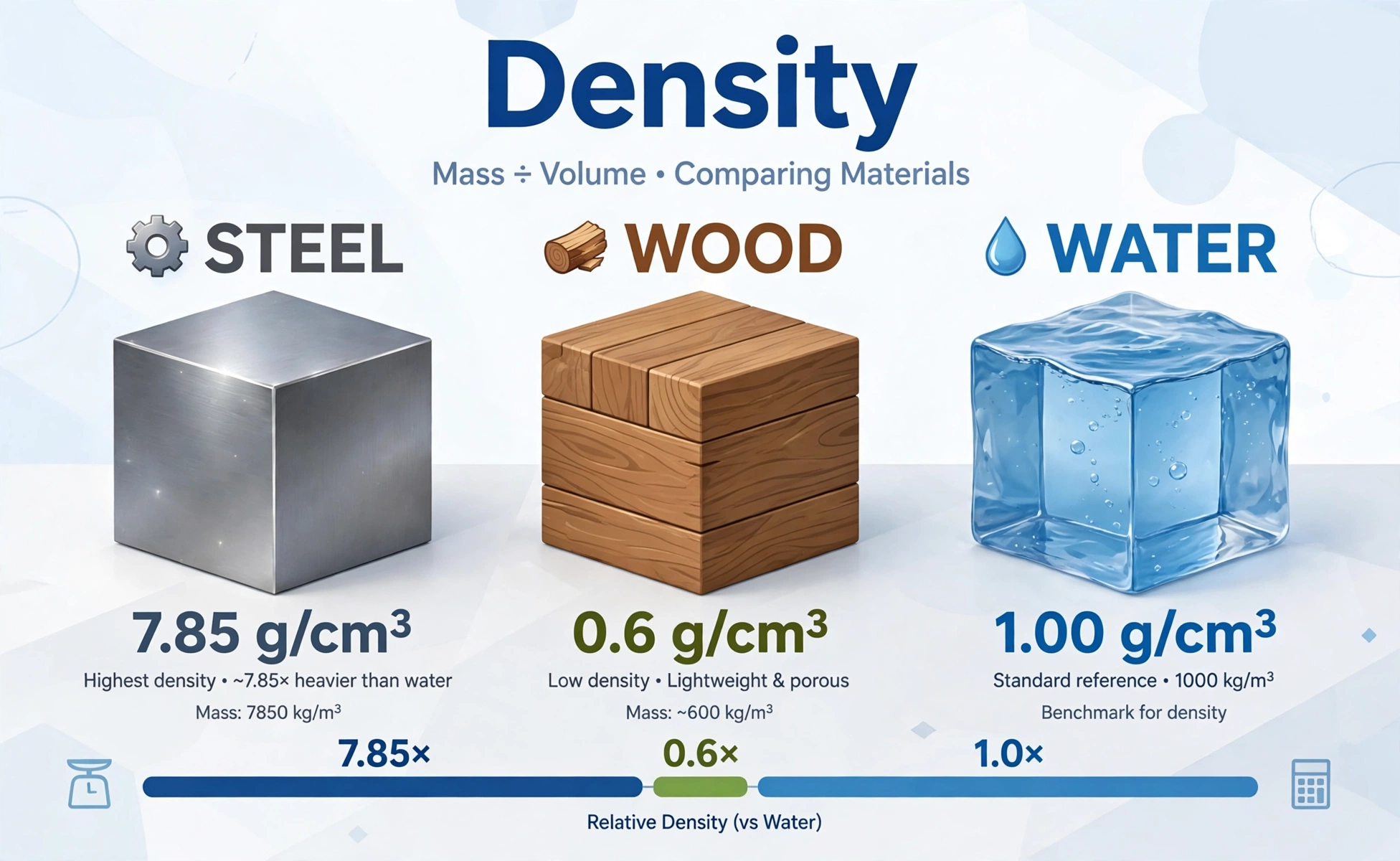
Density is mass per unit volume: how much matter is packed into a given space. It is written as the Greek letter rho, and calculated as mass divided by volume. Water has a density of 1,000 kilograms per cubic meter, steel about 7,850, and air about 1.2, which is why steel sinks, wood floats, and a balloon rises.
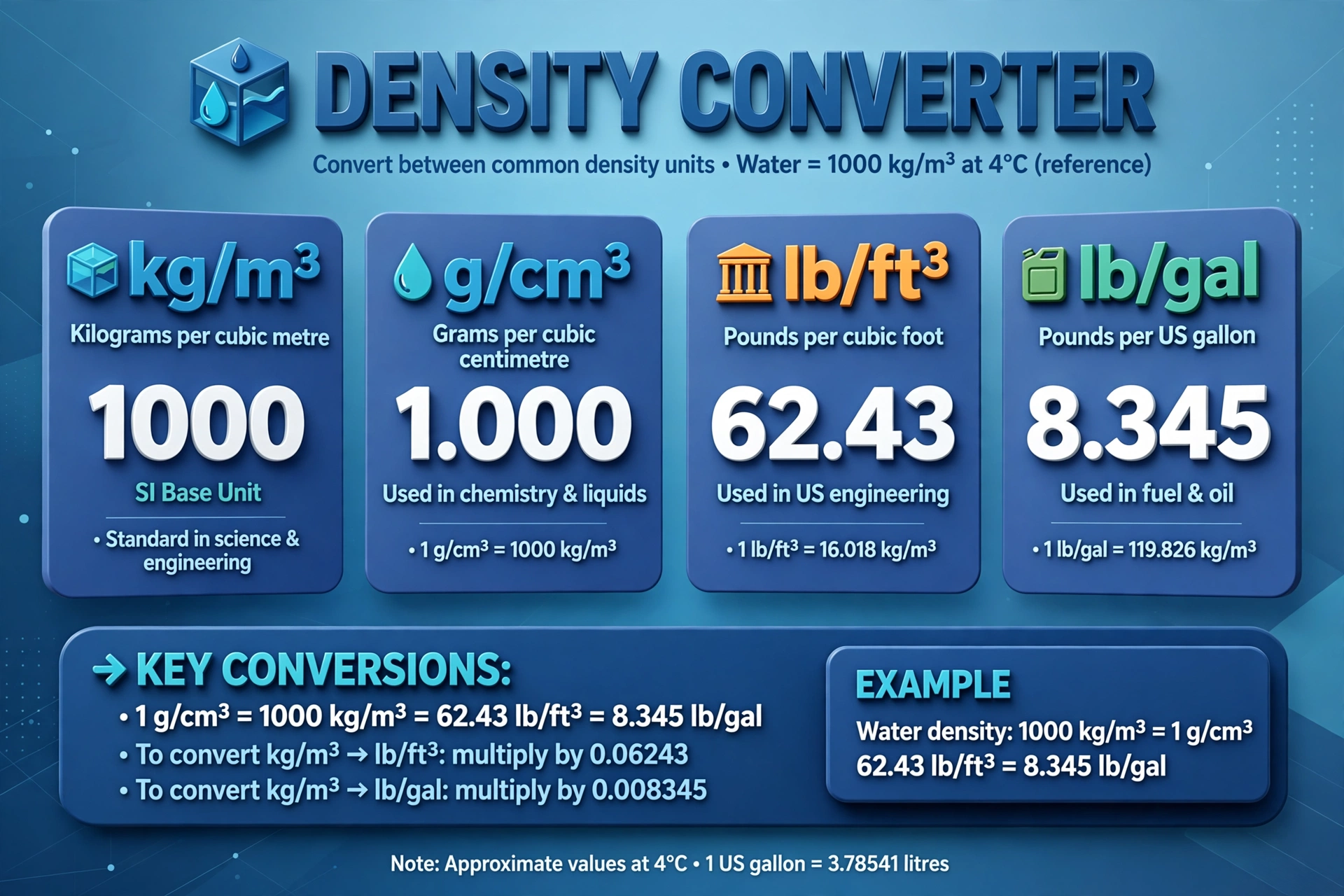
Density units combine a mass unit with a volume unit, so converting density means converting both parts at once. That is why the factors look unfamiliar: 1 gram per cubic centimeter equals 1,000 kilograms per cubic meter, because grams to kilograms divides by 1,000 while cubic centimeters to cubic meters multiplies by 1,000,000, and the two effects combine.
For mass alone, a weight converter converts kilograms, pounds, and ounces, and for volume alone, a volume converter converts liters, gallons, and cubic feet.
The Conversion Factors
All conversions here go through kilograms per cubic meter as the base unit. Multiply the input by its factor to get kilograms per cubic meter, then divide by the target unit's factor. The factors come from exact definitions: 1 pound is 0.45359237 kilograms, 1 foot is 0.3048 meters, and 1 US gallon is 3.785411784 liters.
So 1 pound per cubic foot equals 16.01846337 kilograms per cubic meter, 1 pound per US gallon equals 119.826427, and 1 ounce per cubic inch equals 1729.994044. Specific gravity is simpler: it is density divided by the density of water, about 1,000 kilograms per cubic meter, so it is numerically equal to density in grams per cubic centimeter.
| Unit | kg/m3 per unit | Use |
|---|---|---|
| kg/m3 | 1 | SI unit, physics and engineering |
| g/cm3 | 1000 | Chemistry, materials science |
| kg/L | 1000 | Liquids, chemistry |
| lb/ft3 | 16.01846337 | US engineering, construction |
| lb/gal (US) | 119.826427 | Fuels, liquids in the US |
| oz/in3 | 1729.994044 | Dense metals in US units |
Worked Examples
Example 1: convert 1 gram per cubic centimeter. That is 1,000 kilograms per cubic meter, 1 kilogram per liter, 62.428 pounds per cubic foot, and 8.345 pounds per US gallon, which is the density of water. Example 2: convert 2.5 grams per cubic centimeter. That is 2,500 kilograms per cubic meter, 156.07 pounds per cubic foot, and 20.86 pounds per US gallon.
Example 3: convert steel at 7.87 grams per cubic centimeter. That is 7,870 kilograms per cubic meter and 491.3 pounds per cubic foot. Example 4: convert diesel at 850 kilograms per cubic meter. That is 0.85 grams per cubic centimeter, 53.04 pounds per cubic foot, and 7.09 pounds per US gallon.
| Input | kg/m3 | g/cm3 | lb/ft3 | lb/gal (US) |
|---|---|---|---|---|
| 1 g/cm3 (water) | 1000 | 1 | 62.43 | 8.35 |
| 2.5 g/cm3 | 2500 | 2.5 | 156.07 | 20.86 |
| 7.87 g/cm3 (steel) | 7870 | 7.87 | 491.3 | 65.68 |
| 850 kg/m3 (diesel) | 850 | 0.85 | 53.04 | 7.09 |
Densities of Common Materials
Air at sea level is about 1.2 kilograms per cubic meter, cork about 240, pine wood about 500, ice 917, water 1,000, seawater 1,025, concrete 2,400, aluminum 2,700, steel 7,850, copper 8,960, lead 11,340, mercury 13,546, gold 19,320, and osmium, the densest naturally occurring element, about 22,590. Those values are typical at room temperature, and exact values vary with temperature, purity, and alloy.
A material floats in a liquid when its density is lower than the liquid's, and sinks when it is higher, which is why ice, at 917, floats on water at 1,000 with about 90 percent submerged. The same rule decides whether oil floats on water, and whether a hot air balloon rises, since hot air is less dense than the surrounding cool air.
| Material | kg/m3 | g/cm3 | lb/ft3 |
|---|---|---|---|
| Air | 1.2 | 0.0012 | 0.07 |
| Water | 1000 | 1 | 62.43 |
| Concrete | 2400 | 2.4 | 149.83 |
| Aluminum | 2700 | 2.7 | 168.56 |
| Steel | 7850 | 7.85 | 490.06 |
| Gold | 19320 | 19.32 | 1206.13 |
Common Mistakes
The most common mistake is converting only the mass or only the volume part of a density unit, which gives a factor off by a thousand or more. Always convert through a base unit, as this calculator does, rather than guessing a single factor. Another mistake is mixing US and UK gallons: a UK gallon is 4.54609 liters, larger than the US gallon at 3.78541 liters, so pounds per UK gallon differ from pounds per US gallon.
A third mistake is treating specific gravity as if it had units. It is a ratio, so it has no units, and it equals density in grams per cubic centimeter only when water at 4 degrees Celsius is the reference, which is the usual convention. A fourth mistake is ignoring temperature: liquids expand when warm, so their density falls, and fuel densities are usually quoted at 15 degrees Celsius for that reason.
Practical Uses
Density conversions matter in engineering specifications, chemical formulations, material procurement, and fuel handling, where a specification in one unit system must be checked against a datasheet in another. A steel beam specified at 490 pounds per cubic foot is the same steel specified at 7,850 kilograms per cubic meter, and a mix-up between the two would be a factor of 16 error.
For finding mass from density and volume, use mass equals density times volume: a 0.05 cubic meter steel block at 7,850 kilograms per cubic meter weighs 392.5 kilograms. For volume from mass and density, use volume equals mass divided by density: 1 kilogram of gold at 19,320 kilograms per cubic meter occupies about 51.8 cubic centimeters.

Frequently asked questions
How many kg/m3 is 1 g/cm3?
1,000 kg/m3. Multiply grams per cubic centimeter by 1,000 to get kilograms per cubic meter.
How many lb/ft3 is 1 g/cm3?
62.428 lb/ft3. So water at 1 g/cm3 is 62.43 lb/ft3, and steel at 7.87 g/cm3 is about 491.3 lb/ft3.
What is specific gravity?
Density divided by the density of water, about 1,000 kg/m3. It has no units, and it is numerically equal to density in g/cm3.
What is the difference between US and UK gallons for density?
A US gallon is 3.78541 liters and a UK gallon is 4.54609 liters, so pounds per UK gallon are larger than pounds per US gallon for the same liquid. This converter uses US gallons.
Does temperature affect density?
Yes, especially for liquids. Warm liquids expand and become less dense, so fuel densities are usually quoted at 15 degrees Celsius.
How do I find mass from density?
Multiply density by volume. A 0.05 cubic meter steel block at 7,850 kg/m3 weighs 392.5 kilograms.
Why is density in kg/m3 so much larger than in g/cm3?
Because a cubic meter holds a million cubic centimeters, while a kilogram holds a thousand grams, and those two changes combine into a factor of 1,000.