Calorie Deficit Calculator: Your Daily Target for Weight Loss
Enter your age, sex, weight, height, and activity level, pick how fast you want to lose weight, and get your daily calorie target for safe, steady loss.
Formulas verified against standard references. Calculator logic tested with verified worked examples. Last reviewed: October 2026. Our methodology
What a Calorie Deficit Is
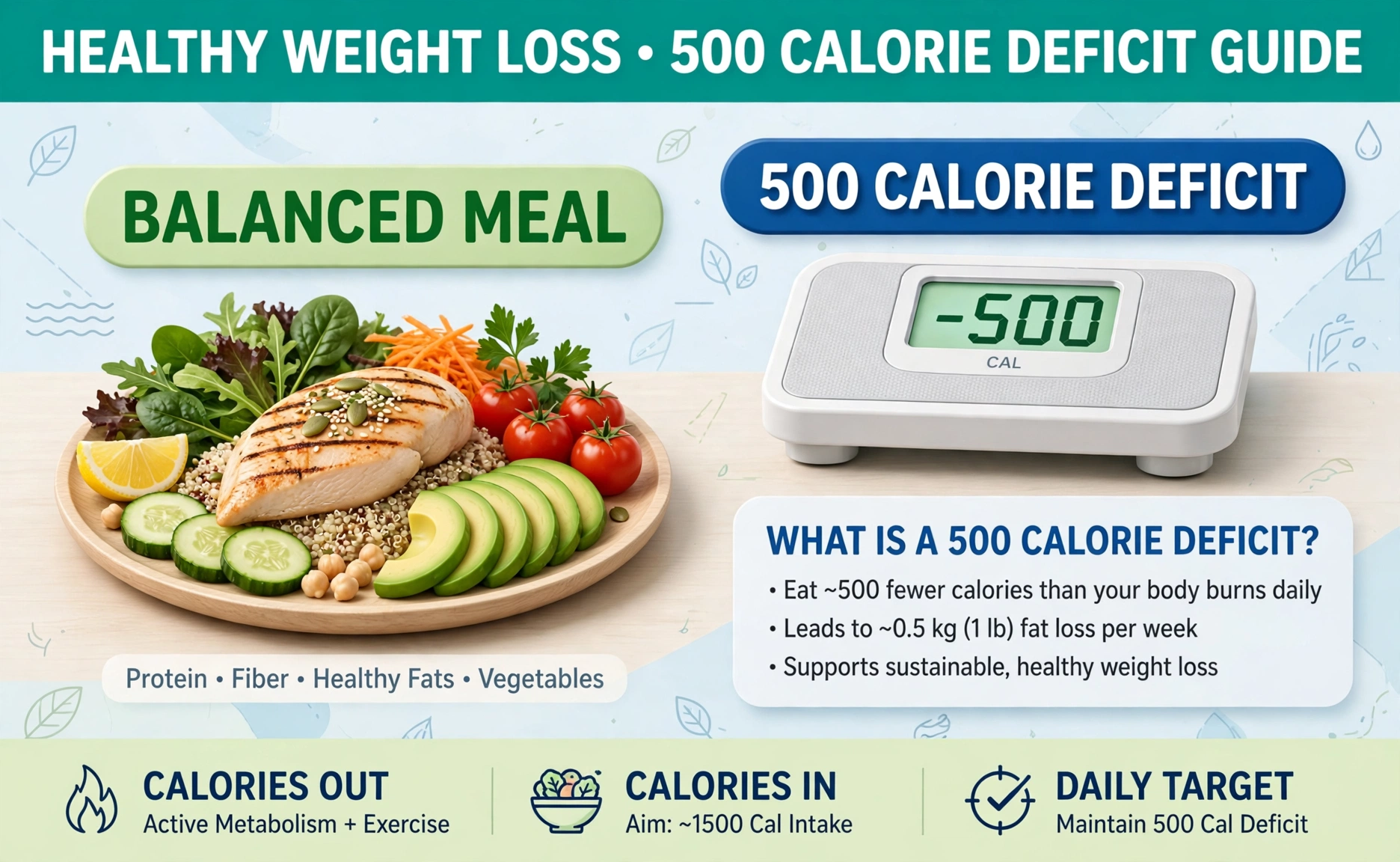
A calorie deficit means eating fewer calories than your body burns in a day, so the shortfall comes from stored body fat. Your body burns calories at rest to keep you alive, called basal metabolic rate or BMR, plus calories for movement, digestion, and exercise, which together make your total daily energy expenditure, or TDEE.
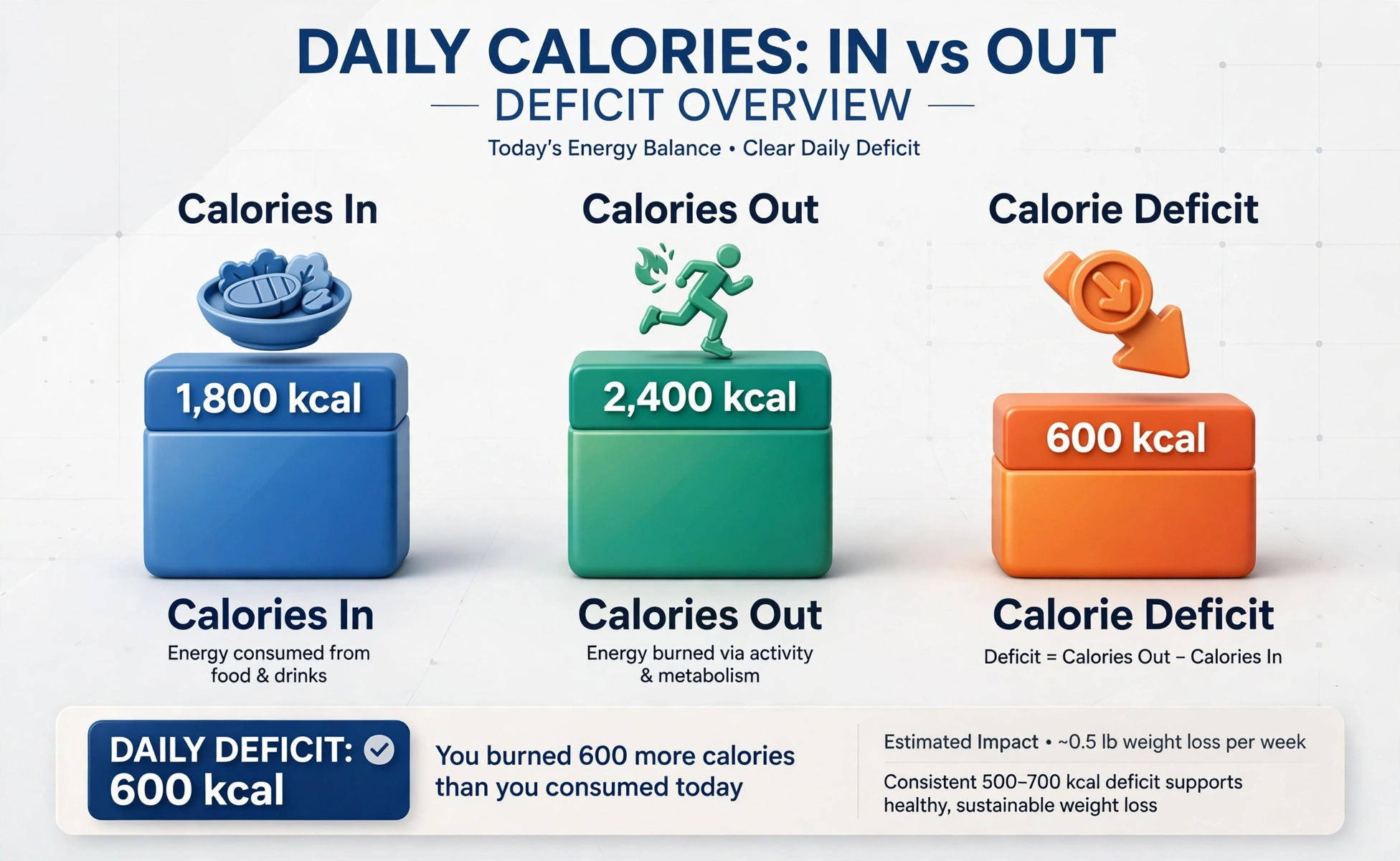
If your TDEE is 2,500 calories and you eat 2,000, the 500 calorie daily deficit adds up to 3,500 a week, roughly 0.45 kg of fat, since 1 kg of body fat stores about 7,700 calories. That arithmetic is the whole idea: a steady daily deficit produces steady weekly loss.
For body composition rather than weight alone, a BMI calculator and a body fat calculator track what the weight is made of.
The Mifflin-St Jeor Formula
This calculator uses the Mifflin-St Jeor equation, the formula most dietitians use for BMR. For men it is 10 times weight in kilograms plus 6.25 times height in centimeters minus 5 times age plus 5. For women it is the same, minus 161 instead of plus 5, because women typically carry less muscle at the same weight.
TDEE is BMR times an activity factor: 1.2 for sedentary, 1.375 for lightly active, 1.55 for moderately active, 1.725 for very active, and 1.9 for extremely active. The activity factor is the roughest part of the estimate, so pick honestly: most desk workers are sedentary or lightly active, not moderately active.
| Sex | BMR formula (W = kg, H = cm, A = years) |
|---|---|
| Male | 10W + 6.25H - 5A + 5 |
| Female | 10W + 6.25H - 5A - 161 |
Worked Example
Example: a 30 year old man, 80 kg, 175 cm, moderately active. BMR is 10 times 80 plus 6.25 times 175 minus 5 times 30 plus 5, which is 800 plus 1093.75 minus 150 plus 5, or 1748.75 calories. TDEE is 1748.75 times 1.55, or about 2711 calories.
For 0.5 kg a week, the deficit is 0.5 times 7700 divided by 7, or 550 calories a day, so the target intake is 2711 minus 550, or about 2161 calories. At that rate, losing 5 kg takes 10 weeks.
| Step | Calculation | Result |
|---|---|---|
| BMR | 10x80 + 6.25x175 - 5x30 + 5 | 1749 kcal |
| TDEE | 1749 x 1.55 | 2711 kcal |
| Daily deficit | 0.5 x 7700 / 7 | 550 kcal |
| Target intake | 2711 - 550 | 2161 kcal |
How Fast Should You Lose Weight
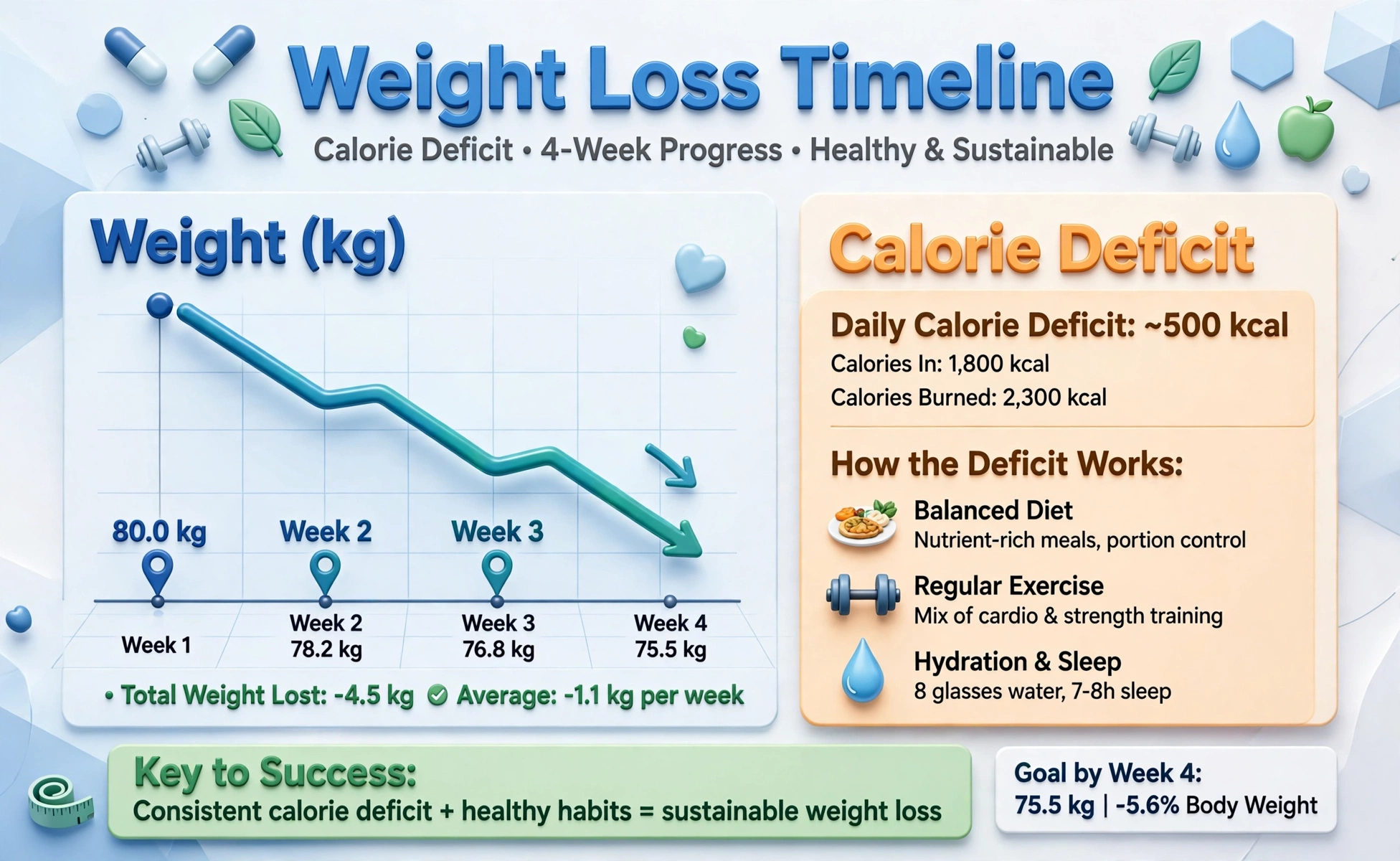
A loss of 0.5 to 1 kg a week is the usual safe range for most adults, and slower is fine: 0.25 kg a week still loses 13 kg in a year. Faster loss risks muscle loss, gallstones, fatigue, and rebound, because very low intakes are hard to sustain and the body adapts by burning fewer calories.
As a floor, most guidance keeps women at or above 1200 calories a day and men at or above 1500 without medical supervision. Below that, it is hard to get enough protein, vitamins, and minerals from food alone, and a clinician or dietitian should be involved.
| Pace | Daily deficit | Loss in 10 weeks |
|---|---|---|
| 0.25 kg/week | 275 kcal | 2.5 kg |
| 0.5 kg/week | 550 kcal | 5 kg |
| 0.75 kg/week | 825 kcal | 7.5 kg |
| 1 kg/week | 1100 kcal | 10 kg |
Common Mistakes
The most common mistake is overestimating activity: picking moderately active for a desk job inflates TDEE by hundreds of calories and wipes out the deficit. A second mistake is ignoring liquid calories, cooking oil, and snacks, which are easy to forget and can total 300 calories or more.
A third mistake is cutting too hard after a plateau: weight loss slows as you get lighter because a smaller body burns fewer calories, so recalculate TDEE every few kilograms instead of slashing intake further. A fourth mistake is judging by one weigh-in: water weight swings 1 to 2 kg day to day, so judge by the weekly trend.
Practical Uses
Use the target as a daily budget: plan meals to land near it, keep protein around 1.6 to 2.2 grams per kilogram of body weight to protect muscle, and fill the rest with foods you actually enjoy, because a plan you quit in week two loses nothing. Track intake for a week or two to calibrate your eye for portions.
Pair the deficit with resistance training and daily steps, which protect muscle and keep the deficit honest. And recheck every month: as weight falls, TDEE falls too, so the same intake slowly becomes maintenance, and the target needs a small update.
Frequently asked questions
How many calories should I eat to lose weight?
Eat below your maintenance (TDEE). For a 0.5 kg weekly loss, subtract about 550 calories a day from TDEE. This calculator finds your TDEE and target from your stats.
What is the Mifflin-St Jeor equation?
The standard BMR formula: 10 times weight in kg plus 6.25 times height in cm minus 5 times age, plus 5 for men or minus 161 for women.
How many calories are in 1 kg of body fat?
About 7,700 calories. So a daily deficit of 550 calories gives roughly 0.5 kg of fat loss per week.
Is a 1000 calorie deficit safe?
It gives about 1 kg a week, the top of the usual range. Check that your target stays above 1200 calories for women or 1500 for men, and talk to a clinician for larger deficits.
Why has my weight loss stalled?
A smaller body burns fewer calories, so the same intake slowly becomes maintenance. Recalculate TDEE at your new weight, and judge by the weekly trend, not one weigh-in.
Does exercise help a calorie deficit?
Yes. Exercise raises TDEE, protects muscle during loss, and makes the same deficit easier to hold, especially resistance training and daily walking.
Should I eat back exercise calories?
Usually not in full. Activity trackers often overestimate burn, so eating them all back can erase the deficit. Treat exercise as a bonus, not a budget increase.