Waist-to-Hip Ratio Calculator: Check Your Risk Category
Enter your waist and hip measurements in cm or inches, choose Female or Male, and see your ratio and WHO risk category.
Formulas verified against standard references. Calculator logic tested with verified worked examples. Last reviewed: October 2026. Our methodology
How to measure waist and hip
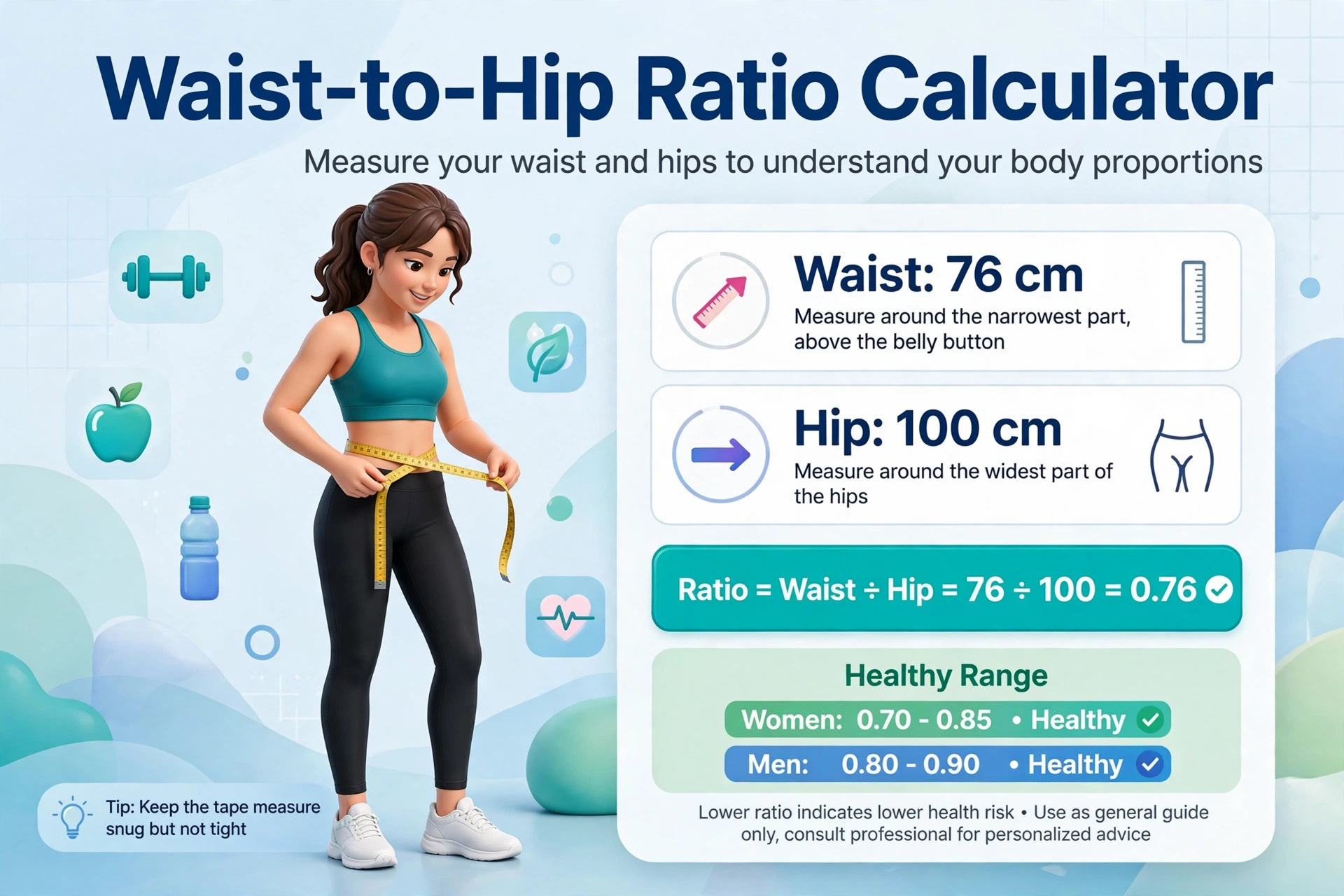
Stand relaxed and breathe out normally. Measure your waist at the narrowest point of your torso, usually just above the belly button, and your hip at the widest point around your buttocks. Keep the tape snug but not tight, and take each measurement twice if the first two differ.
Enter both numbers in the same unit — centimetres or inches, whichever your tape uses. Because the ratio divides one length by another, the unit cancels out, so a waist of 80 cm and hips of 100 cm gives exactly the same ratio as 31.5 inches over 39.4 inches.
The waist-to-hip ratio formula and WHO risk bands
Waist-to-hip ratio = waist measurement / hip measurement
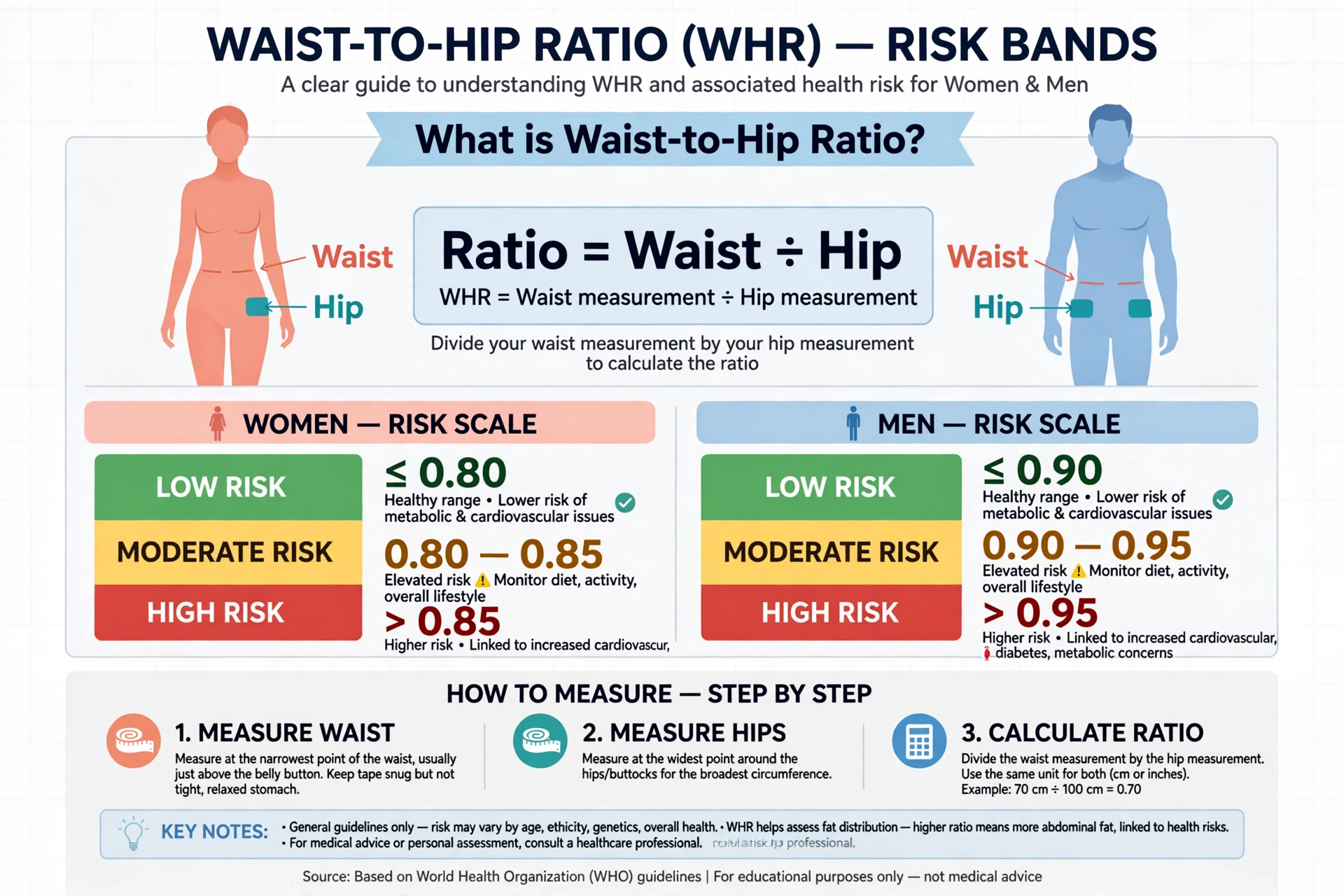
The result has no unit. A ratio of 0.80 means the waist is 80 percent of the hip measurement. The World Health Organization (WHO) risk bands below are the ones this calculator uses.
| Risk category | Female | Male |
|---|---|---|
| Low | 0.80 or below | 0.90 or below |
| Moderate | 0.81 - 0.85 | 0.91 - 0.99 |
| High | 0.86 or above | 1.00 or above |
Worked examples
Female, waist 80, hip 100: ratio = 80 / 100 = 0.80. That sits at the top of the female low-risk band (0.80 or below), so the result is Low risk.
Male, waist 95, hip 100: ratio = 95 / 100 = 0.95. That falls inside the male moderate band (0.91 - 0.99), so the result is Moderate risk.
| Example | Waist / Hip | Ratio | Risk category |
|---|---|---|---|
| Female | 80 / 100 | 0.80 | Low risk |
| Male | 95 / 100 | 0.95 | Moderate risk |
| Female | 90 / 100 | 0.90 | High risk |
| Male | 85 / 100 | 0.85 | Low risk |
What your result means — and what it does not
Waist-to-hip ratio describes where body fat tends to sit, not how much fat there is overall. Fat carried around the waist is associated with higher health risk than fat carried around the hips, which is why the ratio is used alongside other measures rather than on its own.
For a broader picture of weight status, a BMI calculator compares weight to height, while this ratio compares two body measurements.
To estimate body composition itself, a body fat calculator estimates body fat percentage from measurements including waist, neck and hip.
A single ratio is not a diagnosis. If your result is moderate or high, or if it changes quickly, a clinician can interpret it with your full health history.
Tips for a consistent measurement
Measure at the same time of day, wearing light clothing or none over the measuring points, and avoid measuring straight after a large meal. Small differences in tape placement change the ratio, so consistency matters more than chasing a single decimal place.
Record the two measurements as well as the ratio: if the ratio changes next month, the raw numbers show whether the waist, the hips, or both moved.
Frequently asked questions
How do I calculate my waist-to-hip ratio?
Divide your waist measurement by your hip measurement, using the same unit for both. For example, 80 / 100 = 0.80.
What is a healthy waist-to-hip ratio for a woman?
Low risk is 0.80 or below, moderate is 0.81 to 0.85, and high is 0.86 or above, using the WHO bands.
What is a healthy waist-to-hip ratio for a man?
Low risk is 0.90 or below, moderate is 0.91 to 0.99, and high is 1.00 or above, using the WHO bands.
Does it matter if I measure in cm or inches?
No, as long as waist and hip use the same unit. The unit cancels out in the division, so the ratio is identical either way.
Is waist-to-hip ratio better than BMI?
They measure different things: BMI compares weight to height, while waist-to-hip ratio describes fat distribution. They are best used together.
Where exactly do I measure my waist?
At the narrowest point of your torso, usually just above the belly button, with the tape snug but not tight and after breathing out normally.
What if my ratio is in the high band?
It is a prompt to talk to a clinician, not a diagnosis on its own. Diet, activity and overall health history all matter alongside the ratio.