Waist-to-Height Ratio Calculator
Check one of the simplest validated health screens: your waist-to-height ratio (WHtR). Enter your waist and height in centimeters or inches to get your ratio, your band on the Ashwell shape chart, and the healthy waist range for your exact height, so you leave with a concrete target, not just a number.

Formulas verified against standard references. Calculator logic tested with verified worked examples. Last reviewed: October 2026. Our methodology
What the Ratio Measures
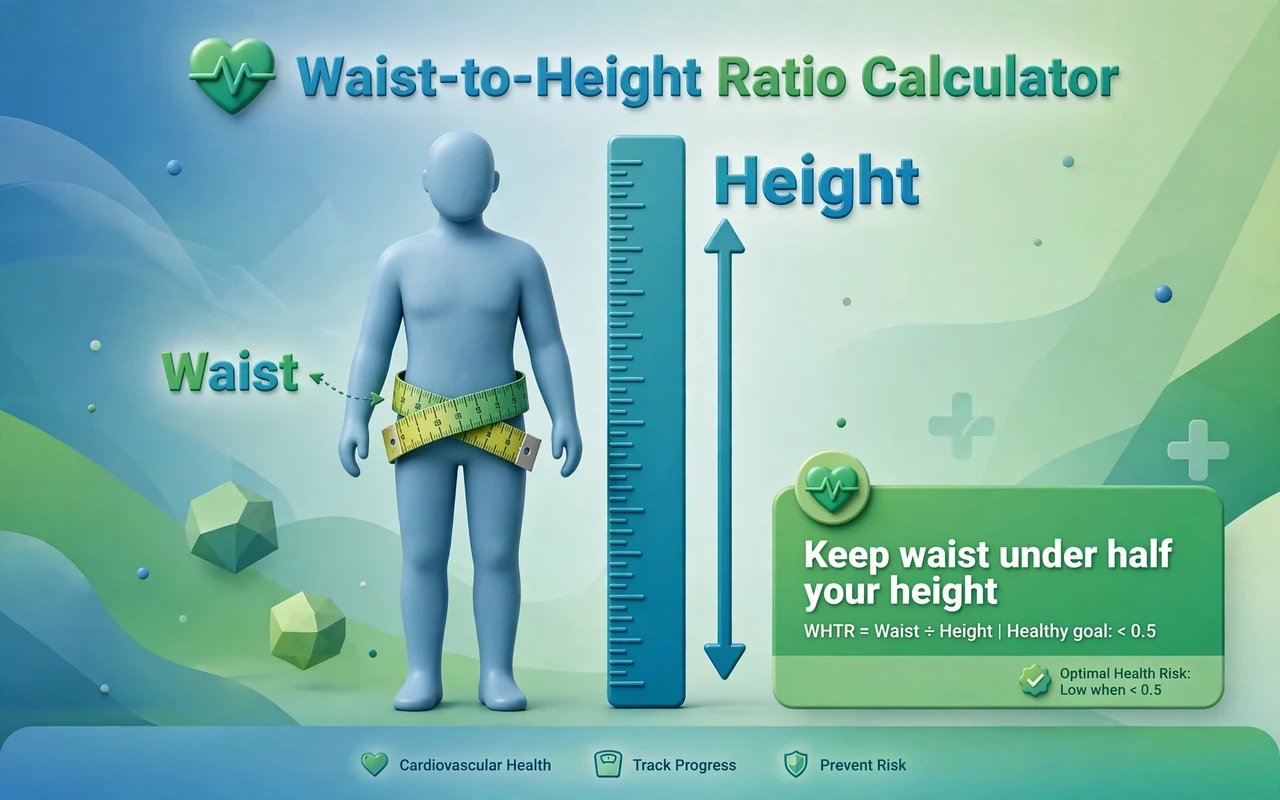
Waist-to-height ratio is waist circumference divided by height, both in the same unit. The units cancel, so 85 cm / 175 cm gives the same 0.486 as 33.5 in / 68.9 in. It is a screen for central obesity: fat carried around the middle, which tracks cardiometabolic risk more closely than total weight.
The rule of thumb behind it is memorable: keep your waist to less than half your height. A 6-foot (183 cm) person should aim for a waist under 91.5 cm (36 in). Unlike BMI, the ratio adjusts for frame size automatically, because height is in the denominator.
The Ashwell Shape Chart Bands
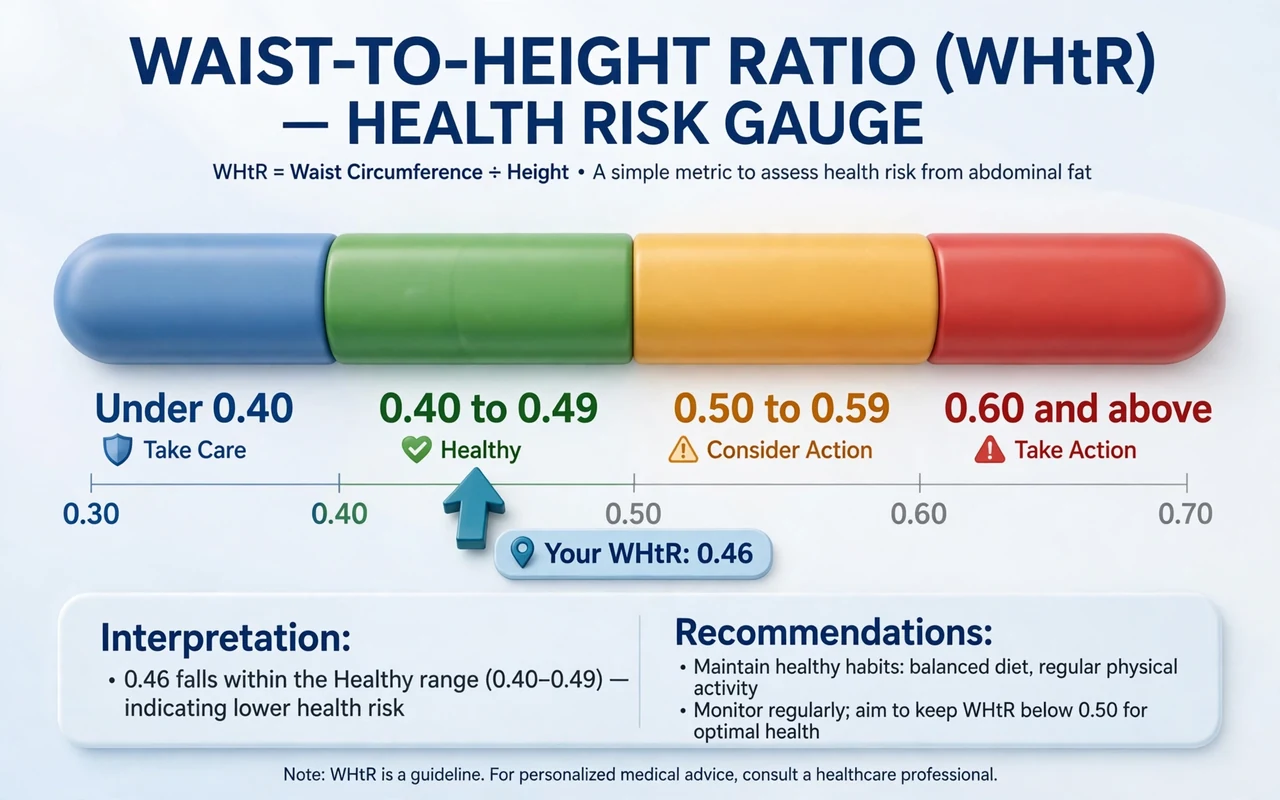
This calculator interprets your ratio with the widely used Ashwell shape-chart bands. Below 0.40 is the take-care zone (possibly underweight), 0.40 to 0.49 is the healthy OK zone, 0.50 to 0.59 suggests considering action, and 0.60 or above is the take-action zone.
Boundaries use the unrounded ratio, so a displayed 0.50 after rounding may still sit just inside healthy. The bands apply to adults; for children over 5 the same numeric bands are used but the action wording differs, and adult thresholds fit from roughly age 15 to 16 onward.
| WHtR | Band | What it suggests |
|---|---|---|
| Below 0.40 | Take care | Possibly underweight |
| 0.40 - 0.49 | Healthy (OK) | Lower cardiometabolic risk |
| 0.50 - 0.59 | Consider action | Elevated risk |
| 0.60 and above | Take action | High risk |
Your Healthy Waist Range
A single ratio number is abstract; a waist range in your own units is actionable. The calculator reports the healthy waist for your exact height: 0.40 × height to 0.50 × height. At 175 cm, that is 70 to 87.5 cm; at 68.9 in, it is 27.6 to 34.5 in.
It also shows your headroom against the half-height ceiling: how far under (or over) 0.5 × height your waist sits. Small, steady changes move the needle here: a 2 cm waist reduction at 175 cm drops the ratio by about 0.011, which can cross a band boundary near the edges.
WHtR vs BMI
BMI divides weight by height squared and cannot tell muscle from fat, so athletic builds often score overweight while carrying little fat. WHtR looks only at waist relative to height, which is why several studies found it a stronger predictor of heart disease and diabetes risk than BMI alone.
The two complement rather than replace each other: BMI screens total mass, WHtR screens distribution. If your BMI is normal but your WHtR is above 0.5, the distribution deserves attention; if both are healthy, you are in good shape on both axes. The BMI calculator gives you the other half of the picture.
| Measure | Formula | What it misses |
|---|---|---|
| WHtR | Waist / height | Muscle vs fat, visceral vs subcutaneous |
| BMI | Weight / height^2 | Fat distribution, muscle mass |
| Waist alone | Tape measure | Frame size differences |
Measuring Correctly
Measure your waist midway between the bottom rib and the top of the hip bone, after breathing out normally, with the tape snug but not compressing the skin. Measure height standing straight, without shoes, ideally in the morning.
Common errors: measuring over bulky clothing (adds centimeters), sucking in the stomach (a vanity reading, not a health reading), or using pant size as waist size (vanity sizing runs small). Measure three times and take the middle value.
Limits of the Screen
WHtR is a screening tool, not a diagnosis. It says nothing about muscle mass, bone density, fitness, or whether fat sits under the skin or around organs. A very muscular person can score above 0.5 without excess fat, and pregnancy, bloating, or medical conditions can distort the reading.
A result in the healthy band does not rule out disease, and a high result does not diagnose one. Use it as a prompt for lifestyle review or a clinician conversation, alongside blood pressure, lipids, and blood sugar. For the calorie side of that lifestyle review, the calorie calculator estimates daily needs.

Frequently asked questions
What is a good waist-to-height ratio?
Between 0.40 and 0.49 is the healthy band for adults. The simple rule: keep your waist less than half your height, which is a ratio below 0.50.
How do I measure my waist for WHtR?
Wrap a tape midway between your lowest rib and hip bone, breathe out normally, and keep the tape snug without pressing in. Measure over thin clothing or bare skin.
Is WHtR better than BMI?
For cardiometabolic risk, several studies found WHtR the stronger predictor, because it captures fat distribution while BMI cannot distinguish muscle from fat. They work best together.
Does the ratio work for children?
The same numeric bands are used for children over 5, but the action wording differs, and adult thresholds apply from about age 15 to 16.
What waist should I aim for at my height?
A healthy waist is 0.40 to 0.50 times your height. At 175 cm that is 70 to 87.5 cm; the calculator shows your exact range.
Can muscular people have a high WHtR?
Yes. The ratio cannot tell muscle from fat, so very muscular builds can score above 0.5 without excess body fat.
Do men and women use the same thresholds?
The Ashwell bands used here apply to both sexes. Some clinical tools use slightly different cutoffs by sex, but the 0.5 half-height rule is universal.