Typing Speed Test: Measure Your WPM and Accuracy
Type the passage below to start the timer. After 60 seconds you get gross and net words per minute, accuracy, and characters per minute.

Formulas verified against standard references. Calculator logic tested with verified worked examples. Last reviewed: October 2026. Our methodology
How the Test Works
Start typing the passage and the timer begins on your first keystroke. Type for the full test length, or press Calculate to finish early. The timer stops automatically at zero or when you complete the passage exactly.
Your result shows four numbers. Gross WPM is raw speed: characters typed divided by 5, divided by minutes. Net WPM subtracts one word per error per minute and is the number employers use. Accuracy is the share of correct keystrokes, and CPM is characters per minute.

Gross WPM vs Net WPM
Gross WPM measures how fast your fingers move, ignoring mistakes. Net WPM measures usable output by penalizing errors, which is why it is always equal to or lower than gross. A typist at 80 gross WPM with 5 errors in a minute scores 75 net WPM.
The gap between the two tells you what to practice. A big gap means errors are eating your speed, so slow down and focus on accuracy first. A small gap with low gross speed means your accuracy is solid and you can push for pace.
| Metric | Formula | What it tells you |
|---|---|---|
| Gross WPM | (characters / 5) / minutes | Raw finger speed |
| Net WPM | Gross WPM - (errors / minutes) | Usable output |
| Accuracy | correct keys / all keys x 100 | Precision |
| CPM | characters / minutes | Same speed, other unit |
Worked Example
Suppose you type 300 characters in one minute with 4 errors. Gross WPM is (300 / 5) / 1 = 60. The error penalty is 4 / 1 = 4, so net WPM is 60 - 4 = 56. Accuracy is 296 / 300 = 98.7 percent, and CPM is 300.
Notice how expensive errors are: each one erases a full word from the score. That is why accuracy-first training beats speed-first training for almost everyone, and why the test highlights errors in the passage as you type.
| Typed | Errors | Gross WPM | Net WPM | Accuracy |
|---|---|---|---|---|
| 300 chars | 4 | 60 | 56 | 98.7% |
| 230 chars | 7 | 46 | 39 | 97.0% |
What Is a Good Typing Speed
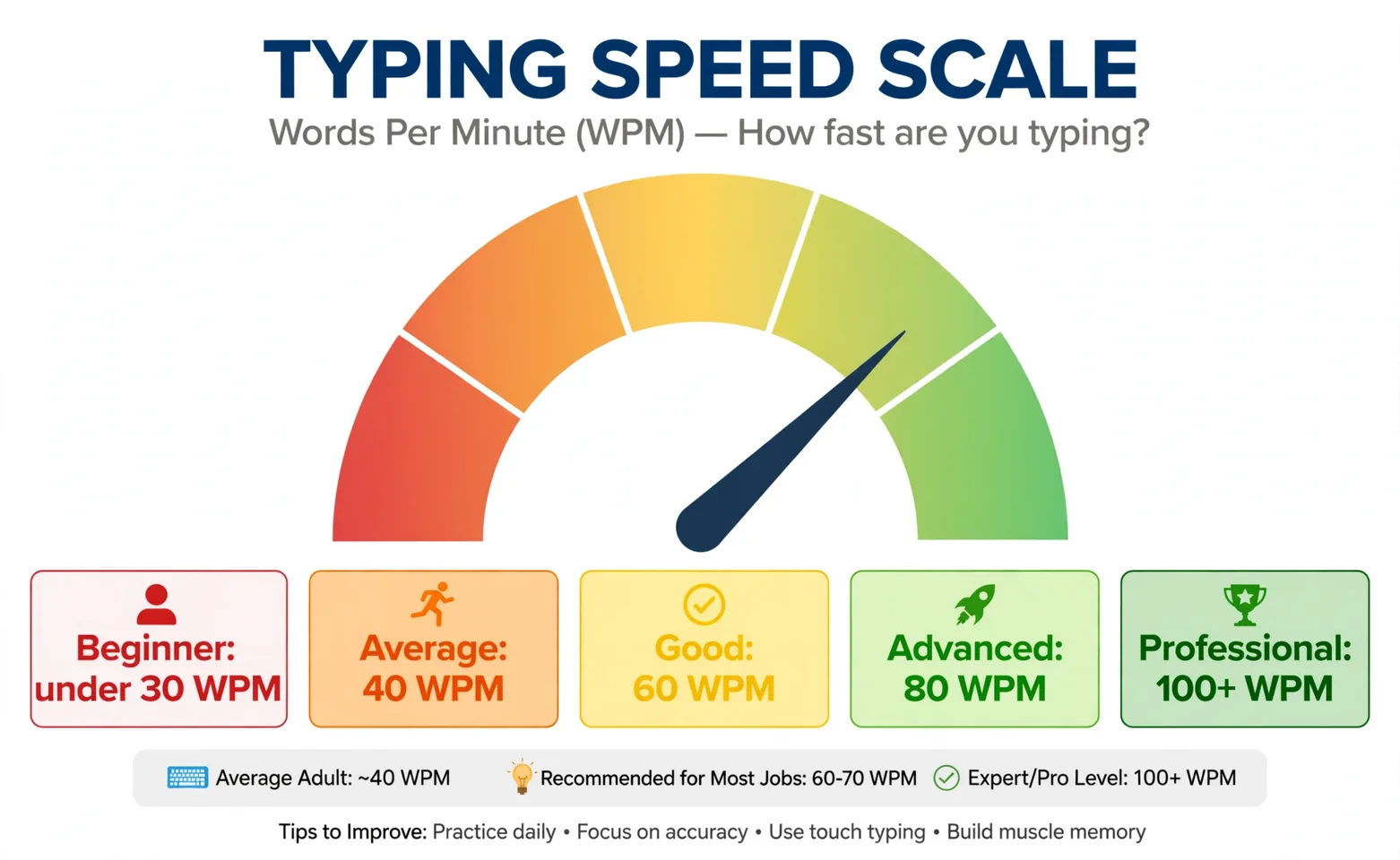
The average typist manages around 40 WPM. Above 40 puts you ahead of most people, 60 enters the top few percent where programmers, journalists, and translators usually sit, and 80-plus is professional territory. For accuracy, 95 percent is a solid baseline and data-entry roles often ask for 98 percent or better.
Context matters more than the raw number. Code typing with symbols and brackets runs slower than prose at the same skill level, and a 90 WPM score at 85 percent accuracy is worse in practice than 65 WPM at 99 percent, because every error costs seconds to notice and fix.
How to Improve
Practice in short daily sessions rather than occasional marathons: 15 focused minutes a day beats two hours on Sunday. Keep your eyes on the passage, not the keyboard, and resist the urge to look down when you stumble. Slow down until errors disappear, then let speed rebuild on top of clean accuracy.
Use proper posture too: feet flat, wrists straight and floating, screen at eye level. Tension in the shoulders slows the fingers, so shake out your hands between runs. The word counter is handy for checking the length of practice texts you paste in from elsewhere.
Test Tips and Fairness
Take the test when you are fresh, not after hours of typing, and use the keyboard you normally type on. Results vary with passage difficulty, so compare runs on this same passage rather than across different tests. Close other tabs so notifications do not break your rhythm.
One run is a snapshot, not a verdict. Take three runs and average them for a stable number, and retest monthly to track progress. If your accuracy is below 90 percent, treat that as the signal to slow down before chasing more speed.

Frequently asked questions
What does WPM mean in typing?
Words per minute, where one word is standardized as 5 characters including spaces. 300 characters in a minute equals 60 WPM.
What is the difference between gross and net WPM?
Gross WPM is raw speed ignoring errors. Net WPM subtracts one word per error per minute, so it reflects usable output and is the figure employers use.
What is a good typing speed?
Around 40 WPM is average, above 40 beats most people, 60 is strong professional territory, and 80-plus is expert level, all at 95 percent accuracy or better.
How is accuracy calculated?
Correct keystrokes divided by total keystrokes, times 100. Backspaced and fixed mistakes still count as errors in the keystroke tally.
Why is my net WPM much lower than gross?
Errors are expensive: each one costs a full word per minute. Slow down until accuracy passes 95 percent, then rebuild speed.
How long should I practice each day?
About 15 focused minutes daily beats occasional long sessions. Consistency builds the muscle memory that speed depends on.
Does the keyboard affect my score?
Yes. Test on the keyboard you normally use, since switching layouts or key travel changes both speed and accuracy.