Trigonometry Calculator
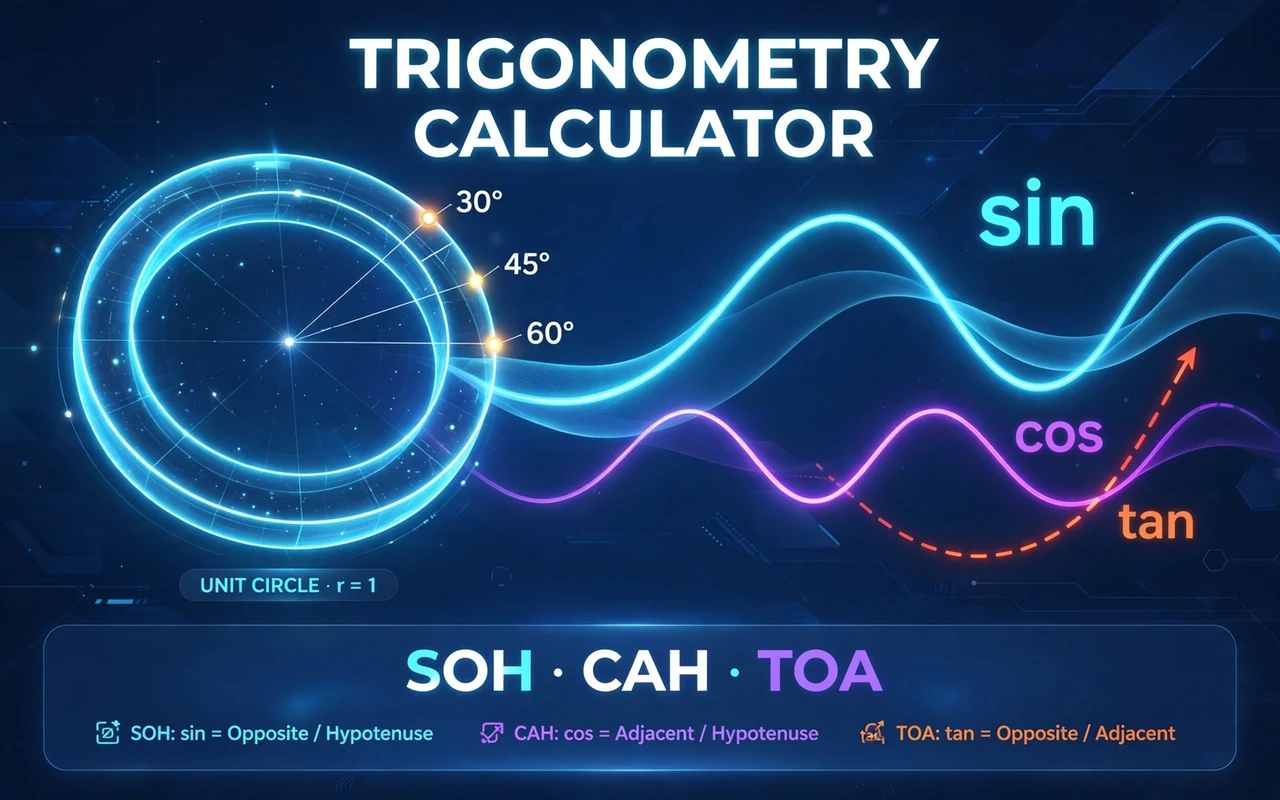
Find the sine, cosine, tangent, and reciprocal trig functions for any angle in degrees or radians, or work backwards with arcsin, arccos, and arctan to recover the angle from a ratio. Results show all six functions at once, with exact values for the common angles students meet most.

Formulas verified against standard references. Calculator logic tested with verified worked examples. Last reviewed: October 2026. Our methodology
The Six Trig Functions
Enter any angle and pick degrees or radians, and the calculator returns all six trigonometric functions at once: sine, cosine, tangent, and their reciprocals cosecant, secant, and cotangent. Most homework and exam problems only need the first three, but seeing all six together helps you spot relationships like tan = sin / cos.
Angles can be negative or larger than 360 degrees; the functions are periodic, so sin(390°) equals sin(30°). Where a function has no finite value, for example tan(90°), the calculator says undefined instead of printing a misleading huge number.
| Function | Definition | Example at 30° |
|---|---|---|
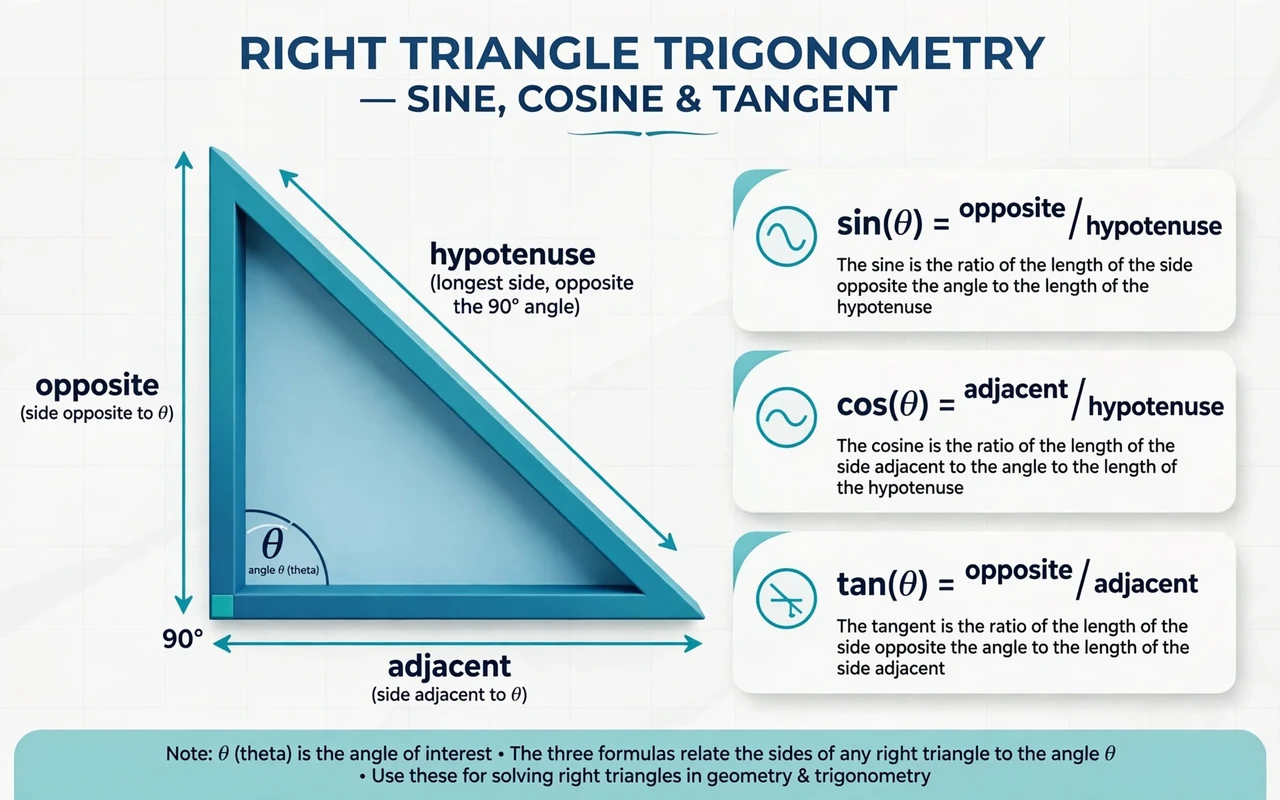
| sin | opposite / hypotenuse | 0.5 |
| cos | adjacent / hypotenuse | 0.866025 |
| tan | sin / cos | 0.57735 |
| csc | 1 / sin | 2 |
| sec | 1 / cos | 1.154701 |
| cot | 1 / tan | 1.732051 |
Degrees or Radians: Picking the Right Unit
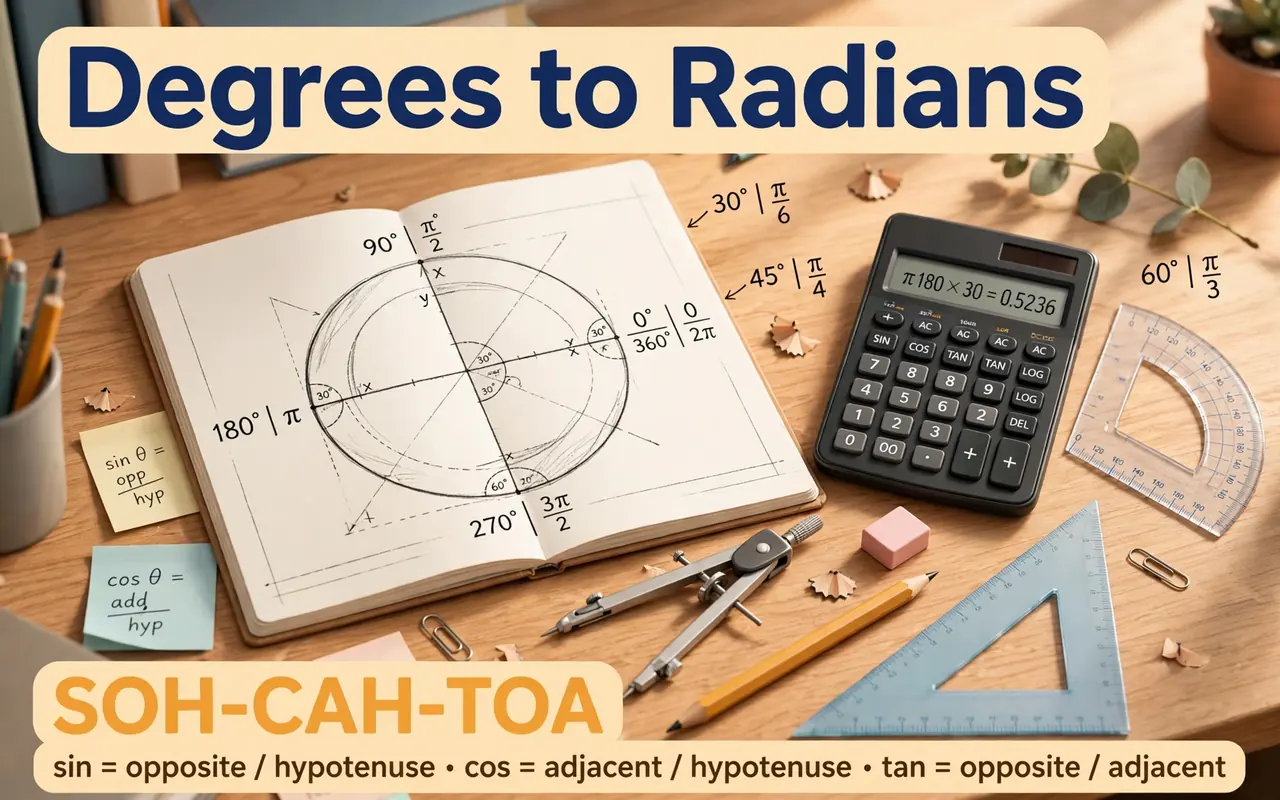
The single most common trig mistake is mixing up degrees and radians. Typing 30 while the calculator is in radian mode computes sin(30 radians), which is -0.988, not 0.5. School geometry almost always uses degrees; calculus and physics usually use radians, where a full circle is 2π.
Convert between them with a fixed factor: radians = degrees × π / 180. So 30° is π/6 ≈ 0.5236 rad, 45° is π/4 ≈ 0.7854 rad, and 90° is π/2 ≈ 1.5708 rad. If your answer looks nothing like the triangle you sketched, the unit setting is the first thing to check.
Inverse Trig: Finding the Angle
Inverse mode works backwards: give it a ratio and it returns the angle. Enter 0.5 with arcsin and you get 30° (0.5236 rad), because sin(30°) = 0.5. This is the step students miss when a problem gives side lengths and asks for an angle.
Arcsin and arccos only accept inputs from -1 to 1, since no sine or cosine value can fall outside that range; the calculator rejects anything else with a clear message. Arctan accepts any real number. Inverse functions return the principal value, the standard single answer in the accepted range, so arctan(1) gives 45°, not 225°.
| Inverse function | Accepts | Example |
|---|---|---|
| arcsin(x) | -1 to 1 | arcsin(0.5) = 30° |
| arccos(x) | -1 to 1 | arccos(0.5) = 60° |
| arctan(x) | any number | arctan(1) = 45° |
Exact Values Worth Memorizing
For the angles 0°, 30°, 45°, 60°, and 90°, the trig values have clean exact forms with square roots, and teachers love testing them. Memorizing the pattern saves time: sine goes 0, 1/2, √2/2, √3/2, 1 across those five angles, and cosine runs the same list backwards.
When your angle matches one of these, the calculator shows the exact form next to the decimal, so you can give the answer your teacher expects. Decimal approximations are fine for applied problems, but exact forms keep full precision through multi-step solutions.
| Angle | sin (exact) | cos (exact) | tan (exact) |
|---|---|---|---|
| 0° | 0 | 1 | 0 |
| 30° | 1/2 | √3/2 | √3/3 |
| 45° | √2/2 | √2/2 | 1 |
| 60° | √3/2 | 1/2 | √3 |
| 90° | 1 | 0 | undefined |
SOH-CAH-TOA and Right Triangles
Every trig ratio comes from a right triangle: SOH-CAH-TOA stands for Sine = Opposite/Hypotenuse, Cosine = Adjacent/Hypotenuse, Tangent = Opposite/Adjacent. Pick the ratio that uses the sides you know and the one you want.
Example: a 10-meter ladder leaning so it makes 60° with the ground reaches 10 × sin(60°) ≈ 8.66 meters up the wall. The adjacent side touches the angle (but is not the hypotenuse); the opposite side faces it. Label the triangle before you calculate and the right ratio picks itself.
When to Reach for a Full Scientific Calculator
This tool covers trig values and inverse trig, which is the whole trig workload for most classes. When a problem mixes trig with logarithms, exponents, factorials, or complex expressions, switch to the scientific calculator instead of chaining tools.
For pure root and power work without any trig, the square root calculator handles square, cube, and nth roots with simplified radicals, which pairs well with the exact-value table above.
Frequently asked questions
What is a trigonometry calculator?
A tool that computes sine, cosine, tangent, and the reciprocal trig functions for any angle, and can also run inverse functions (arcsin, arccos, arctan) to find an angle from a ratio.
Should I use degrees or radians?
Use degrees for school geometry and most everyday problems, radians for calculus and physics. The key rule: the unit setting must match the problem, or the answer will be completely wrong.
Why does tan(90°) say undefined?
Because cos(90°) is zero and tan = sin/cos, so tan(90°) would require dividing by zero. It has no finite value, and the calculator says so instead of showing a huge misleading number.
What are arcsin, arccos, and arctan?
The inverse trig functions: they take a ratio and return the angle that produces it. arcsin(0.5) = 30° because sin(30°) = 0.5. They are how you find unknown angles from known side lengths.
Why do arcsin and arccos reject numbers outside -1 to 1?
Sine and cosine values always lie between -1 and 1, so no angle can have a sine of 2. Asking for arcsin(2) has no real answer, and the calculator tells you that directly.
What is SOH-CAH-TOA?
A memory aid for the three main ratios: Sine = Opposite/Hypotenuse, Cosine = Adjacent/Hypotenuse, Tangent = Opposite/Adjacent, all measured on a right triangle.
How accurate are the results?
Values are computed in double precision (about 15 significant digits) and shown to 6 decimal places, far more precise than printed trig tables.