Time Calculator: Add and Subtract Time Durations
Enter two durations in hours, minutes, and seconds, choose Add or Subtract, and get the normalized result plus the total in hours, minutes, and seconds.
Formulas verified against standard references. Calculator logic tested with verified worked examples. Last reviewed: October 2026. Our methodology
Why Time Addition Needs Care
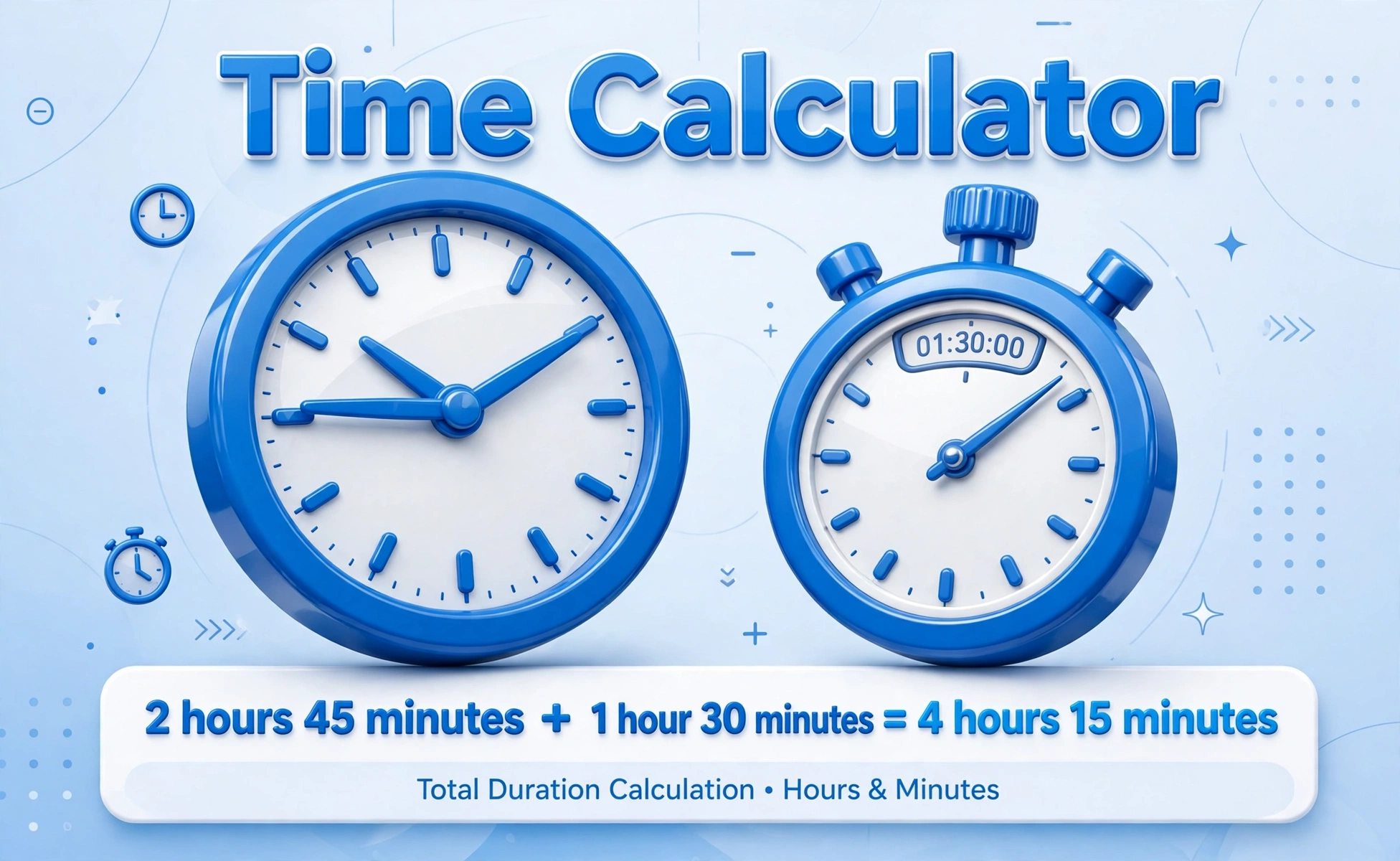
Time is not decimal: 60 seconds make a minute and 60 minutes make an hour, not 100 of each. That is why adding 2 hours 45 minutes and 1 hour 30 minutes on a pocket calculator as 2.45 plus 1.30 gives 3.75, which looks like 3 hours 75 minutes but is wrong as a duration. The correct total is 4 hours 15 minutes, because 75 minutes carries one hour.
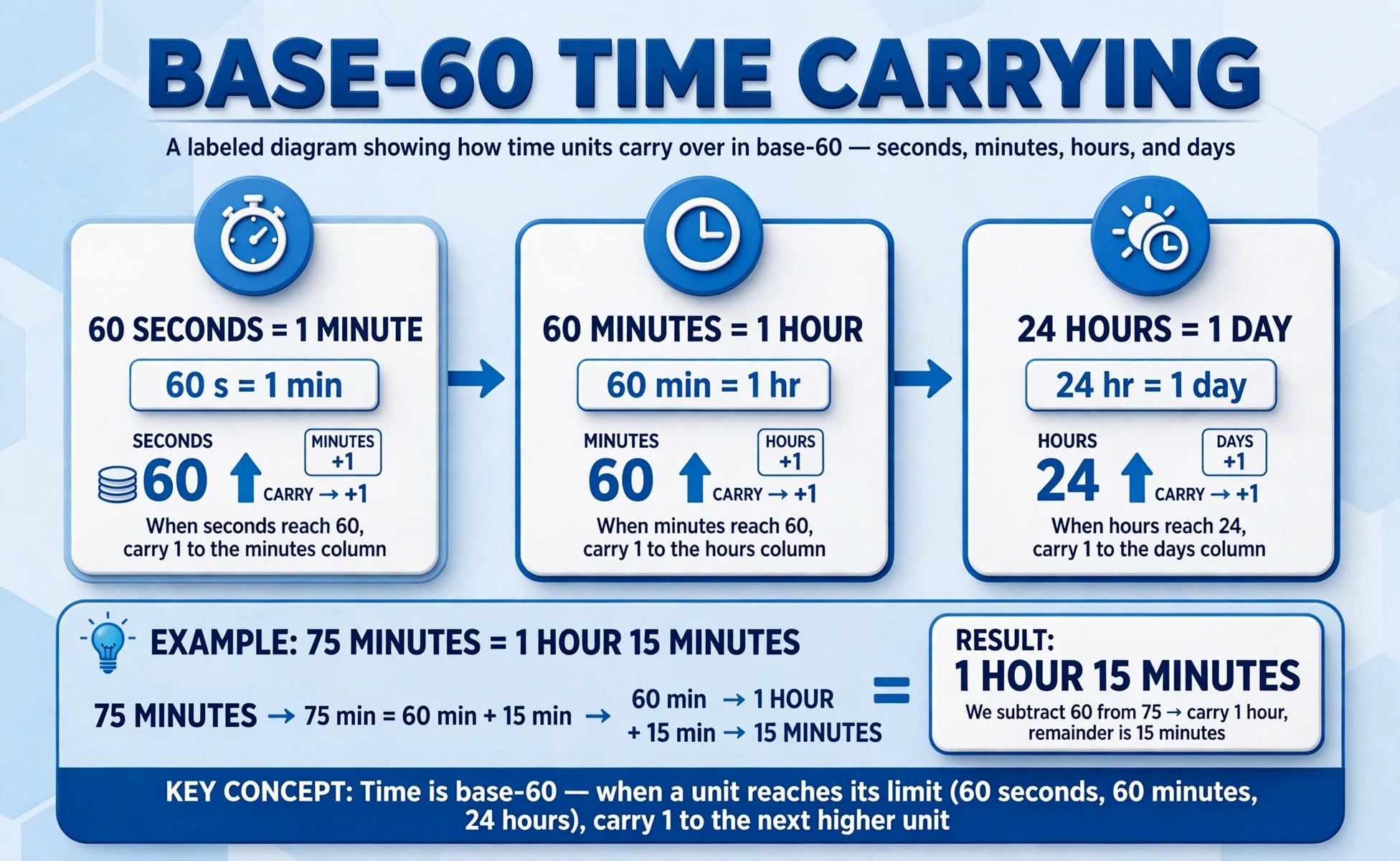
This calculator converts each duration to seconds, does the arithmetic, and converts back, so every carry happens correctly. Values above 59 in any field are also handled: entering 90 minutes is treated as 1 hour 30 minutes, because the conversion goes through total seconds either way.
If you need the gap between two clock times rather than the sum of two durations, a time duration calculator is the right tool.
The Method, Step by Step
First, convert each duration to its total in seconds: multiply hours by 3600, minutes by 60, and add the seconds. For 2 hours 45 minutes, that is 2 times 3600 plus 45 times 60, which is 9900 seconds. For 1 hour 30 minutes, it is 5400 seconds. Add them for 15300 seconds, or subtract for a difference.
Then convert back: divide by 86400 for days, take the remainder and divide by 3600 for hours, take the remainder and divide by 60 for minutes, and the final remainder is seconds. For 15300 seconds, that gives 4 hours 15 minutes and 0 seconds. Decimal hours come from dividing the total seconds by 3600, which is the format most payroll systems want.
| Unit | Seconds | Example |
|---|---|---|
| 1 second | 1 | 1 second |
| 1 minute | 60 | 90 seconds = 1 minute 30 seconds |
| 1 hour | 3600 | 2 hours 45 minutes = 9900 seconds |
| 1 day | 86400 | 25 hours = 1 day 1 hour |
Worked Examples
Example 1: 2 hours 45 minutes plus 1 hour 30 minutes. In seconds that is 9900 plus 5400, which is 15300, or 4 hours 15 minutes. Example 2: 3 hours 20 minutes minus 1 hour 45 minutes. In seconds that is 12000 minus 6300, which is 5700, or 1 hour 35 minutes.
Example 3: 23 hours 30 minutes plus 2 hours. The total is 25 hours 30 minutes, which the calculator also shows as 1 day 1 hour 30 minutes. Example 4: 1 hour 10 minutes minus 45 minutes. Borrowing an hour turns the first duration into 70 minutes, and 70 minus 45 is 25 minutes.
| Calculation | Total seconds | Result |
|---|---|---|
| 2h 45m + 1h 30m | 15300 | 4h 15m |
| 3h 20m - 1h 45m | 5700 | 1h 35m |
| 23h 30m + 2h | 91800 | 1 day 1h 30m |
| 1h 10m - 45m | 1500 | 25m |
Time Units Reference
A day holds 24 hours, 1440 minutes, and 86400 seconds. A week holds 168 hours and 604800 seconds. A year of 365 days holds 8760 hours and 31536000 seconds, while a leap year adds one more day, 24 hours, and 86400 seconds. Those totals are handy for converting a duration into the unit a timesheet or a report asks for.
Decimal hours are the payroll standard: 15 minutes is 0.25 hours, 30 minutes is 0.5 hours, and 45 minutes is 0.75 hours. To convert a duration to decimal hours, divide total minutes by 60, or divide total seconds by 3600.
| Period | Hours | Minutes | Seconds |
|---|---|---|---|
| 1 day | 24 | 1440 | 86400 |
| 1 week | 168 | 10080 | 604800 |
| 1 year (365 days) | 8760 | 525600 | 31536000 |
Common Mistakes
The biggest mistake is writing hours and minutes as a decimal: 2 hours 45 minutes is 2.75 hours, not 2.45 hours. The digits after the point in a duration are sixtieths, not hundredths, so 2.45 on a pocket calculator means 2 hours 27 minutes if it is read as a duration at all.
Another mistake is forgetting to borrow when subtracting: 3 hours 20 minutes minus 1 hour 45 minutes is not 2 hours negative 25 minutes. Borrow one hour from the 3, turning it into 2 hours 80 minutes, and the subtraction gives 1 hour 35 minutes. A third mistake is dropping the day carry: 25 hours is a full day plus an hour, not simply 25 hours, when a schedule needs days.
Practical Uses
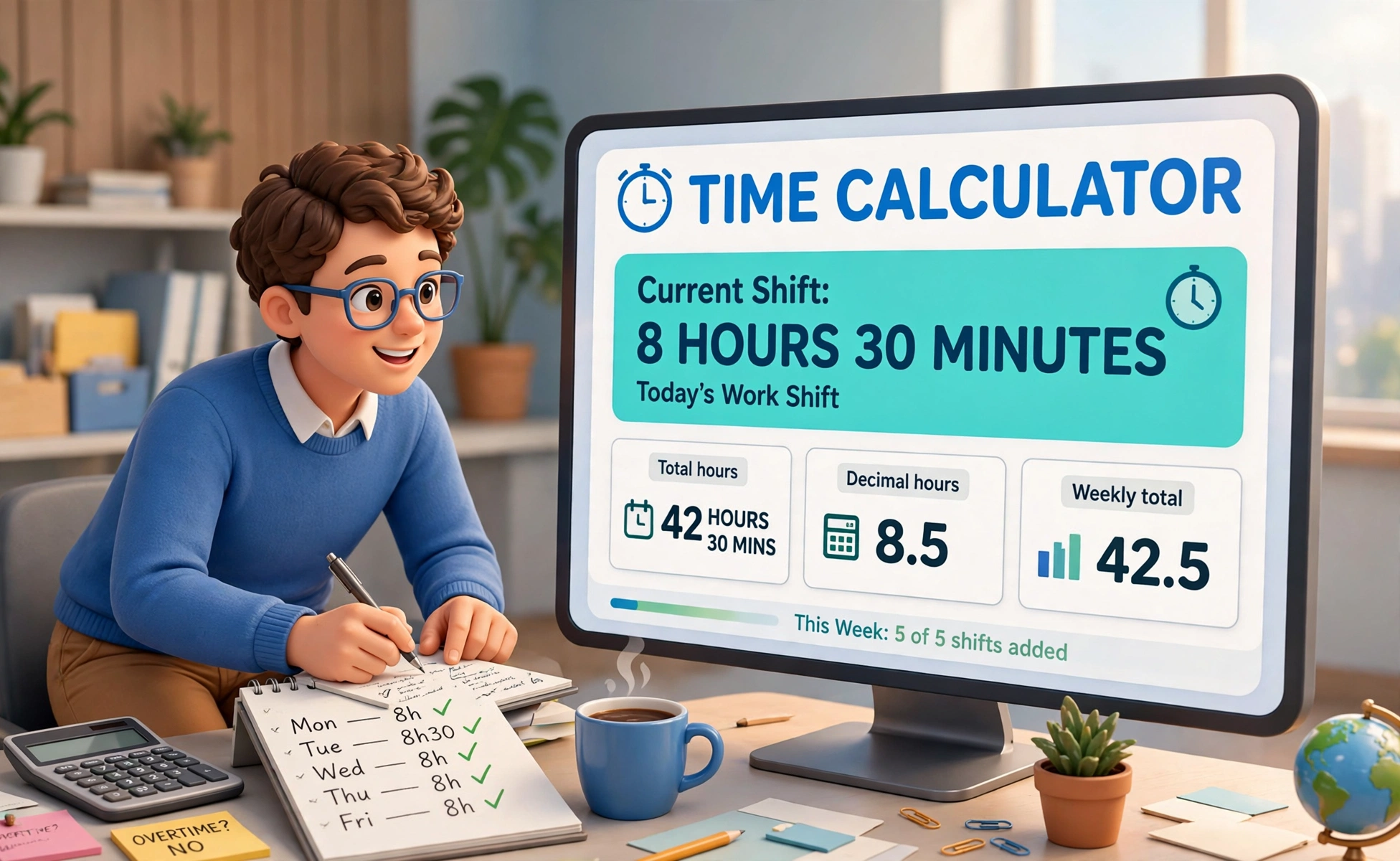
Adding durations is the core of timesheets, study logs, workout totals, and project tracking. A freelancer adding four sessions of 1 hour 30 minutes gets 6 hours, which at an hourly rate gives the billable total. A student adding daily study blocks across a week gets the weekly total in one step.
For shift work with clock-in and clock-out times and a break, a time card calculator handles the breaks and the pay. Use this calculator for plain duration arithmetic, where the inputs are lengths of time rather than times of day.
Frequently asked questions
How do I add hours and minutes?
Add the hours and the minutes separately, then carry every 60 minutes into an hour. 2 hours 45 minutes plus 1 hour 30 minutes is 3 hours 75 minutes, which carries to 4 hours 15 minutes.
What is 2 hours 45 minutes as a decimal?
2.75 hours. Divide the minutes by 60: 45 divided by 60 is 0.75, so the total is 2.75 hours.
How many seconds are in a day?
86400 seconds: 24 hours times 60 minutes times 60 seconds.
What if the subtraction gives a negative result?
It means the second duration is longer than the first. 1 hour minus 1 hour 30 minutes is negative 30 minutes, and this calculator shows the minus sign.
Can I enter more than 59 minutes?
Yes. Values above 59 are carried automatically, so 90 minutes counts as 1 hour 30 minutes.
How many minutes are in a week?
10080 minutes: 7 days times 1440 minutes per day.
What is the difference between a duration and a time of day?
A duration is a length of time, such as 3 hours. A time of day is a clock reading, such as 3 PM. This calculator adds and subtracts durations.