Roman Numeral Converter: Numbers to Roman Numerals
Enter a number between 1 and 3999 to get its Roman numeral, or enter a Roman numeral to get its number, with each symbol and subtraction step explained.

Formulas verified against standard references. Calculator logic tested with verified worked examples. Last reviewed: October 2026. Our methodology
The Seven Roman Symbols
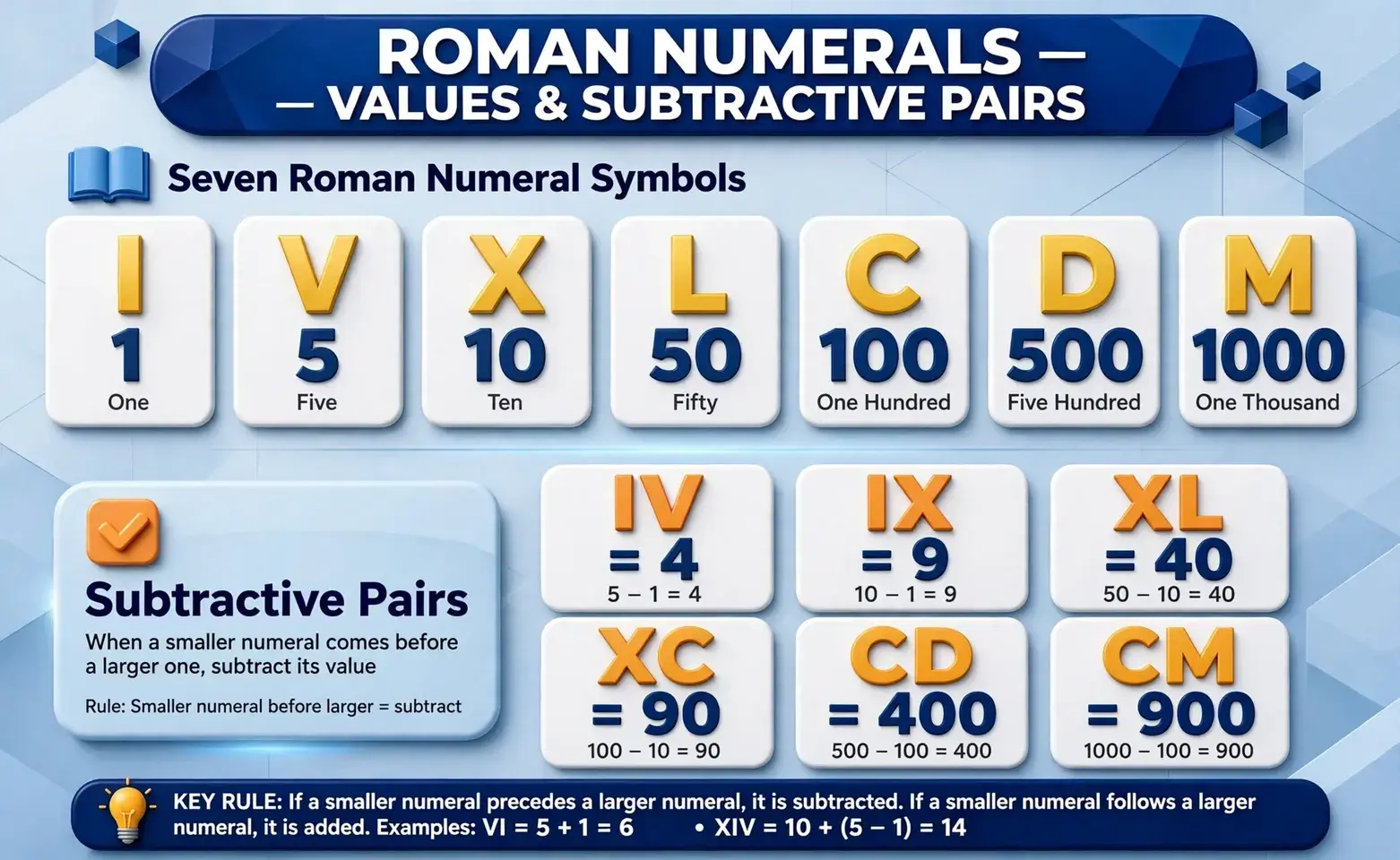
Roman numerals use seven letters: I is 1, V is 5, X is 10, L is 50, C is 100, D is 500, and M is 1000. Larger values sit to the left of smaller ones and add up, so XVI is 10 plus 5 plus 1, which is 16. The system has no zero and no place value, which is why Roman arithmetic is awkward and the system survives mainly for dates, clocks, and outlines.
The symbols repeat at most three times in a row for the same value. Three Is make 3, but four Is are never used, because 4 is written as IV, one before five. The same rule gives IX for 9, XL for 40, XC for 90, CD for 400, and CM for 900.
Addition and Subtraction Rules
Read a Roman numeral left to right. When a symbol is followed by a symbol of equal or smaller value, add it. When a smaller symbol sits before a larger one, subtract it instead: IV is 5 minus 1, which is 4, and XC is 100 minus 10, which is 90. Only one smaller symbol may be subtracted, and only I, X, and C may be subtracted, and only from the next two larger values.
That restriction is why IL is not 49. The correct form is XLIX: 40 plus 9, written as XL plus IX. Similarly, 99 is XCIX, not IC. Checking a numeral by converting it back to a number and then forward again catches most invalid forms, which is exactly what this converter does.
| Symbol | Value | Subtractive pair |
|---|---|---|
| I | 1 | IV = 4, IX = 9 |
| X | 10 | XL = 40, XC = 90 |
| C | 100 | CD = 400, CM = 900 |
| V, L, D | 5, 50, 500 | Never subtracted |
Worked Examples
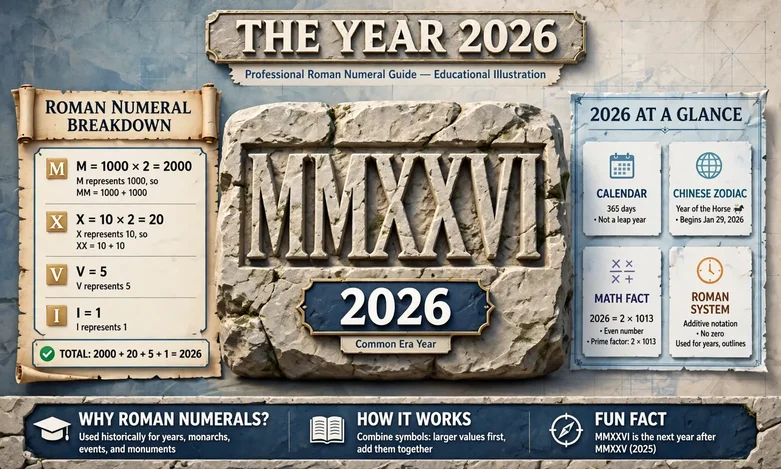
Example 1: 2026 converts as 2000 plus 20 plus 6, which is MM plus XX plus VI, giving MMXXVI. Example 2: 1999 converts as 1000 plus 900 plus 90 plus 9, which is M plus CM plus XC plus IX, giving MCMXCIX. Example 3: 44 converts as 40 plus 4, which is XL plus IV, giving XLIV.
Example 4, reverse: XIV is X plus IV, which is 10 plus 4, giving 14. Example 5, reverse: MCMXCIX is M plus CM plus XC plus IX, which is 1000 plus 900 plus 90 plus 9, giving 1999. Working in place-value chunks, thousands, hundreds, tens, ones, keeps every conversion short.
| Number | Chunks | Roman numeral |
|---|---|---|
| 2026 | 2000 + 20 + 6 | MMXXVI |
| 1999 | 1000 + 900 + 90 + 9 | MCMXCIX |
| 44 | 40 + 4 | XLIV |
| 14 | 10 + 4 | XIV |
Why the Range Stops at 3999
The standard system has no symbol above M, 1000, so 3999, MMMCMXCIX, is the largest number written without extra notation. Larger numbers historically used a bar over a symbol to multiply it by 1000, but that notation has no standard keyboard form and is rarely used today, so this converter caps the range at 3999.
Zero also has no Roman symbol, because the system predates zero as a number in European mathematics. Dates before year 1, and any calculation needing zero or fractions, need the ordinary decimal system instead. For everyday use, clock faces, book chapters, and film copyright years all sit comfortably inside 1 to 3999.
Common Mistakes
The most common mistake is writing four of the same symbol, such as IIII for 4 or XXXX for 40. The correct forms are IV and XL. A second mistake is subtracting from too far away, such as IL for 49 or IC for 99; the correct forms are XLIX and XCIX.
A third mistake is subtracting V, L, or D, which never happens: VL is not 45, the correct form is XLV. A fourth mistake is reading left to right without checking the next symbol, which turns IX into 11 instead of 9. Always check whether the next symbol is larger before adding.
Where Roman Numerals Still Appear
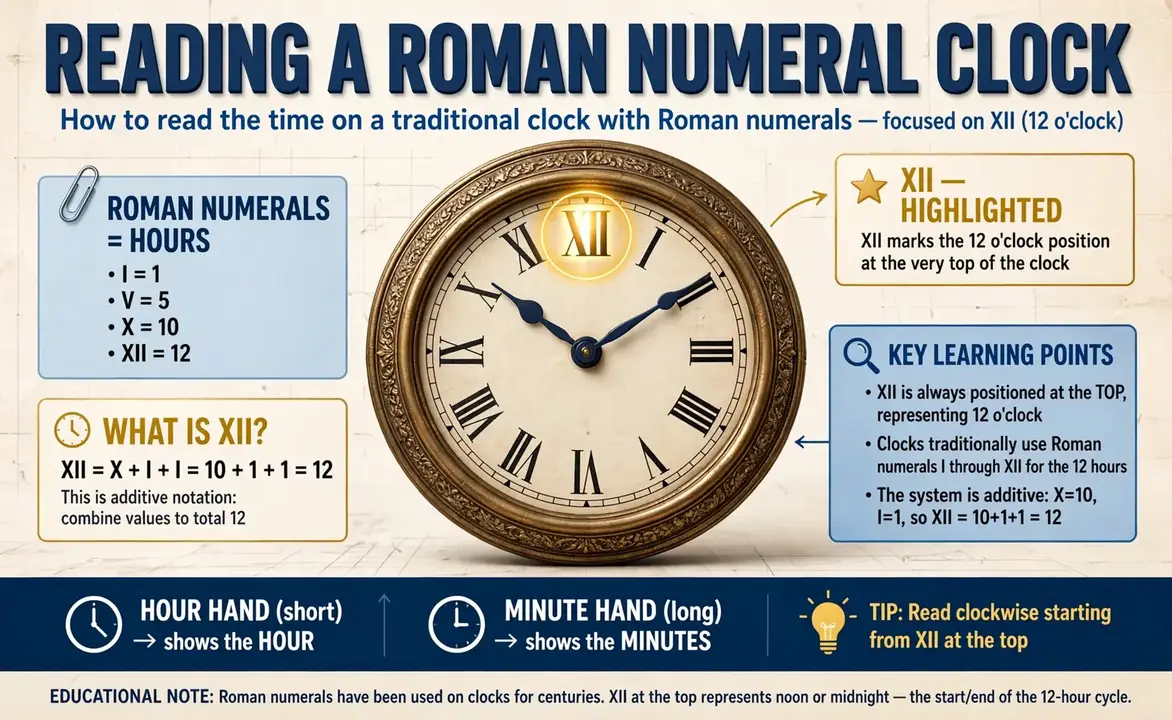
Roman numerals still mark clock faces, with IIII sometimes used for 4 by tradition, book prefaces and chapters, film and television copyright years, monarch and pope numbering, and sporting events such as the Super Bowl. They signal formality and tradition, which is why they survive long after decimal numbers replaced them for calculation.
For a date on a building or a tattoo, convert the year first and double-check the subtractive pairs, since a single wrong pair changes the year by a large amount. A year written as MCMXCIX is 1999, but a slip to MCMXCIV would read as 1994.
Frequently asked questions
What is 2026 in Roman numerals?
MMXXVI. Break it into 2000 plus 20 plus 6: MM plus XX plus VI.
What number is XIV?
14. X is 10 and IV is 4, so XIV is 10 plus 4, which is 14.
Why is 4 written as IV and not IIII?
Roman numerals use subtraction for 4, 9, 40, 90, 400, and 900, and never repeat a symbol four times. IV is 5 minus 1, which is 4.
What is the largest standard Roman numeral?
3999, written MMMCMXCIX. There is no standard symbol above M (1000), so larger numbers need extra notation.
Is there a Roman numeral for zero?
No. The Roman system has no zero symbol, because it predates zero as a number in European mathematics.
How do you read a Roman numeral?
Read left to right. Add a symbol when the next symbol is equal or smaller, and subtract it when the next symbol is larger, as in IX = 9.
Why is 99 written as XCIX?
99 is 90 plus 9, which is XC plus IX. Writing IC is not allowed, because I may only be subtracted from V and X.