Random Number Generator: Fair Picks, Any Range
Set a minimum and maximum, choose how many numbers you need, and generate them instantly, with optional duplicate blocking and sorting.

Formulas verified against standard references. Calculator logic tested with verified worked examples. Last reviewed: October 2026. Our methodology
What It Does
This generator picks random whole numbers between any minimum and maximum you set. Ask for 6 numbers between 1 and 49 for a lottery-style draw, one number between 1 and 6 for a die roll, or 100 numbers between 0 and 1 for a simulation. Every number in the range has an equal chance on every draw.
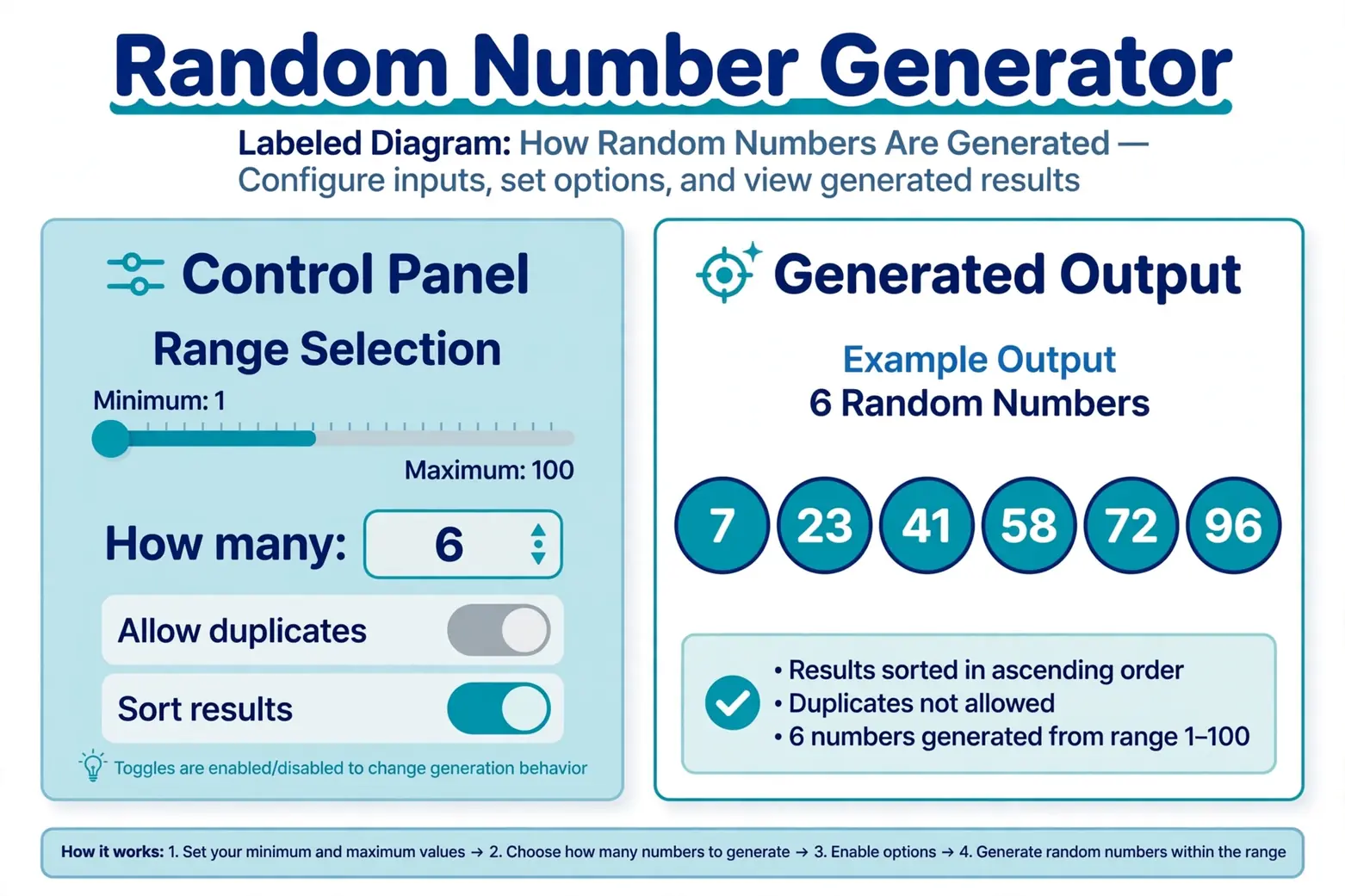
Two options shape the draw. Blocking duplicates turns it into a draw without replacement, like pulling names from a hat. Sorting arranges the results ascending, which is convenient for lottery tickets but does not change the odds.
With and Without Duplicates
Allowing duplicates means each draw is independent: rolling a die six times can absolutely show the same face twice. Blocking duplicates means each number can appear at most once, so the count you ask for cannot exceed the size of the range.
Use duplicates for dice, coin flips, and repeated trials. Block them for raffles, team drafts, and lottery picks, where each entry should win at most once. The calculator enforces the range limit for you and explains the error if you ask for the impossible.
| Mode | Example | Use for |
|---|---|---|
| Allow duplicates | 6 numbers, 1 to 6 | Dice rolls, repeated trials |
| No duplicates | 6 numbers, 1 to 49 | Lottery picks, raffles |
| No duplicates | 1 number, 1 to 100 | Single fair pick |
Worked Examples
Example 1: 6 numbers from 1 to 49 with no duplicates gives a lottery-style line like 7, 23, 41, 58, 72, 96 after sorting. Example 2: 2 numbers from 1 to 6 with duplicates simulates two dice, and doubles are possible.
Example 3: 10 numbers from 1 to 10 with no duplicates always returns all ten numbers, just shuffled. Example 4: 1 number from 1 to 100 picks a single winner fairly from 100 entries.
| Request | Typical result shape | Note |
|---|---|---|
| 6 from 1-49, no dupes | 6 distinct numbers | Lottery line |
| 2 from 1-6, dupes | e.g. 4, 4 | Doubles possible |
| 10 from 1-10, no dupes | All 10, shuffled | Full shuffle |
How the Numbers Are Generated
The generator uses your browser's cryptographic random number generator, the same source used for security keys, rather than a simple pseudorandom formula. A rejection method maps the raw random bits onto your range without bias, so no number is favored, including at the edges of the range.
That said, randomness has no memory and no sense of fairness across short runs. Ten coin flips can easily land 8 heads. Streaks and clusters are normal in truly random data, and seeing them does not mean the generator is broken.
Common Uses
Teachers use it to call on students fairly, pick groups, and generate quiz numbers. Game hosts use it for raffles, giveaways, and draft orders. Developers and students use it to sample data, simulate trials, and test how algorithms behave on random inputs.
For questions about the odds behind a draw, the probability calculator works out dice, coin, and card probabilities, and the permutation and combination calculator counts how many distinct draws are possible.
Fairness Notes and Limits
Each draw is independent and uniform across the range you set, but the tool is meant for everyday fairness, not for cryptography, gambling systems, or regulated draws, which need audited hardware randomness and oversight. Do not use it to run a real-money lottery.
Draws are capped at 1,000 numbers per click to keep the page responsive. If you need more, run the generator again: consecutive runs are independent, so combining them is statistically sound.
Frequently asked questions
Is this random number generator truly random?
It uses your browser's cryptographic random source with bias-free range mapping, which is random enough for draws, games, teaching, and simulations. It is not certified for regulated gambling or cryptography.
Can I generate numbers without duplicates?
Yes. Choose the no-duplicates option, which draws without replacement like pulling names from a hat. You cannot ask for more numbers than the range holds.
Why did I get the same number twice?
With duplicates allowed, each draw is independent, so repeats are normal and expected. A die rolled twice can absolutely show the same face.
What is the largest range I can use?
Any whole-number minimum and maximum your browser can represent, including negative ranges like -50 to 50. Each draw is capped at 1,000 numbers.
Does sorting change the odds?
No. Sorting only rearranges the display order. The set of numbers drawn, and the probability of drawing it, is identical either way.
Can I pick a random winner from a list?
Number your entries from 1 to N, then generate one number in that range with no duplicates needed. The matching entry is your winner.
Do I need to install anything?
No. The generator runs entirely in your browser with no sign-up, no download, and nothing sent to a server.