Net Worth Calculator: Find Your Total Wealth in Seconds
Add up everything you own, subtract everything you owe, and see your net worth as one clear number. Enter your amounts below, press Calculate, and the net worth calculator does the math.
How to use the net worth calculator
A net worth calculator turns a long list of accounts and debts into one number. The more complete your list, the more useful the result. Here is the fastest way to get an accurate figure.
Step by step
- List your assets. Enter cash and savings, investments, home value and other assets.
- List your liabilities. Enter your mortgage balance, vehicle and other loans, and credit card debt.
- Press Calculate. The calculator adds each side and subtracts.
- Read your results: total assets, total liabilities, net worth, and your asset-to-liability ratio.
What you get
- Total assets — everything you own, added up
- Total liabilities — everything you owe, added up
- Net worth — assets minus liabilities (shown in red when negative)
- Asset-to-liability ratio — how many times over your assets cover your debts
The net worth formula
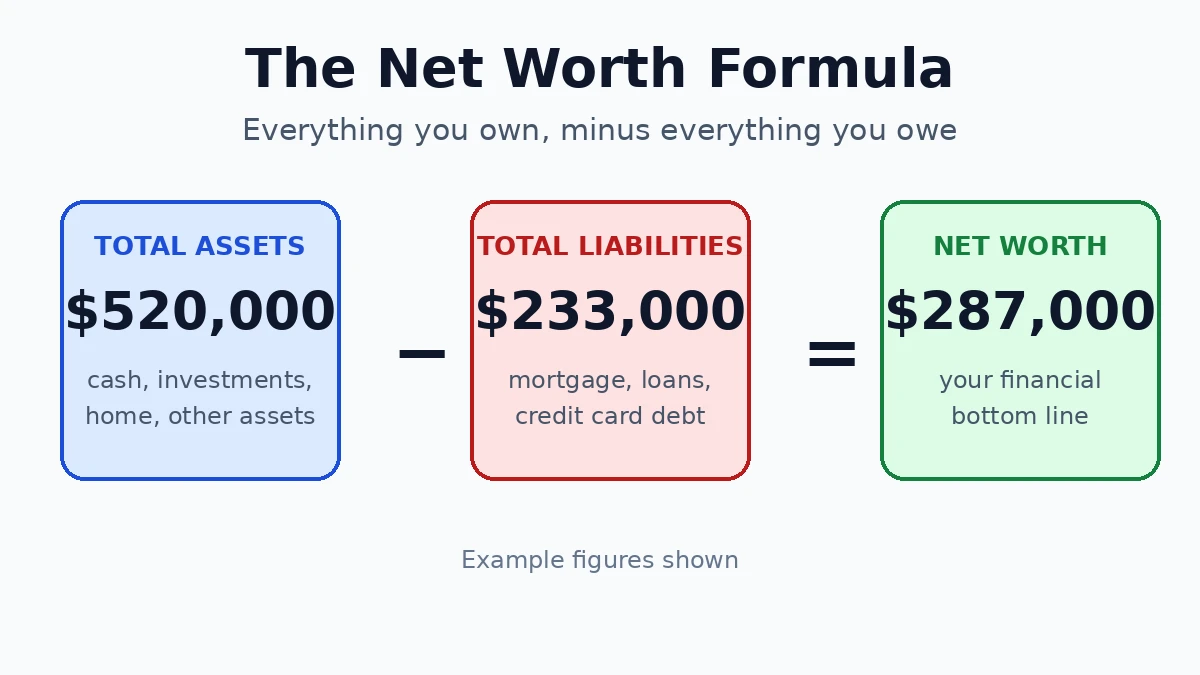
Net worth = total assets − total liabilities. That is the whole formula. The U.S. Securities and Exchange Commission’s investor education site describes the same two-column method — list what you own on one side, what you owe on the other, then subtract — in its guide to figuring out your finances.
Worked example
Take these entries and run them through the calculator above:
- Cash and savings $50,000 + investments $150,000 + home value $300,000 + other assets $20,000 = $520,000 in total assets
- Mortgage $200,000 + vehicle and other loans $25,000 + credit card debt $8,000 = $233,000 in total liabilities
- Net worth = 520,000 − 233,000 = $287,000
- Asset-to-liability ratio = 520,000 ÷ 233,000 × 100 = 223.2%
A positive result means you own more than you owe. A negative result means your debts exceed your assets — which is common early in a mortgage — and it is a starting point, not a verdict.
What counts as an asset or a liability
An asset is anything you own that has a measurable value and could be converted to cash. A liability is anything you owe. The trickiest part is valuation: use today’s realistic value, not what you paid.
Common assets and how to value them
| Asset | Examples | Use this value |
|---|---|---|
| Cash and savings | Checking, savings, cash on hand | Current balances |
| Investments | Stocks, bonds, mutual funds | Current market value |
| Retirement accounts | 401(k), IRA, pension pots | Current balance; pre-tax accounts will be taxed when withdrawn |
| Home and property | House, land | Realistic current sale price |
| Vehicles and valuables | Car, jewelry, collectibles | What you could sell it for today, not the purchase price |
Investment accounts deserve a careful look, since they can grow over time through compounding and an up-to-date balance matters. If you want to see how contributions and returns compound, try our investment calculator.
Common liabilities and how to value them
| Liability | Examples | Use this value |
|---|---|---|
| Mortgage | Home loan | Remaining balance, not the original loan amount |
| Vehicle and personal loans | Car loan, student loan | Outstanding balance |
| Credit card debt | Card balances | Current statement balance, including unpaid interest |
Always use the remaining balance, never the original loan amount. A $300,000 mortgage you have paid down to $200,000 is a $200,000 liability.
Net worth examples by life stage
These simplified illustrations show how the mix of assets and liabilities usually shifts over time. They are examples to learn from, not benchmarks to hit.
| Life stage | Typical assets | Typical liabilities | What moves the number |
|---|---|---|---|
| Early career | Savings, car | Student loans, credit cards | Building savings and paying down debt |
| Mid career | Home equity, investments, retirement accounts | Mortgage, car loan | Home value growth and steady investing |
| Approaching retirement | Paid-off home, larger investments | Little or no debt | Compound growth and debt elimination |
Notice the pattern: net worth grows when assets rise, when debts fall, or both at once. Early on, debt paydown usually does most of the work; later, asset growth takes over.
What your asset-to-liability ratio tells you
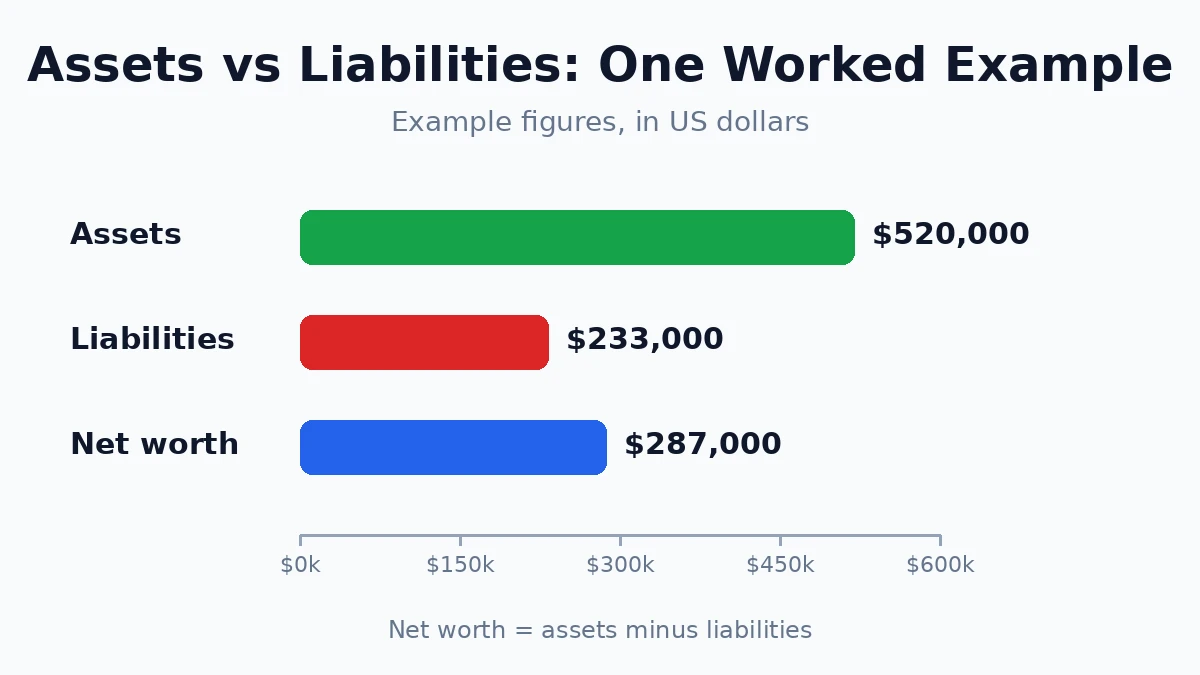
The asset-to-liability ratio divides total assets by total liabilities. A ratio of 2.23 — shown as 223.2% — means you own 2.23 times what you owe. A ratio below 1.0 means liabilities exceed assets, so your net worth is negative.
Track this ratio alongside net worth itself. If both are rising, your position is strengthening from both directions: more owned, less owed. If net worth is rising but the ratio is flat, the gains are coming mostly from asset values, which can reverse.
Five ways to grow your net worth
- Pay down high-interest debt first. Every dollar of debt removed adds a dollar to net worth, and it stops the interest working against you.
- Save automatically. A fixed transfer on payday turns saving from a decision into a habit.
- Invest for the long term. Time in the market lets compounding do the heavy lifting. Our retirement calculator shows how decades of contributions add up.
- Avoid new debt for depreciating purchases. Borrowing to buy things that lose value shrinks net worth twice: the debt rises while the asset falls.
- Re-check your valuations yearly. Home values and investment balances change, so update your figures and watch the trend.
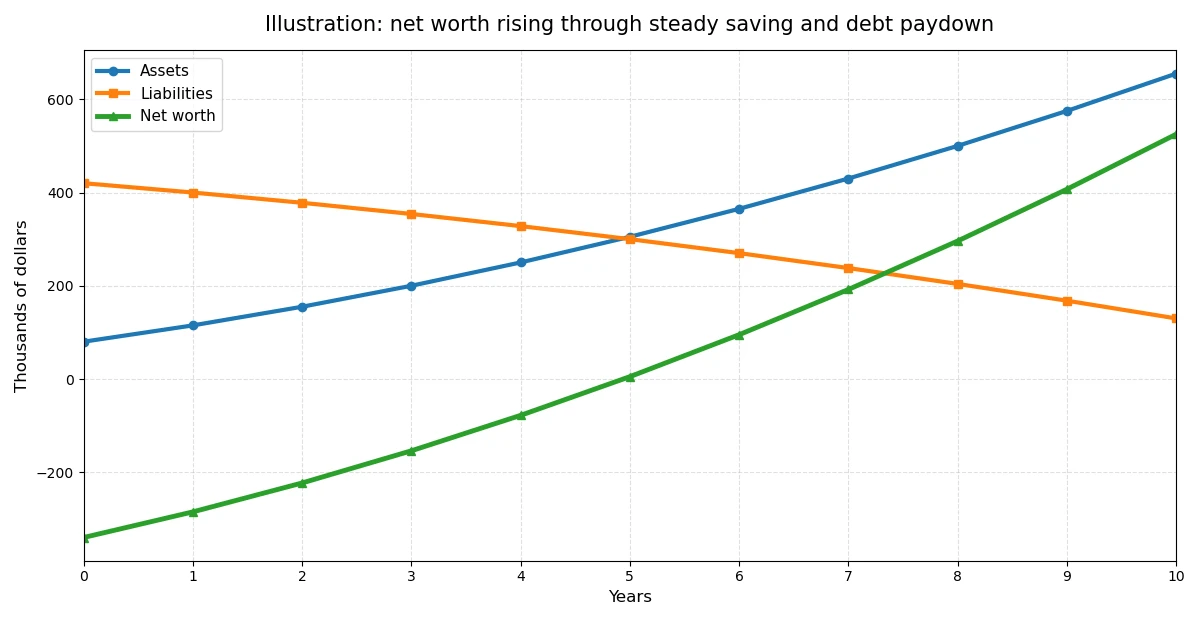
Small, repeated actions beat one dramatic change. A steady savings habit plus shrinking debt is the most reliable route to a higher number.
Limits of this calculator
This calculator is an estimate built from the numbers you enter. It does not adjust for taxes you may owe on pre-tax accounts, selling costs on property, or future market changes. Nothing on this page is financial advice; for decisions that carry real money, speak to a qualified professional.
Frequently asked questions
What is a good net worth?
There is no single number. A good net worth is one that covers your debts, supports your goals, and keeps moving in the right direction. Comparing against your own past results is more useful than comparing against anyone else.
Does net worth include the value of my home?
Yes, at its current realistic market value, and the matching mortgage goes on the liabilities side. Some people also track a second figure that excludes the home, since you cannot spend home equity without selling or borrowing.
Is net worth the same as income?
No. Income is a flow of money over time; net worth is a snapshot of what you own minus what you owe at one moment. A high income with high spending can leave net worth flat.
Should I include my retirement accounts?
Yes, at their current balances. Just remember that pre-tax accounts will be reduced by taxes when you withdraw, so treat the balance as a before-tax figure.
Can net worth be negative?
Yes. If your debts exceed your assets, the result is negative, which is common early in a mortgage or with large student loans. It is a starting point: paying down debt raises net worth dollar for dollar.
How often should I calculate my net worth?
Once a quarter or once a year is enough for most people. Use the same categories each time so the trend is meaningful; frequent recalculation mostly adds noise.
What if my net worth is not growing?
Look at the two sides separately. High-interest debt and low savings are the usual causes. Raising your savings rate, even modestly, and paying down expensive debt are the fastest levers.