Lean Body Mass Calculator: How Much of You Is Muscle?
Your weight on the scale mixes muscle, bone, water and fat together. Enter your height, weight and gender, and this free lean body mass calculator will estimate your fat-free mass — and your body fat percentage — using the validated Boer formula.
Formulas verified against standard references. Calculator logic tested with verified worked examples. Last reviewed: October 2026. Our methodology
The Boer formula for lean body mass
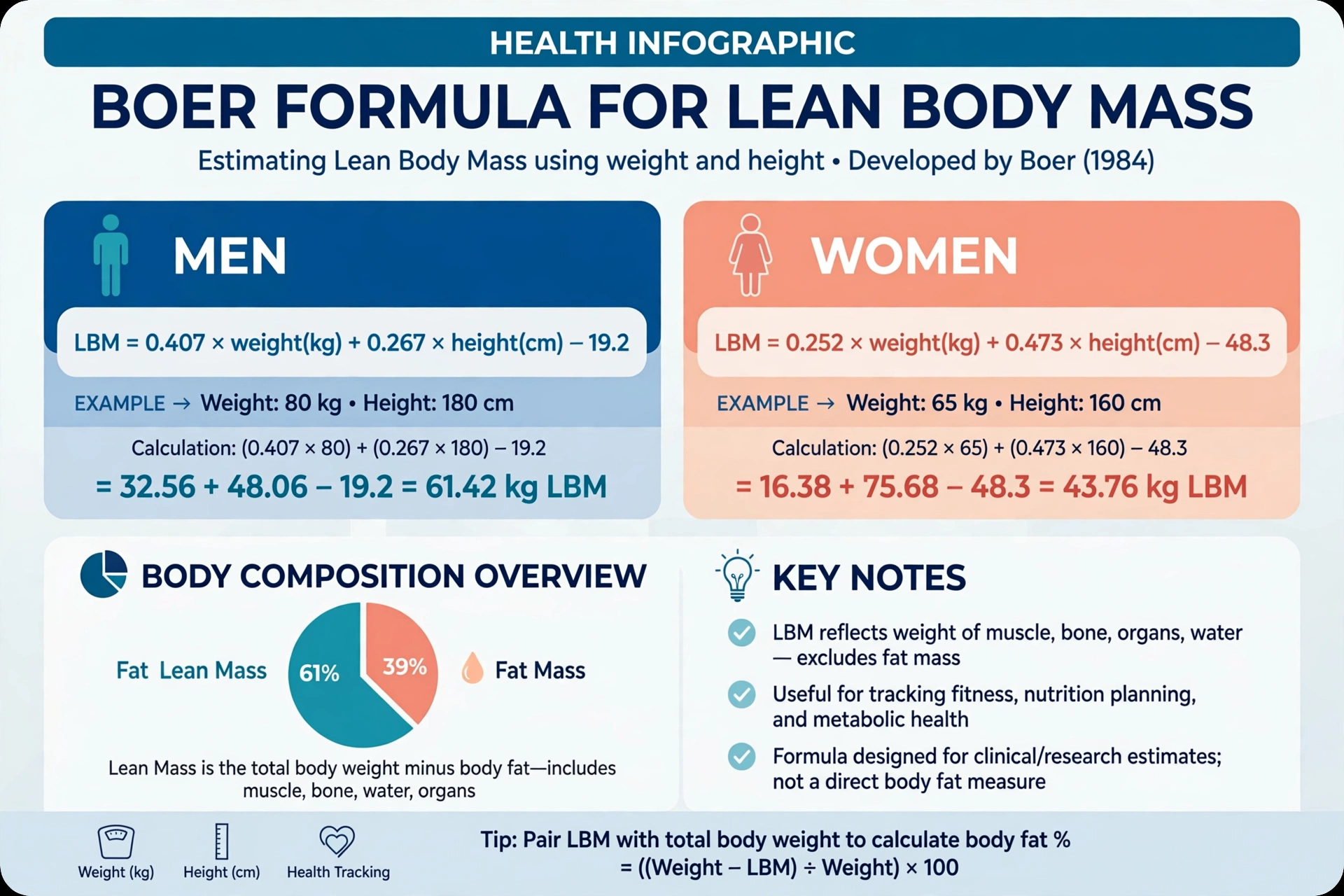
Published by Boer in 1984 and validated against body-composition scans, the formula estimates fat-free mass from just height and weight:
- Men: LBM = 0.407 × weight(kg) + 0.267 × height(cm) − 19.2
- Women: LBM = 0.252 × weight(kg) + 0.473 × height(cm) − 48.3
- Body fat % = (weight − LBM) ÷ weight × 100
| Profile | Lean body mass | Body fat % |
|---|---|---|
| Man, 180 cm, 80 kg | 61.4 kg | 23.2% |
| Woman, 165 cm, 60 kg | 45.0 kg | 25.0% |
| Man, 180 cm, 95 kg | 67.5 kg | 28.9% |
Check the arithmetic for the first row: 0.407 × 80 + 0.267 × 180 − 19.2 = 32.56 + 48.06 − 19.2 = 61.42 kg; body fat = (80 − 61.42) ÷ 80 = 23.2%.
Worked example
A man is 180 cm tall and weighs 80 kg. LBM = 0.407 × 80 + 0.267 × 180 − 19.2.
Multiply: 0.407 × 80 = 32.56; 0.267 × 180 = 48.06. Add: 80.62. Subtract 19.2: 61.42 kg of lean mass. Fat mass: 80 − 61.42 = 18.58 kg. Body fat: 18.58 ÷ 80 × 100 = 23.2% — in the "acceptable" range for men, with room to lean out.
How to use the lean body mass calculator
Weigh yourself in the morning before eating, measure height without shoes, and the formula does the rest.
Step by step
- Select gender. The formula uses different coefficients for men and women.
- Enter height in centimeters. Divide inches by 0.3937 if you only know imperial.
- Enter weight in kilograms. Divide pounds by 2.205 for the conversion.
- Press Calculate. Read your lean mass, fat mass and body fat percentage.
What your body fat percentage means
Ranges differ by gender because women carry more essential fat:
| Category | Men | Women |
|---|---|---|
| Essential fat | 2–5% | 10–13% |
| Athletic | 6–13% | 14–20% |
| Fit | 14–17% | 21–24% |
| Average | 18–24% | 25–31% |
| Above average | 25%+ | 32%+ |
These are population guides, not diagnoses. Athletes in weight-class sports and physique competitors go lower; most healthy adults sit in the fit-to-average bands. Track the trend over months rather than obsessing over a single reading.
Lean body mass vs. BMI: why the scale lies
BMI divides weight by height squared — and calls a muscular 95 kg athlete "overweight". Lean body mass separates what the scale cannot:
- Two people, both 80 kg: one at 15% body fat carries 68 kg of lean mass; one at 30% carries 56 kg. Same weight, very different bodies — BMI scores them identically.
- During a diet, the scale dropping 5 kg could be 4 kg of fat (great) or 3 kg of muscle (bad). LBM estimates reveal which.
- Protein targets are set per kg of lean mass or goal weight, not total weight — lifters use LBM to dose protein accurately.
Use BMI for population screening and lean body mass for personal decisions. A BMI calculator gives the quick screening number; this page gives the composition behind it.
How to raise lean mass (and what the formula cannot see)
The Boer formula is a population estimate — it cannot see your training history. Two levers actually move lean mass:
- Progressive resistance training 2–4 times per week is the only reliable way to add muscle. The formula will underestimate very muscular people.
- Protein around 1.6–2.2 g per kg of body weight daily supports muscle retention in a deficit and growth in a surplus.
- Sleep and patience: noticeable lean-mass gains take months; re-measure quarterly, not weekly.
Limitations to respect: the formula was validated on typical adults — it is less accurate for the very muscular, the very lean, children, and older adults with significant muscle loss. For a gold-standard reading, a DEXA scan measures composition directly.

Frequently asked questions
How is lean body mass calculated?
With the Boer formula: men: 0.407 × weight(kg) + 0.267 × height(cm) − 19.2; women: 0.252 × weight(kg) + 0.473 × height(cm) − 48.3. Body fat % = (weight − LBM) ÷ weight × 100.
What is a good lean body mass?
It scales with height — taller people carry more. More useful is body fat %: athletic men 6–13% and women 14–20%; fit men 14–17% and women 21–24%. Track your own trend over time.
Is the Boer formula accurate?
It is a validated population estimate, good for tracking trends. It underestimates very muscular people and is less accurate for children, the elderly, and the extremely lean. DEXA scans are the gold standard.
Lean body mass vs. fat-free mass: any difference?
Essentially the same concept — everything in the body except fat: muscle, bone, water, organs. 'Lean body mass' sometimes includes a small essential-fat allowance; calculators treat them as identical.
How do I increase my lean body mass?
Progressive resistance training 2–4x weekly plus ~1.6–2.2 g protein per kg of body weight daily. Gains are slow — measure quarterly and expect months, not weeks, for visible change.
Why does BMI call muscular people overweight?
BMI only sees weight vs. height. A muscular 95 kg athlete and a sedentary 95 kg adult get the same BMI. Lean body mass separates muscle from fat, which is why athletes track composition instead.
Do I need my body fat percentage to lose weight?
Not strictly, but it keeps you honest: if the scale drops but LBM estimates fall too, you are losing muscle and should raise protein or ease the deficit.