Frequency Converter: Convert Hz, kHz, MHz, GHz Instantly
Enter a frequency, pick its unit and the unit you want, and get the converted value plus the period and angular frequency in one view.
Formulas verified against standard references. Calculator logic tested with verified worked examples. Last reviewed: October 2026. Our methodology
What Frequency Means
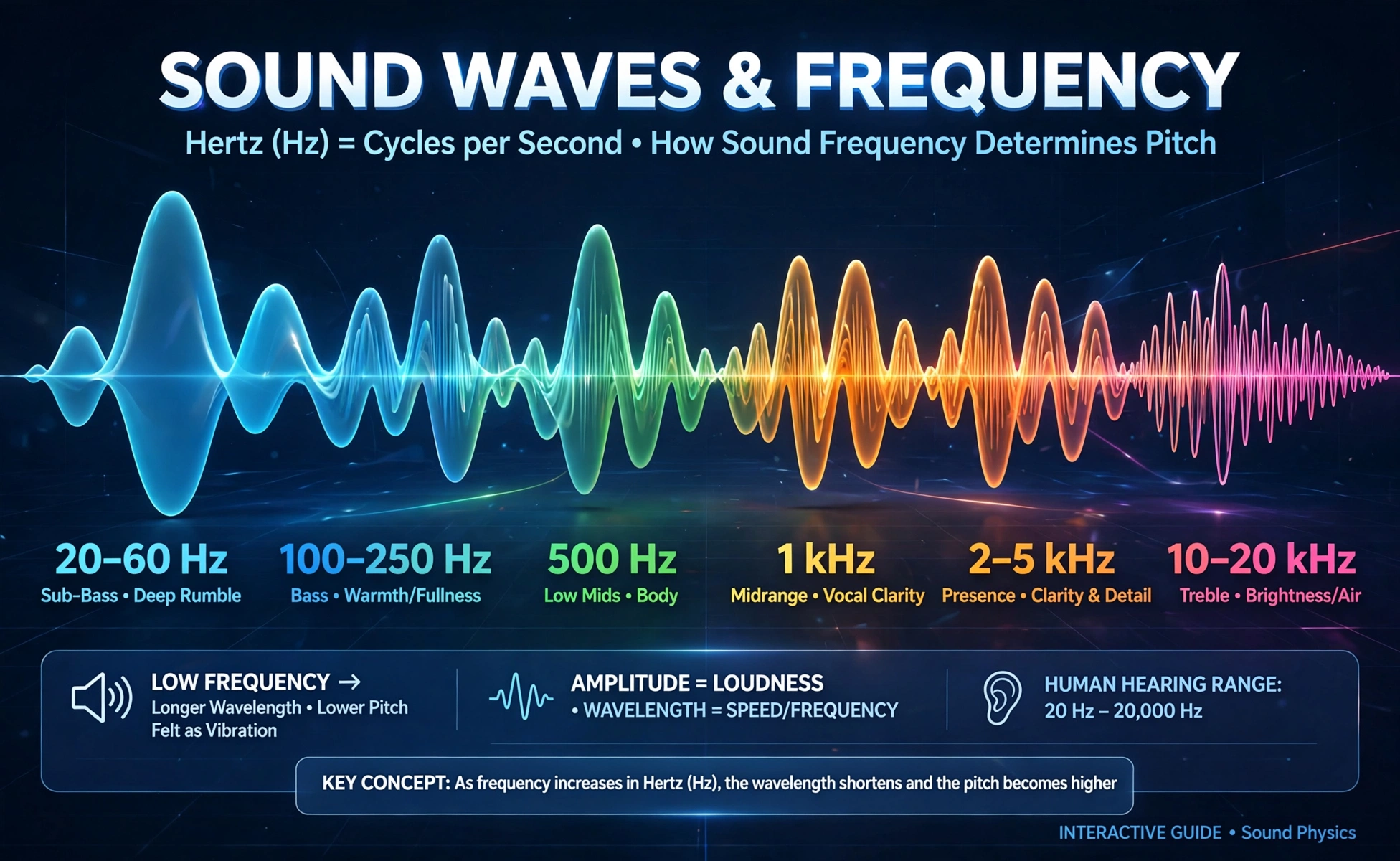
Frequency counts how many cycles of a repeating event happen each second, and the unit is the hertz: 1 hertz is 1 cycle per second. A 50 hertz mains supply alternates 50 times a second, a 440 hertz tuning fork vibrates 440 times a second, and an FM radio station at 100 megahertz oscillates 100 million times a second.
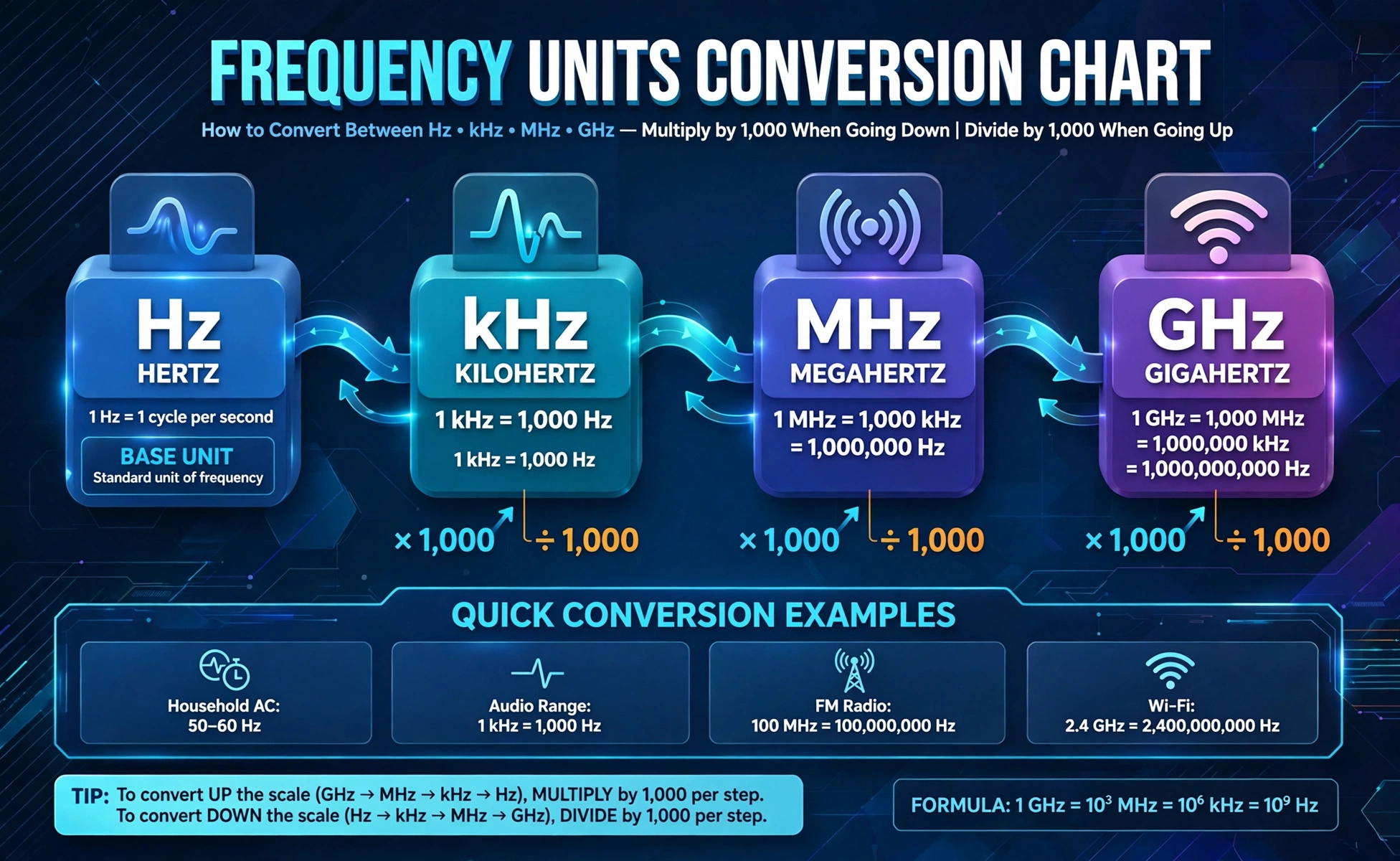
The prefixes scale by thousands: 1 kilohertz is 1,000 hertz, 1 megahertz is 1,000,000, 1 gigahertz is 1,000,000,000, and 1 terahertz is 1,000,000,000,000. Converting is just moving the decimal point by groups of three, which is why the factors look large but the arithmetic stays simple.
For time units rather than cycles, a time converter handles seconds, minutes, and hours, while this converter stays with cycles per second.
Frequency and Period
Period is the time one cycle takes, and it is the reciprocal of frequency: period equals 1 divided by frequency. A 100 hertz wave has a period of 0.01 seconds, or 10 milliseconds, while a 2.4 gigahertz Wi-Fi signal has a period of about 0.42 nanoseconds.
Angular frequency, written omega, is 2 times pi times frequency, in radians per second. It appears in wave and rotation math, where angles are measured in radians rather than cycles: 100 hertz is about 628 radians per second.
| Frequency | Period | Angular frequency |
|---|---|---|
| 50 Hz | 0.02 s (20 ms) | 314 rad/s |
| 100 Hz | 0.01 s (10 ms) | 628 rad/s |
| 1 kHz | 0.001 s (1 ms) | 6,283 rad/s |
| 2.4 GHz | 0.42 ns | 15.08 billion rad/s |
Worked Examples
Example 1: 100 megahertz to kilohertz. 100 megahertz is 100,000,000 hertz, divided by 1,000 gives 100,000 kilohertz. Example 2: 2.4 gigahertz to megahertz: 2,400 megahertz. Example 3: 440 hertz to kilohertz: 0.44 kilohertz, with a period of about 0.00227 seconds.
Example 4: 60 hertz mains to period: 1 divided by 60 is 0.01667 seconds, or 16.67 milliseconds per cycle. That is why mains hum and flicker sit near 50 or 60 hertz depending on the country.
| Input | In hertz | Converted | Period |
|---|---|---|---|
| 100 MHz | 100,000,000 | 100,000 kHz | 10 ns |
| 2.4 GHz | 2,400,000,000 | 2,400 MHz | 0.42 ns |
| 440 Hz | 440 | 0.44 kHz | 2.27 ms |
| 60 Hz | 60 | 0.06 kHz | 16.67 ms |
Frequencies You Meet Every Day
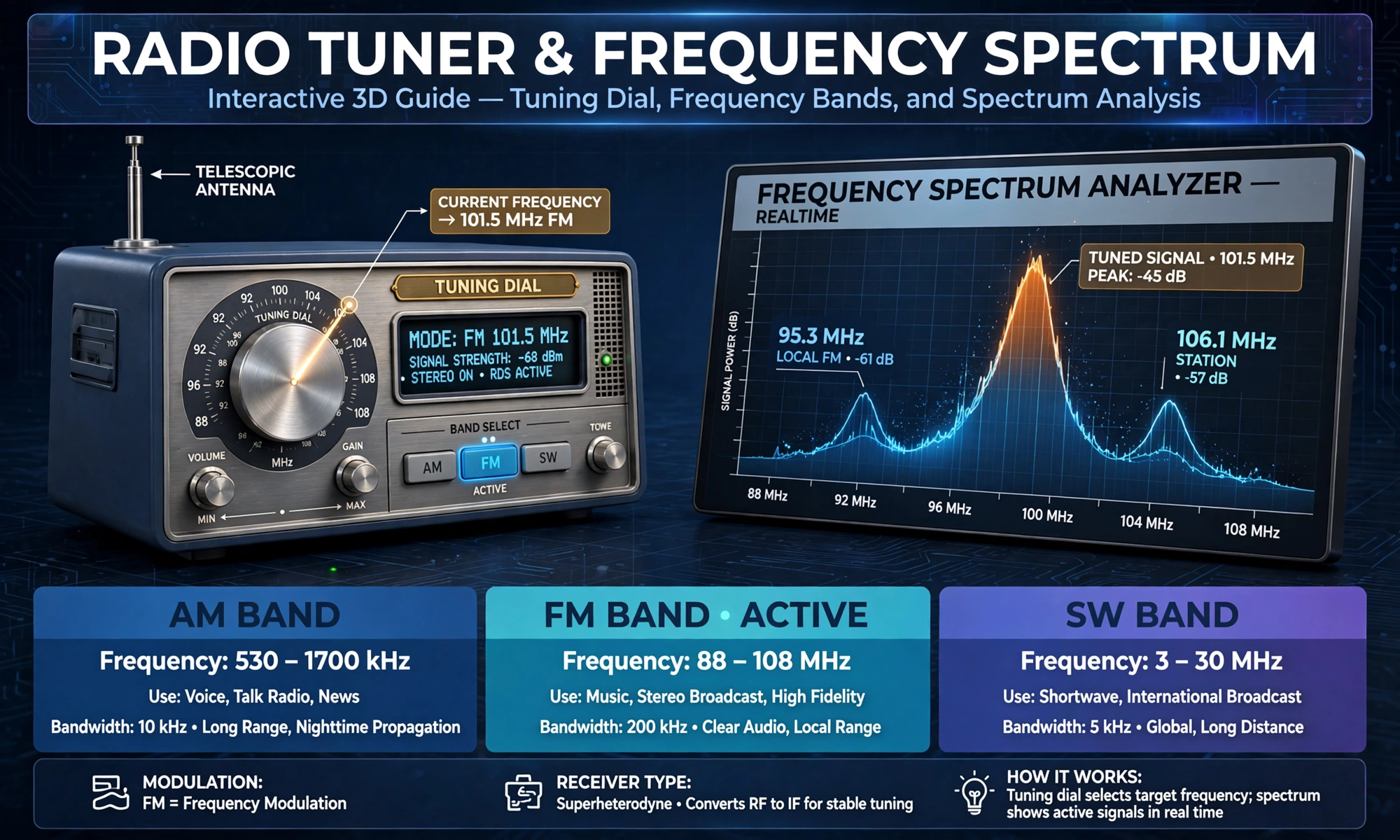
Mains electricity runs at 50 hertz in most of the world and 60 hertz in North America. Human hearing spans roughly 20 hertz to 20 kilohertz. FM radio sits between 88 and 108 megahertz, Wi-Fi uses 2.4 and 5 gigahertz bands, and computer processors run at several gigahertz, meaning billions of cycles per second.
Light is also a frequency, but far higher: visible light spans about 430 to 770 terahertz, which is why terahertz appears in optics even though it rarely appears in audio or radio work.
| Source | Typical frequency |
|---|---|
| Mains electricity | 50 or 60 Hz |
| Human hearing | 20 Hz to 20 kHz |
| FM radio | 88 to 108 MHz |
| Wi-Fi | 2.4 and 5 GHz |
| Computer processor | 3 to 5 GHz |
| Visible light | 430 to 770 THz |
Common Mistakes
The most common mistake is mixing up kilohertz and megahertz by a factor of 1,000: 100 megahertz is 100,000 kilohertz, not 100. A second mistake is treating frequency and period as the same thing: frequency counts cycles per second, period measures seconds per cycle, and they are reciprocals, not equals.
A third mistake is confusing frequency with wavelength: higher frequency means shorter wavelength for the same wave speed, since wavelength equals speed divided by frequency. For radio waves, speed is the speed of light, about 300 million meters per second.
Practical Uses
Frequency conversion matters in electronics, radio, audio, and computing: matching a radio to a station, checking a processor clock, setting an oscillator, or reading a spectrum analyzer all need clean unit changes. Audio engineers live in hertz and kilohertz, radio engineers in megahertz and gigahertz.
Period matters wherever timing is critical: a 1 kilohertz control loop has 1 millisecond per cycle to do its work, and a 60 hertz display refreshes every 16.67 milliseconds. Knowing both forms of the same number avoids timing errors that are hard to debug later.
Frequently asked questions
How many hertz are in 1 megahertz?
1,000,000 hertz. Mega means million, so multiply megahertz by 1,000,000 to get hertz.
How do I convert 2.4 GHz to MHz?
Multiply by 1,000: 2.4 gigahertz is 2,400 megahertz, since 1 gigahertz is 1,000 megahertz.
What is the period of a 100 Hz wave?
0.01 seconds, or 10 milliseconds. Period is 1 divided by frequency.
What is the difference between frequency and wavelength?
Frequency counts cycles per second, while wavelength measures the length of one cycle. For the same wave speed, higher frequency means shorter wavelength.
What frequency is FM radio?
FM radio broadcasts between 88 and 108 megahertz. A station at 100 MHz oscillates 100 million times per second.
What is angular frequency?
2 times pi times frequency, in radians per second. A 100 Hz wave has an angular frequency of about 628 radians per second.
Why do computers use gigahertz?
A processor at 3 GHz completes about 3 billion clock cycles per second, and each cycle can do a small step of work, so higher clock speed usually means faster processing.