Fraction to Decimal Converter: Exact Decimal Values
Enter a fraction or mixed number and get its decimal instantly, with repeating decimals shown clearly and the simplified fraction alongside.

Formulas verified against standard references. Calculator logic tested with verified worked examples. Last reviewed: October 2026. Our methodology
What the Converter Does
A fraction is a division waiting to happen: 3/4 means 3 divided by 4, which is 0.75. This converter performs that division for any fraction or mixed number and tells you whether the decimal terminates or repeats, so you always know exactly what kind of number you are dealing with.
Enter an optional whole number for mixed numbers like 2 and 3/4, which converts to 2.75. Negative fractions work too: -1/2 converts to -0.5. The simplified fraction is shown alongside, which is handy for homework that asks for both forms.
Terminating vs Repeating Decimals
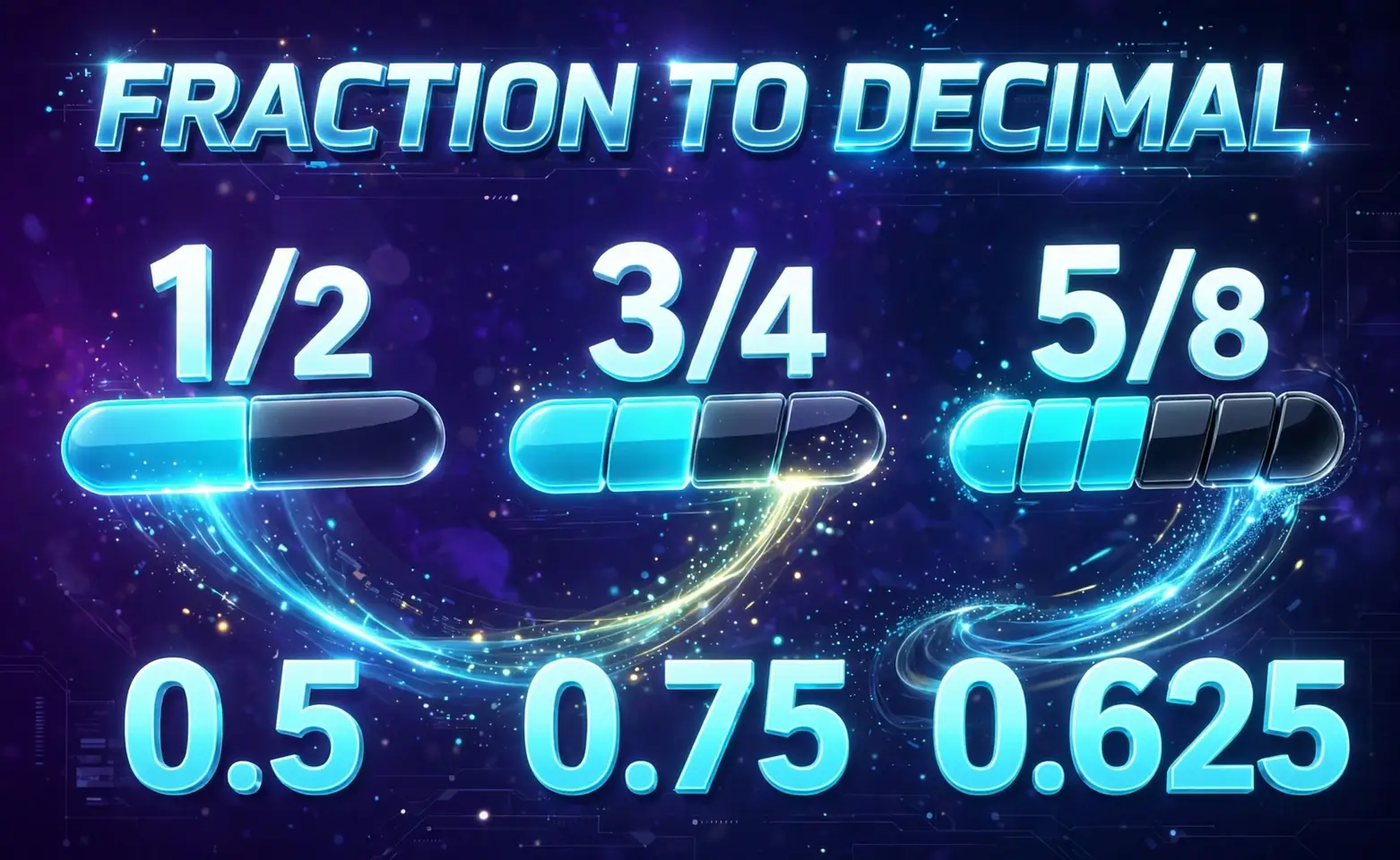
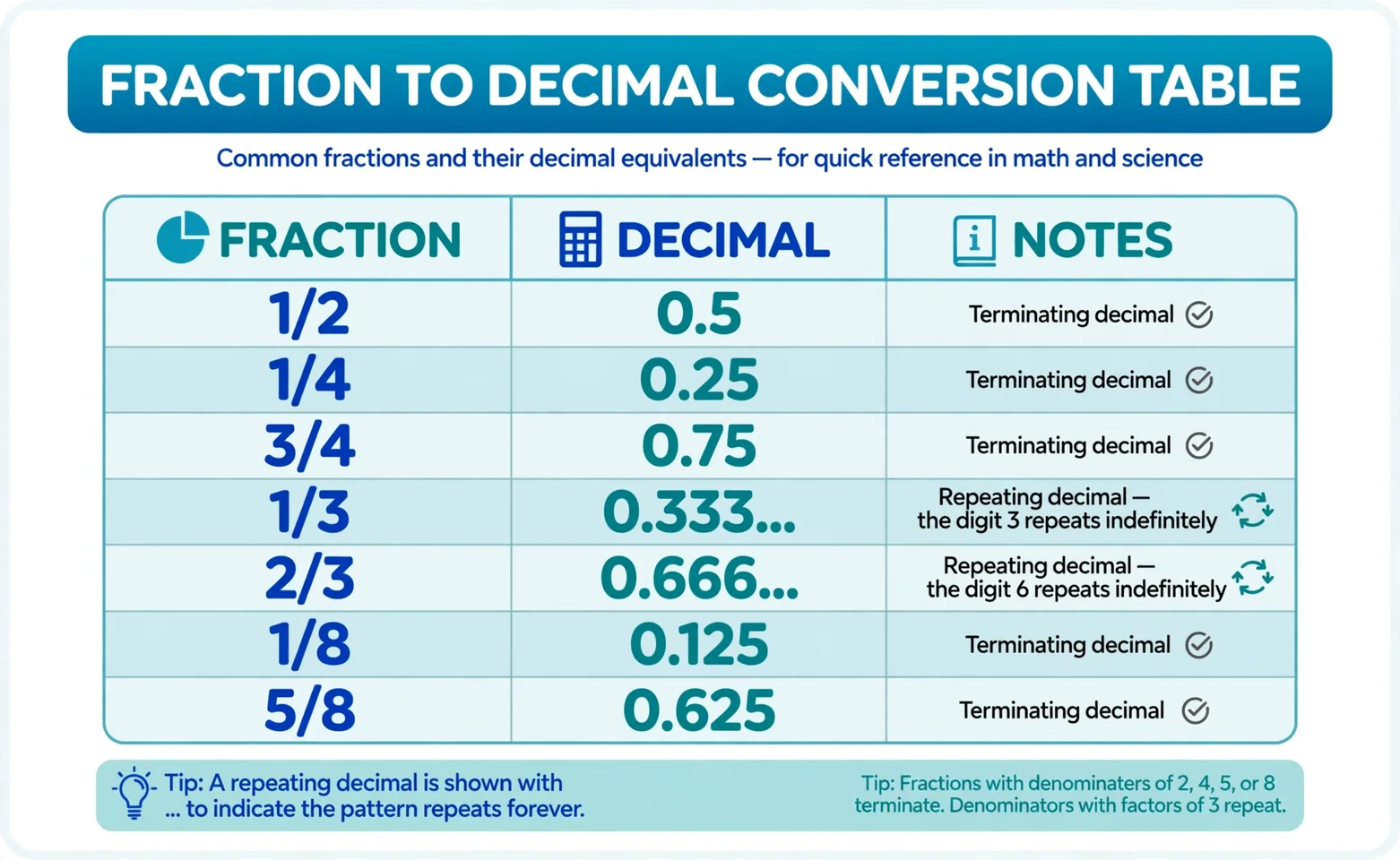
A fraction terminates when its simplified denominator has no prime factors other than 2 and 5: 1/2 is 0.5, 3/4 is 0.75, 7/20 is 0.35. Any other prime factor in the denominator makes the decimal repeat: 1/3 is 0.333..., 5/6 is 0.8333..., and 5/7 repeats a six-digit block.
Repeating decimals are shown with the repeating block in parentheses, like 0.(3) for 1/3, which is the standard compact notation. The decimal to fraction converter runs the reverse trip, turning decimals back into simplified fractions.
| Fraction | Decimal | Type |
|---|---|---|
| 1/2 | 0.5 | Terminating |
| 3/4 | 0.75 | Terminating |
| 1/3 | 0.(3) | Repeating |
| 5/6 | 0.8(3) | Repeating |
| 5/7 | 0.(714285) | Repeating |
Worked Examples
Example 1: 3/4. Divide 3 by 4 to get 0.75, a terminating decimal. Example 2: 2 and 1/3. The fraction part 1/3 repeats as 0.333..., so the mixed number is 2.333.... Example 3: 7/8. Divide 7 by 8 to get 0.875, which terminates because 8 is 2 cubed.
Example 4: -5/6. The sign carries through the division: -(5 / 6) = -0.8333.... Example 5: 22/7, the famous pi approximation, gives 3.142857 repeating, which is why it matches pi only to two decimal places.
| Input | Decimal | Simplified |
|---|---|---|
| 3/4 | 0.75 | 3/4 |
| 2 1/3 | 2.(3) | 2 1/3 |
| 7/8 | 0.875 | 7/8 |
| 22/7 | 3.(142857) | 22/7 |
How to Convert by Hand
Divide the numerator by the denominator with long division. For 5/8, 8 goes into 5.0 zero times, into 50 six times (48, remainder 2), into 20 two times (20, remainder 0), giving 0.625. When a remainder repeats a value you have seen before, the digits from that point repeat forever.
A shortcut for common fractions is worth memorizing: halves, quarters, and eighths all terminate, while thirds, sixths, and sevenths repeat. Knowing that 1/8 is 0.125 lets you build 3/8 as 0.375 and 5/8 as 0.625 by multiplication.
Common Mistakes
The most common mistake is flipping the fraction: 4/3 is 1.333..., not 0.75. Always divide the top number by the bottom number. The second is forgetting the whole number in a mixed number: 2 and 1/2 is 2.5, not 0.5.
A third mistake is rounding a repeating decimal too aggressively. Writing 1/3 as 0.33 introduces an error that grows when the value is multiplied later. Keep the repeating notation or several extra digits until the final step.
Where You Use This
Fractions to decimals come up in recipes (half a cup is 0.5), construction (5/8 inch is 0.625), money (a quarter is 0.25), and test scores (17/20 is 85 percent). Spreadsheets and calculators want decimals, while people usually speak in fractions, so conversion bridges the two.
For fraction arithmetic without converting, the fraction calculator adds, subtracts, multiplies, and divides fractions directly, keeping everything in fraction form with the steps shown.
Frequently asked questions
What is 3/4 as a decimal?
0.75. Divide 3 by 4: 4 goes into 30 seven times (28, remainder 2), then into 20 five times exactly.
What is 1/3 as a decimal?
0.333 repeating, written 0.(3). The remainder never resolves because 3 has a prime factor other than 2 or 5.
How do you convert a mixed number to a decimal?
Convert the fraction part to a decimal and add the whole number. 2 and 1/4 becomes 2 + 0.25 = 2.25.
Which fractions terminate and which repeat?
A simplified fraction terminates if its denominator's only prime factors are 2 and 5. Any other prime factor, like 3 or 7, makes it repeat.
What does 0.(142857) mean?
The digits 142857 repeat forever: 0.142857142857.... It is the decimal for 1/7, shown in compact repeating notation.
Can the denominator be zero?
No. Division by zero is undefined, so the converter rejects a zero denominator with an error message.
How do I turn a decimal back into a fraction?
Use the reverse tool: enter the decimal and it returns the simplified fraction, detecting repeating patterns where possible.