Dividend Calculator
Enter the share price, annual dividend per share, and how many shares you hold. Get the dividend yield, your projected annual and per-payment income, and the payout ratio if you add earnings per share.

Formulas verified against standard references. Calculator logic tested with verified worked examples. Last reviewed: November 2026. Our methodology
The Dividend Yield Formula
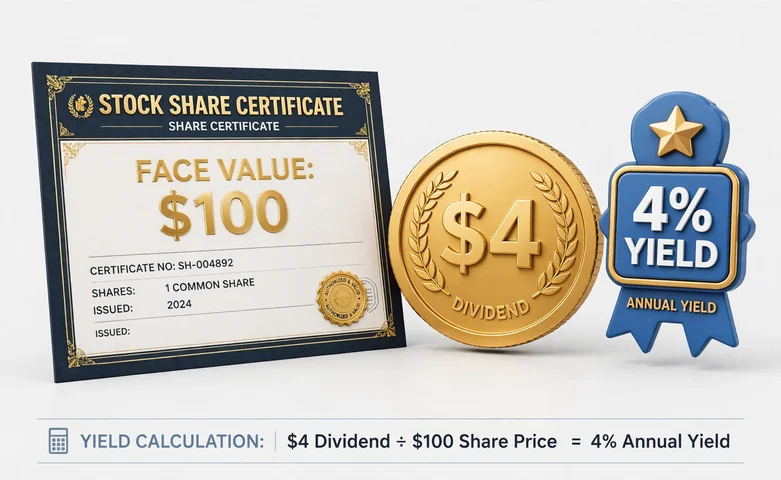
Dividend yield answers one question: how much cash does each dollar invested return per year? Divide the annual dividend per share by the share price and multiply by 100. A $2.40 dividend on an $80 share is a 3.0% yield.
Yield moves with price even when the dividend never changes. If that $80 share falls to $60, the same $2.40 dividend becomes a 4.0% yield. A rising yield can mean a bargain, or a market warning that the dividend is about to be cut.
Payout Ratio: Can They Afford It?
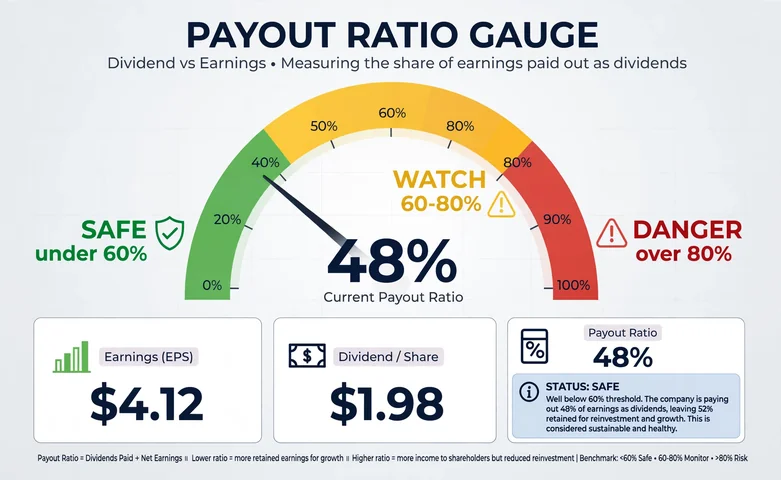
The payout ratio divides the dividend by earnings per share, showing what share of profit is paid out. A 48% ratio means the company keeps about half its earnings for growth and reserves; ratios consistently above 70% leave little room for a bad year.
Add EPS to get the ratio. It is the single most useful reality check on a high yield: a 9% yield with a 95% payout ratio is far riskier than a 3% yield with a 40% ratio, because the first company has almost no cushion.
| Payout ratio | Reading |
|---|---|
| Under 40% | Conservative; room to grow the dividend |
| 40% to 60% | Healthy balance of payout and reinvestment |
| 60% to 80% | Stretched; watch earnings closely |
| Over 80% | Fragile; a cut is plausible in a downturn |
Cash vs DRIP: Reinvest or Spend
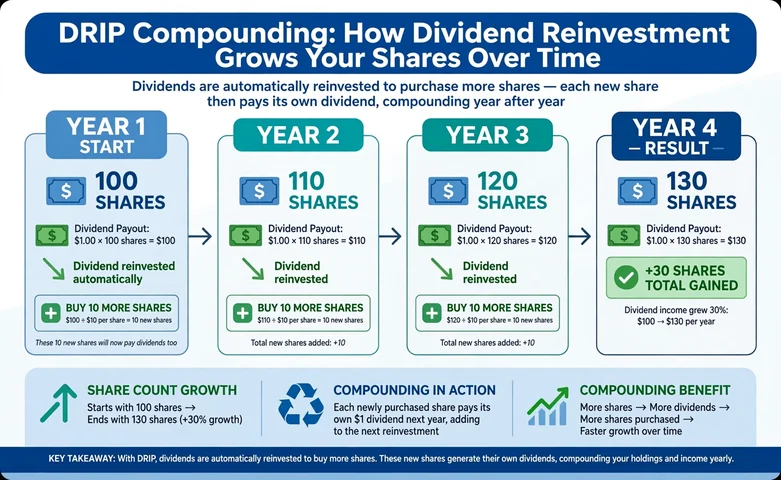
Dividends arrive as cash by default, but most brokers offer a DRIP: dividend reinvestment plan. A DRIP uses each payout to buy more shares automatically, often with no commission, so the share count compounds and future dividends grow.
Reinvesting suits the accumulation years; taking cash suits retirement income. The math is unforgiving either way: a 4% yield reinvested for 20 years buys roughly a third more shares than the starting position, before any price appreciation.
Worked Example: $80 Share, $2.40 Dividend
Take a share priced at $80 paying $2.40 a year, with earnings of $5 per share, and an investor holding 100 shares paid quarterly. Yield = 2.40 / 80 = 3.0%. Annual income = 2.40 x 100 = $240. Each quarterly payment = $240 / 4 = $60. Payout ratio = 2.40 / 5 = 48%.
The 3.0% yield sits in the moderate band, and the 48% payout ratio leaves the company half its earnings. That combination, steady yield plus affordable payout, is what dividend investors screen for.
Yield Rating Scale
Yields mean little without context, so the calculator rates yours on the standard scale used across dividend screeners. Most quality stocks sit between 2% and 6%; anything far outside deserves a second look at why.
| Yield | Rating | Typical meaning |
|---|---|---|
| 0% to 1% | Very low | Growth stocks; token dividend |
| 1% to 2% | Low | Blue chips prioritizing growth |
| 2% to 4% | Moderate | Classic dividend payers |
| 4% to 6% | High | Income stocks; check the payout ratio |
| 6% to 10% | Very high | Possible value trap; verify sustainability |
| Over 10% | Extreme | Market expects a dividend cut |
Taxes and Limitations
Dividends are usually taxable in the year they are paid, even when a DRIP reinvests them automatically. Qualified dividends often get a lower rate than ordinary income, but the rules vary by country and account type, so confirm yours before planning around the gross figures.
The calculator also assumes the dividend and price you enter stay fixed; real yields drift as both move. For total-return planning that includes price growth, the stock profit calculator adds the capital-gain side of the story.
Frequently asked questions
How do you calculate dividend yield?
Divide the annual dividend per share by the current share price and multiply by 100. A $2.40 dividend on an $80 share is a 3.0% yield.
What is a good dividend yield?
Most quality dividend stocks yield 2% to 6%. Below 2% is typical of growth stocks; above 8-10% often signals the market expects a dividend cut.
What is the payout ratio?
Annual dividend per share divided by earnings per share, times 100. It shows what share of profit funds the dividend; under 60-70% is generally considered sustainable.
How is dividend income calculated?
Multiply the annual dividend per share by the number of shares you own. With quarterly payments, divide the annual total by 4 for each payout.
What is a DRIP?
A dividend reinvestment plan that automatically uses your dividend cash to buy more shares, compounding your share count without commissions.
Are dividends taxed?
Usually yes, in the year paid, even if reinvested through a DRIP. Qualified dividends often get preferential rates; rules vary by country and account type.
Why did my yield rise when the price fell?
Yield is dividend divided by price, so a falling price raises the yield mechanically. Check the payout ratio before celebrating: the market may be pricing in a cut.