Cube Root Calculator: Find Any Cube Root in Seconds
Enter any number, positive or negative, to get its real cube root, a check that cubing the answer returns your number, and whether your number is a perfect cube.
Formulas verified against standard references. Calculator logic tested with verified worked examples. Last reviewed: October 2026. Our methodology
How a Cube Root Works
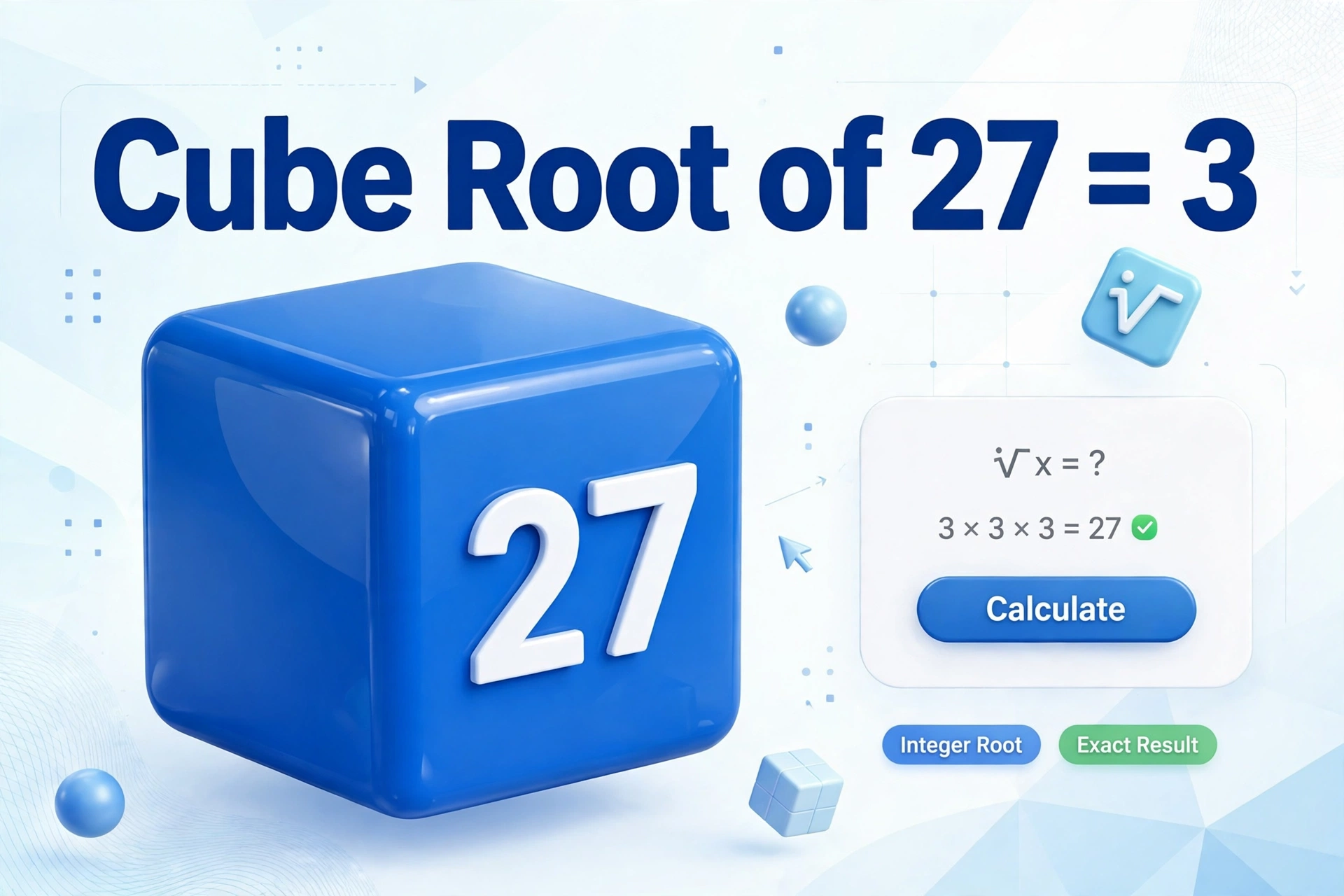
A cube root asks a simple question: which number, multiplied by itself three times, gives the number you started with. The cube root of 27 is 3, because 3 times 3 times 3 equals 27. The cube root of 64 is 4, and the cube root of 1000 is 10. Cubing stretches numbers fast, so roots shrink them back just as fast.
Unlike a square root, a cube root always has a real answer, even for a negative number. A negative number cubed stays negative, because two negatives make a positive and the third negative flips it back: negative 3 times negative 3 times negative 3 equals negative 27. So the cube root of negative 27 is negative 3, with no complex numbers needed.
For the reverse problem in two dimensions, a square root calculator handles square, cube, and nth roots side by side.
The Cube Root Formula
The cube root of x is written with a small 3 above the root symbol, and it is the same as x to the power one third. That power form is useful on any scientific calculator: type the number, press the power key, and enter one third. For a negative number, take the cube root of the positive value and then apply the negative sign, which is exactly what this calculator does.
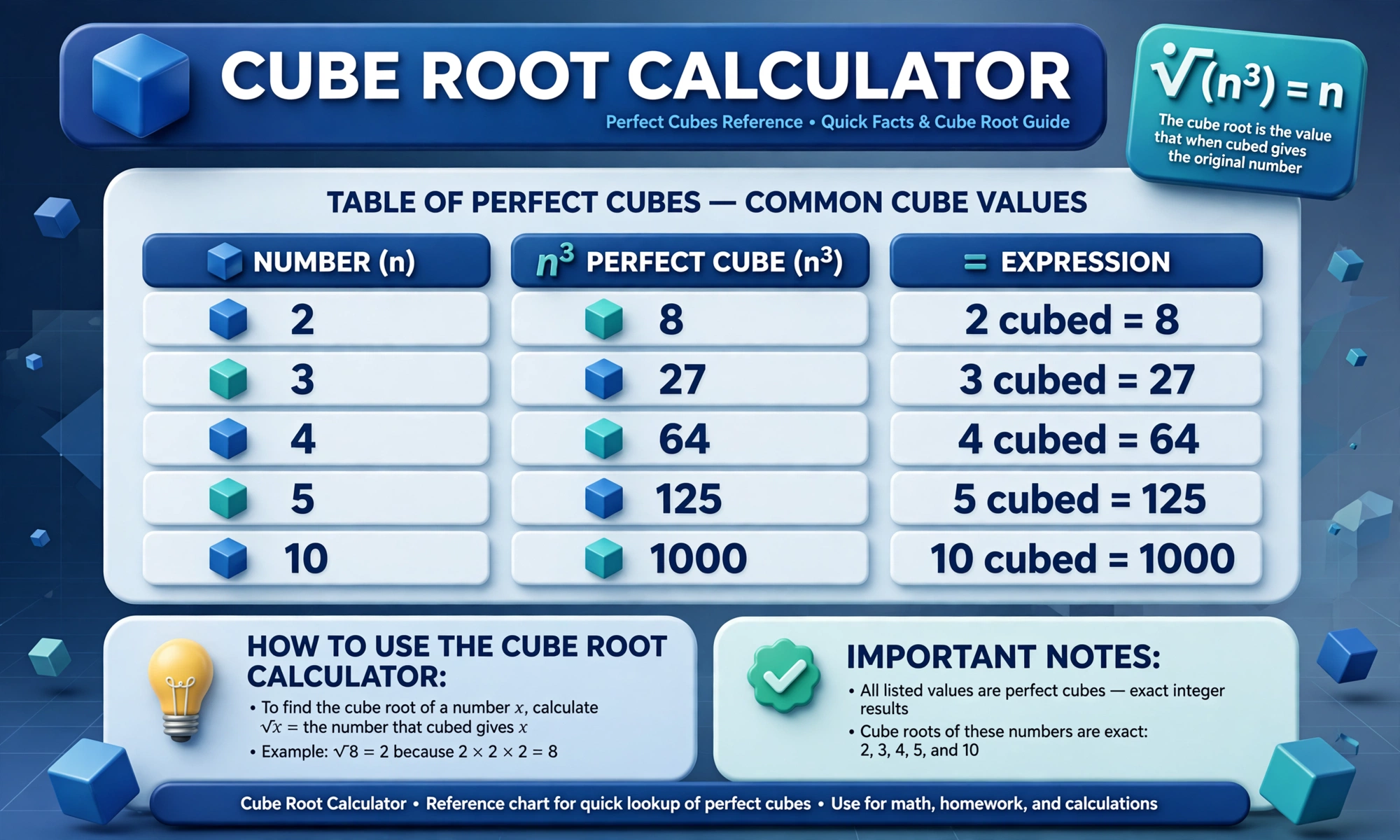
A perfect cube is a whole number cubed: 1, 8, 27, 64, 125, 216, 343, 512, and 1000 are the cubes of 1 through 10. If your number is not a perfect cube, its cube root is irrational, and the decimal shown here is rounded to six places, which is plenty for geometry, volume, and engineering estimates.
| Number | Cube | Cube root |
|---|---|---|
| 8 | 2 cubed | 2 |
| 27 | 3 cubed | 3 |
| 64 | 4 cubed | 4 |
| 125 | 5 cubed | 5 |
| 1000 | 10 cubed | 10 |
Worked Examples
Example 1: find the cube root of 27. The factors are 3 times 3 times 3, so the answer is exactly 3, and 27 is a perfect cube. Example 2: find the cube root of negative 27. The answer is negative 3, because negative 3 cubed equals negative 27. Example 3: find the cube root of 2. No whole number cubes to 2, so the answer is about 1.259921, and cubing it returns very close to 2.
Example 4: find the cube root of 1000. The answer is exactly 10, which is the side length of a cube with volume 1000 cubic units. That volume link is the most common real use of cube roots: volume gives you the cube, and the cube root gives you the side.
| Problem | Answer | Check |
|---|---|---|
| Cube root of 27 | 3 | 3 cubed = 27 |
| Cube root of negative 27 | negative 3 | negative 3 cubed = negative 27 |
| Cube root of 2 | 1.259921 | 1.259921 cubed is about 2 |
| Cube root of 1000 | 10 | 10 cubed = 1000 |
Perfect Cubes to Remember
Memorizing the first ten perfect cubes makes volume problems much faster, because you can spot an exact answer before reaching for a calculator. The cubes grow quickly: from 512 for 8 to 729 for 9 to 1000 for 10, each step adds a larger gap than the last, which is why cube roots compress large volumes into modest side lengths.
To estimate a cube root by hand, find the two perfect cubes your number sits between. For 100, the roots sit between 4 and 5, since 64 and 125 bracket 100, and a closer estimate is about 4.6416. For 500, the roots sit between 7 and 8, since 343 and 512 bracket 500.
| Base | Cube | Cube root of the cube |
|---|---|---|
| 4 | 64 | 4 |
| 6 | 216 | 6 |
| 8 | 512 | 8 |
| 9 | 729 | 9 |
| 10 | 1000 | 10 |
Common Mistakes
The most common mistake is dividing by 3 instead of taking a cube root: the cube root of 27 is 3, not 9, because 27 divided by 3 is 9 but 3 cubed is 27. Another mistake is treating a cube root like a square root and declaring that a negative number has no real cube root. It does, and the sign simply carries through.
A third mistake is adding cube roots as if they were ordinary numbers: the cube root of 8 plus 27 is the cube root of 35, about 3.2711, not 2 plus 3, which is 5. Roots do not split over addition, but they do split over multiplication: the cube root of 8 times 27 equals the cube root of 8 times the cube root of 27, which is 6.
When to Use a Cube Root Calculator
Cube roots appear whenever a volume is known and a side length is needed: a cube-shaped tank, a storage box, or a block of material. They also appear in physics, where some scaling laws involve cube roots, and in statistics, where a cube root transform can make skewed data easier to work with.
For powers in the other direction, an exponent calculator raises any base to any exponent. Use this cube root calculator whenever the unknown is the base and the power is 3.
Frequently asked questions
What is a cube root?
The number that, multiplied by itself three times, gives the original number. The cube root of 27 is 3, because 3 times 3 times 3 equals 27.
Can a cube root be negative?
Yes. The cube root of negative 27 is negative 3, because negative 3 cubed equals negative 27. Cube roots of negative numbers are real.
What is the cube root of 2?
About 1.259921. It is irrational, so its decimal never ends or repeats, and cubing 1.259921 returns very close to 2.
What is a perfect cube?
A whole number raised to the third power, such as 8, 27, 64, 125, and 1000, which are 2, 3, 4, 5, and 10 cubed.
How is a cube root different from a square root?
A square root reverses squaring and has no real answer for a negative number, while a cube root reverses cubing and has a real answer for every number, positive or negative.
How do I estimate a cube root by hand?
Find the two perfect cubes your number sits between. For 100, the answer sits between 4 and 5, since 64 and 125 bracket 100, and a closer estimate is about 4.6416.
What is the cube root of 1000?
Exactly 10, because 10 times 10 times 10 equals 1000. It is also the side length of a cube with volume 1000 cubic units.