Body Surface Area Calculator: BSA in Square Meters
Enter your height and weight, pick the Mosteller or Du Bois formula, and get your body surface area in square meters with the working shown.
Formulas verified against standard references. Calculator logic tested with verified worked examples. Last reviewed: October 2026. Our methodology
What Body Surface Area Is
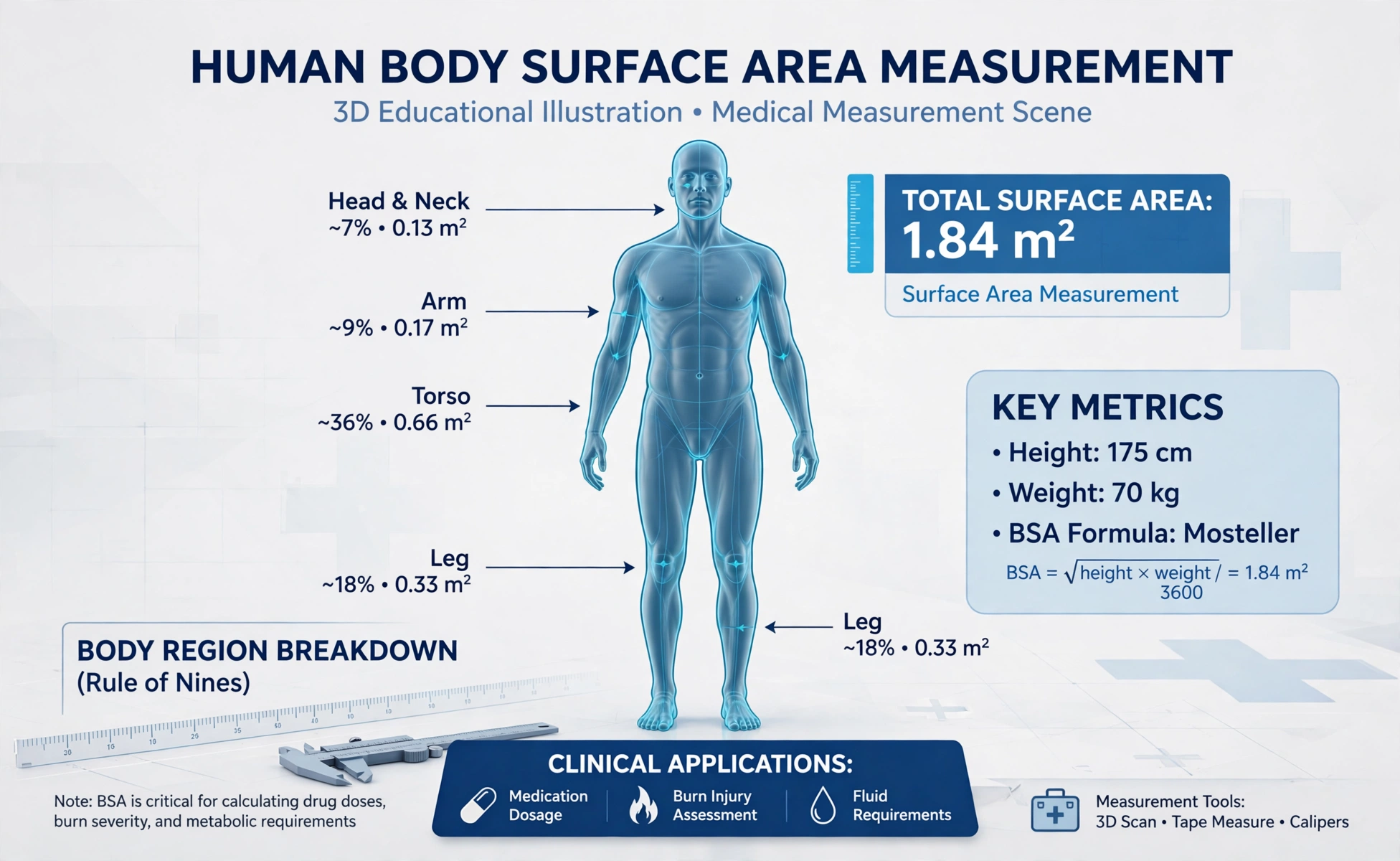
Body surface area, or BSA, is the total surface area of the human body, measured in square meters. An average adult has a BSA of about 1.7 to 1.9 square meters, roughly the area of a single bed sheet laid flat. BSA is not the same as weight or body mass index: two people with the same weight can have different BSAs if their heights differ.
Doctors use BSA because many bodily processes, including drug clearance, heart output, and heat loss, scale better with surface area than with weight alone. That is why chemotherapy doses and some other drug doses are calculated per square meter of BSA rather than per kilogram of body weight.
Mosteller and Du Bois Formulas
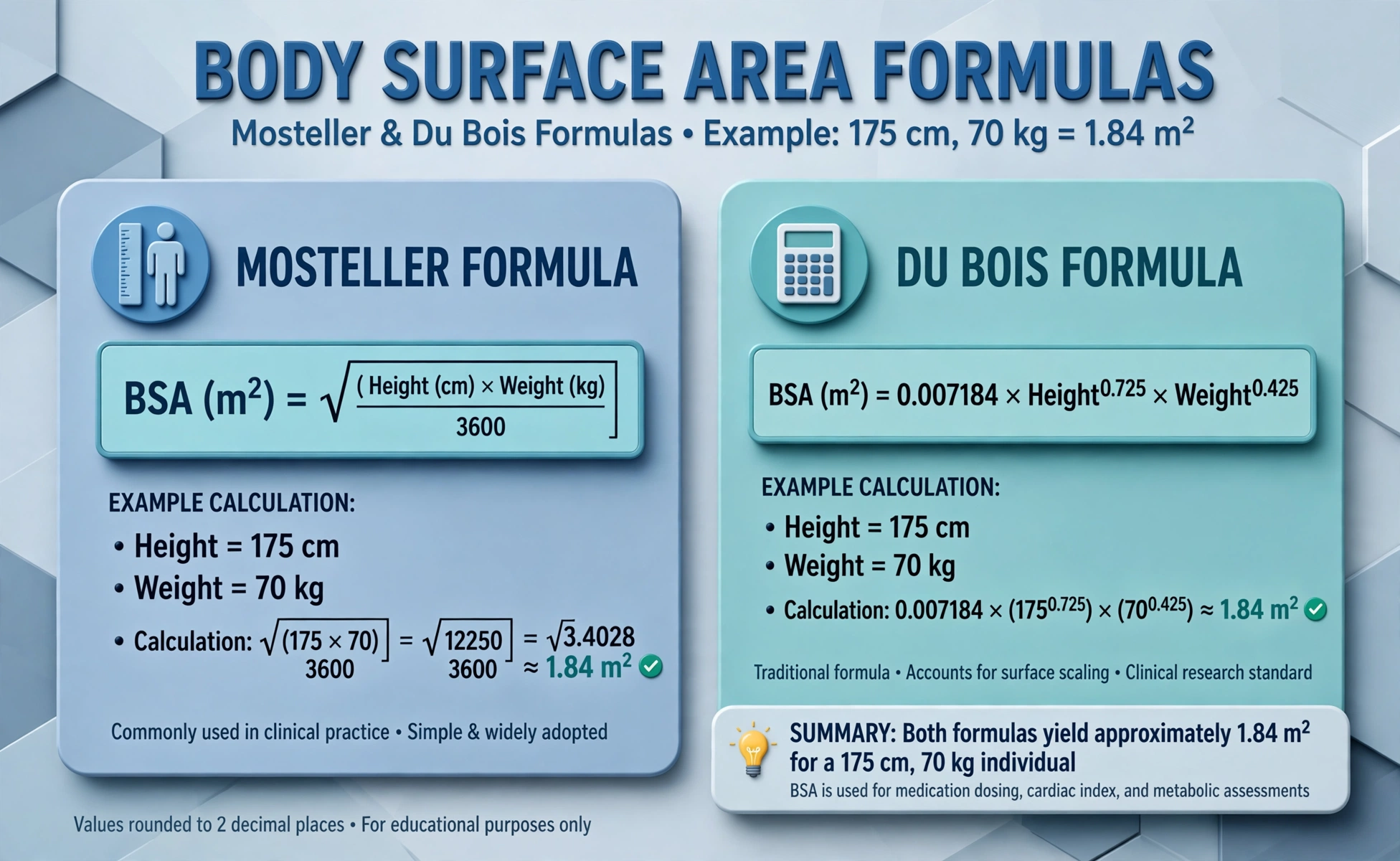
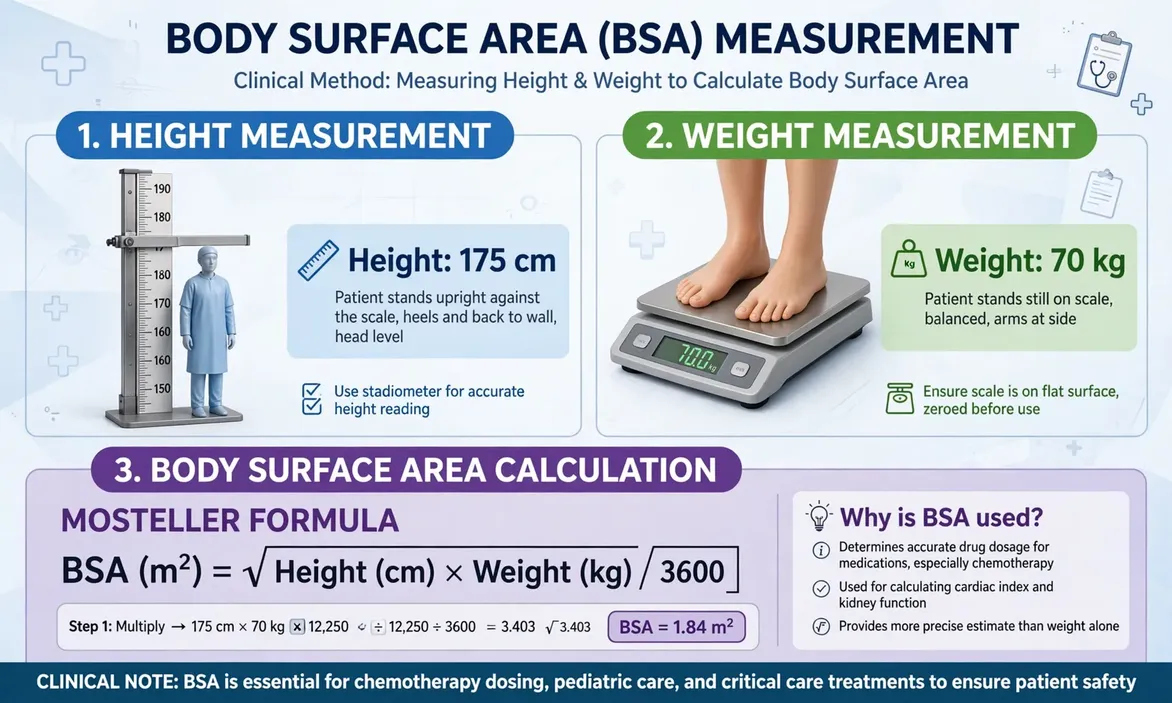
The Mosteller formula is the most widely used today because it is simple: BSA equals the square root of (height in centimeters times weight in kilograms divided by 3600). For 175 cm and 70 kg, that is the square root of (175 times 70 divided by 3600), which is the square root of 3.4028, giving 1.84 square meters.
The Du Bois formula, published in 1916, is 0.007184 times height to the power 0.725 times weight to the power 0.425. For the same 175 cm and 70 kg, it gives 1.85 square meters, very close to Mosteller. For a related body measure, a BMI calculator gives body mass index from the same height and weight.
| Formula | Calculation | 175 cm, 70 kg |
|---|---|---|
| Mosteller | sqrt(height x weight / 3600) | 1.84 square meters |
| Du Bois | 0.007184 x H to the power 0.725 x W to the power 0.425 | 1.85 square meters |
Worked Examples
Example 1: 175 cm, 70 kg, Mosteller gives 1.84 square meters, and Du Bois gives 1.85 square meters. Example 2: 160 cm, 55 kg, Mosteller gives the square root of (160 times 55 divided by 3600), which is the square root of 2.4444, giving 1.56 square meters.
Example 3: 190 cm, 95 kg, Mosteller gives the square root of (190 times 95 divided by 3600), which is the square root of 5.0139, giving 2.24 square meters. Taller and heavier people have larger BSAs, but height matters more than a simple weight ratio suggests, because the formula uses the product of height and weight.
| Height | Weight | Mosteller BSA |
|---|---|---|
| 175 cm | 70 kg | 1.84 square meters |
| 160 cm | 55 kg | 1.56 square meters |
| 190 cm | 95 kg | 2.24 square meters |
Why BSA Matters in Medicine
BSA-based dosing keeps drug exposure consistent across body sizes. A dose of 100 milligrams per square meter means about 184 milligrams for a person with a BSA of 1.84 square meters, and about 156 milligrams for a person with a BSA of 1.56 square meters. Without BSA, both would receive the same dose despite very different body sizes.
BSA also appears in cardiac index, which is cardiac output divided by BSA, and in renal function estimates. These are clinical calculations, and the BSA figure alone does not diagnose or treat anything. Always discuss medical decisions with a qualified clinician.
Common Mistakes
The most common mistake is entering height in meters or inches instead of centimeters, which collapses the result. At 1.75 instead of 175, the Mosteller result drops to about 0.18 square meters, which is obviously wrong. A second mistake is entering weight in pounds instead of kilograms, which inflates the result.
A third mistake is comparing BSAs from different formulas as if they were exact: Mosteller and Du Bois differ slightly, and that small difference is normal. A fourth is treating BSA as a fitness score: it is a size measure used in medicine, not a health grade.
BSA and Everyday Health
For everyday health, BSA is less useful than weight, BMI, waist size, and activity level. It becomes important mainly in clinical settings, for drug dosing and organ function estimates. If a clinician asks for your BSA, this calculator gives the figure to share, along with the formula used, since clinicians may prefer one formula over the other.
Track BSA only if a clinician asks you to. Otherwise, focus on measures you can act on: regular movement, balanced eating, sleep, and the measurements your clinician actually uses for your care.
Frequently asked questions
What is a normal body surface area?
An average adult is about 1.7 to 1.9 square meters. Taller and heavier adults are higher, and smaller adults are lower.
How is BSA calculated?
Mosteller: square root of (height in cm times weight in kg divided by 3600). Du Bois: 0.007184 times height to the power 0.725 times weight to the power 0.425.
What is the BSA for 175 cm and 70 kg?
About 1.84 square meters by Mosteller and 1.85 square meters by Du Bois.
Is BSA the same as BMI?
No. BMI is weight divided by height squared and grades weight relative to height. BSA is total body surface area in square meters.
Why do doctors use BSA for drug doses?
Because drug clearance and related processes scale better with surface area than with weight alone, so BSA dosing keeps exposure consistent across body sizes.
Should I enter height in cm or meters?
Centimeters for this calculator. Entering meters instead of centimeters will give a result about ten times too small.
Is this medical advice?
No. This calculator is for information only. Discuss any medical decision, dose, or treatment with a qualified clinician.
Related calculators

BMI Calculator
Check your Body Mass Index from height and weight, with your healthy range.
Use calculatorBody Fat Calculator
Estimate body fat percentage from measurements and personal details.
Use calculatorCalorie Deficit Calculator
BMR, maintenance calories, deficit target, and weeks to lose 5 kg.
Use calculator