BAC Calculator: Estimate Your Blood Alcohol Content
Alcohol affects everyone differently, but the math behind it is well understood. Enter your weight, gender, drinks and hours since you started, and this free BAC calculator will estimate your blood alcohol content using the Widmark formula — plus how long until you are sober.
Formulas verified against standard references. Calculator logic tested with verified worked examples. Last reviewed: October 2026. Our methodology
How BAC is estimated: the Widmark formula
Swedish chemist Erik Widmark worked out in the 1930s that blood alcohol content follows body water: alcohol distributes through water, and larger, more-hydrated bodies dilute it more. The formula is:
- BAC % = (A × 5.14 ÷ (W × r)) − 0.015 × H, where A is ounces of pure alcohol, W is body weight in pounds, r is the body-water constant (0.73 for men, 0.66 for women), and H is hours since drinking began.
- One standard drink ≈ 0.6 oz of pure alcohol — a 12 oz beer at 5%, a 5 oz glass of wine at 12%, or a 1.5 oz shot at 40%.
- 0.015 per hour is the average rate the liver metabolizes alcohol — about one standard drink per hour, and nothing speeds it up.
| BAC level | Typical effects |
|---|---|
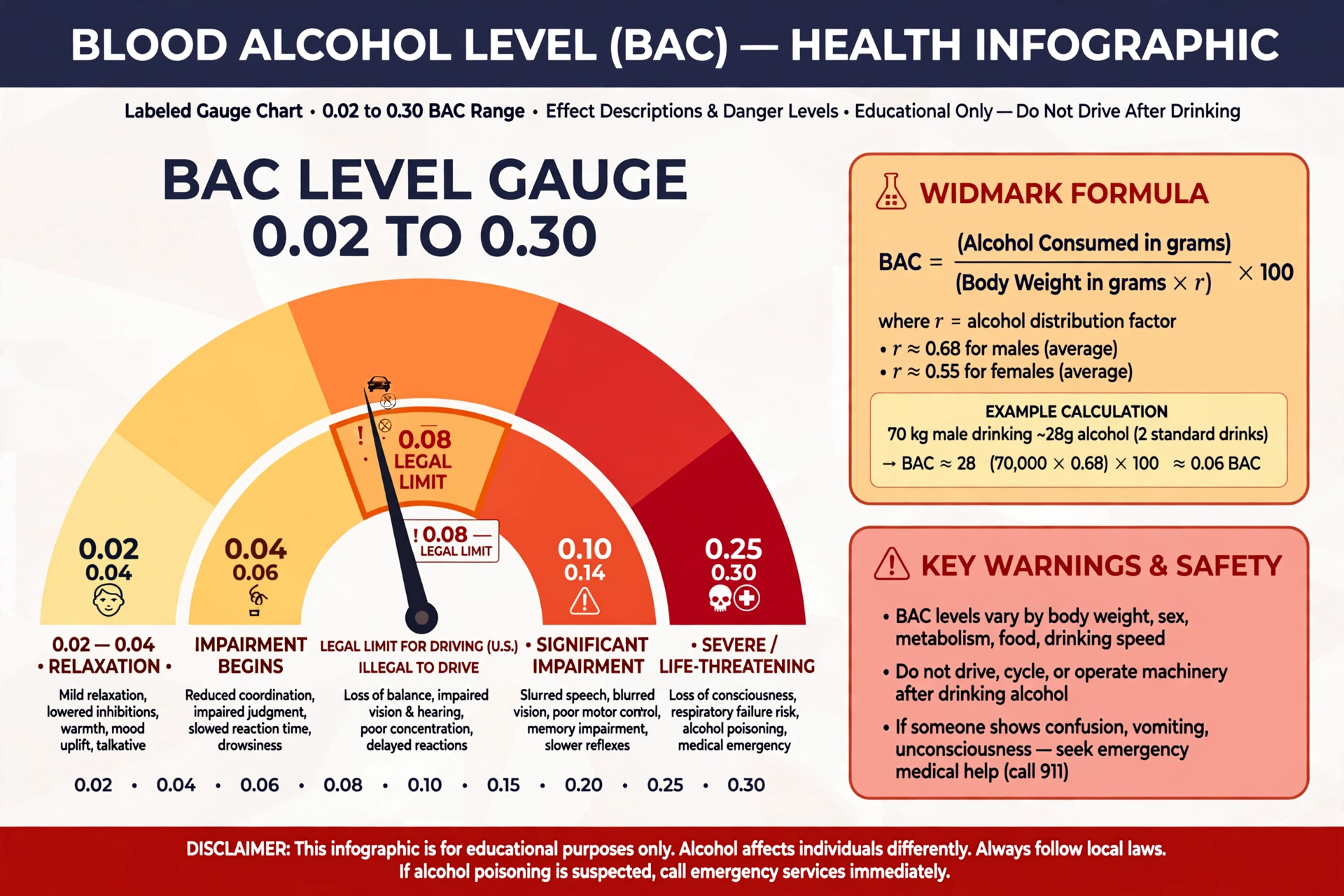
| 0.02–0.03% | Relaxation, mild euphoria, lowered inhibitions |
| 0.05–0.06% | Impaired judgment and coordination; illegal to drive in many countries |
| 0.08% | Legal driving limit in most US states; major impairment |
| 0.15% | Severe impairment, nausea, blackouts possible |
| 0.30%+ | Life-threatening: coma and respiratory failure risk |
Safety note: this is an estimate, not a breathalyzer. Food, medication, fatigue and individual metabolism shift real BAC. Never drive after drinking — when in doubt, don’t.
Worked example
A 180 lb man has 4 standard drinks over 2 hours. Alcohol consumed: 4 × 0.6 = 2.4 oz. The male constant r = 0.73.
BAC = (2.4 × 5.14 ÷ (180 × 0.73)) − 0.015 × 2 = (12.336 ÷ 131.4) − 0.03 = 0.0939 − 0.03 = 0.064%. That is below the 0.08% limit but firmly in impaired territory. Time until sober: 0.064 ÷ 0.015 ≈ 4.3 hours from the first drink.
How to use the BAC calculator
Count honestly — most people underestimate their drinks. A generous home pour can easily be two "standard" drinks.
Step by step
- Enter your body weight in pounds. Heavier bodies dilute alcohol more.
- Select gender. The formula uses different body-water constants for men and women.
- Enter standard drinks. Count 12 oz of 5% beer, 5 oz of 12% wine, or 1.5 oz of 40% spirits as one each; scale up for stronger servings.
- Enter hours since your first drink. The liver clears about 0.015% per hour from the start.
- Press Calculate. Read your estimated BAC, the legal-limit comparison, and the hours until sober.
What counts as one standard drink?
"One drink" is slippery — a pint of strong IPA is not one drink. In the US, a standard drink contains about 0.6 oz (14 g) of pure alcohol:
| Beverage | One standard drink | Common trap |
|---|---|---|
| Beer (5%) | 12 oz can/bottle | A 16 oz pint of 7% IPA ≈ 1.9 drinks |
| Wine (12%) | 5 oz glass | A full restaurant pour is often 6–8 oz |
| Spirits (40%) | 1.5 oz shot | A heavy-handed home pour can be 3 oz |
| Cocktail | Varies — count the shots | Long islands hide 3–4 shots |
When estimating, round up, not down. Undercounting by two drinks can swing your BAC estimate by 0.03–0.05% — the difference between legal and not.
Why coffee, water and cold air do not sober you up
Only time lowers BAC. The liver metabolizes alcohol at a fixed average rate of about 0.015% per hour, and no trick changes that:
- Coffee makes you a more alert drunk person, not a sober one — reaction time stays impaired.
- Water and food slow absorption of drinks still in your stomach, but do nothing for alcohol already in your blood.
- Cold air and exercise feel sobering; measured BAC does not budge.
The calculator’s "time until sober" is the only real cure. Plan the ride home before the first drink, not after the fourth.
BAC limits around the world
The 0.08% US limit is on the lenient side globally. Know the rules where you are:
| Place | Legal driving limit |
|---|---|
| Most US states | 0.08% (0.02–0.04% for under-21 and commercial drivers) |
| UK, Canada | 0.08% |
| Most of Europe | 0.05% |
| Japan, Sweden, Norway | 0.03% or lower |
| Many countries | Zero tolerance for new drivers |
And "under the limit" is not "safe to drive" — impairment of judgment begins around 0.02–0.03%, well below every legal threshold. The safest BAC for driving is 0.00%.
Frequently asked questions
How is BAC calculated?
With the Widmark formula: BAC% = (ounces of alcohol × 5.14 ÷ (weight in lb × r)) − 0.015 × hours, where r is 0.73 for men and 0.66 for women. One standard drink ≈ 0.6 oz of pure alcohol, and the liver clears about 0.015% per hour.
What is a standard drink?
In the US, about 0.6 oz of pure alcohol: 12 oz of 5% beer, 5 oz of 12% wine, or 1.5 oz of 40% spirits. Stronger servings count as more — a pint of 7% IPA is nearly two standard drinks.
How long does it take to sober up?
Roughly BAC ÷ 0.015 hours. A 0.09% BAC needs about 6 hours to reach zero. Coffee, water, food and cold air do not speed this up — only time lowers BAC.
Why do women get drunker than men on the same drinks?
On average women have a lower percentage of body water and lower levels of the stomach enzyme that breaks down alcohol, so the same amount of alcohol reaches a higher blood concentration. The Widmark formula reflects this with a lower body-water constant (0.66 vs 0.73).
What is the legal alcohol limit for driving?
0.08% in most US states (lower for under-21 and commercial drivers), 0.05% across most of Europe, and near-zero in several countries. But impairment starts around 0.02–0.03% — under the limit is not the same as safe.
Does eating before drinking lower BAC?
Food slows alcohol absorption, so your peak BAC arrives later and lower than on an empty stomach — but it does not change how much alcohol you consumed or how long it takes to clear. It helps at the margins; it does not make driving safe.
Can a BAC calculator replace a breathalyzer?
No. It is an estimate based on averages — food, medication, fatigue, drinking pace and individual metabolism all shift real BAC by meaningful amounts. Use it for planning, never as permission to drive.