Annuity Calculator
See how regular deposits compound over time. Enter your starting balance, annual and monthly additions, interest rate, and how many years, then get the end balance, total interest earned, and a year-by-year schedule.

Formulas verified against standard references. Calculator logic tested with verified worked examples. Last reviewed: November 2026. Our methodology
How an Annuity Accumulates
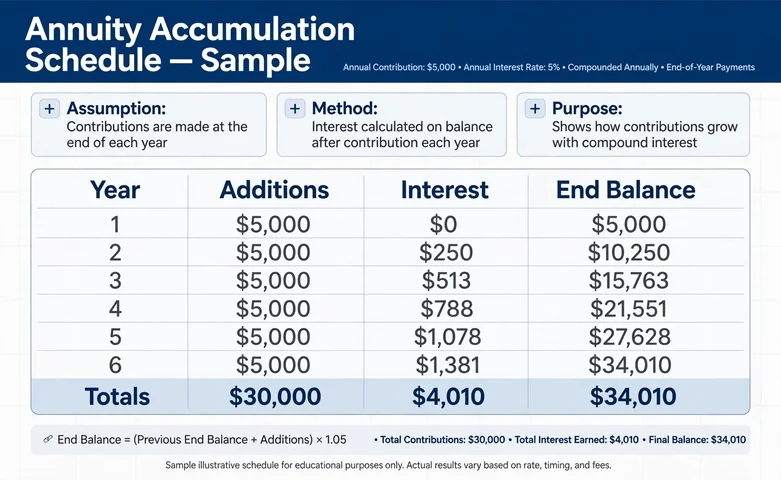
An annuity in its accumulation phase is simple: money goes in on a schedule, and every dollar starts earning interest the moment it arrives. The end balance is the sum of every deposit grown forward at the interest rate, which is why early deposits matter far more than late ones.
This calculator compounds monthly additions each month and annual additions at the start or end of each year, at the rate you set. An optional growth rate raises the annual addition each year, modeling a saver who increases contributions with raises.
Ordinary Annuity vs Annuity Due
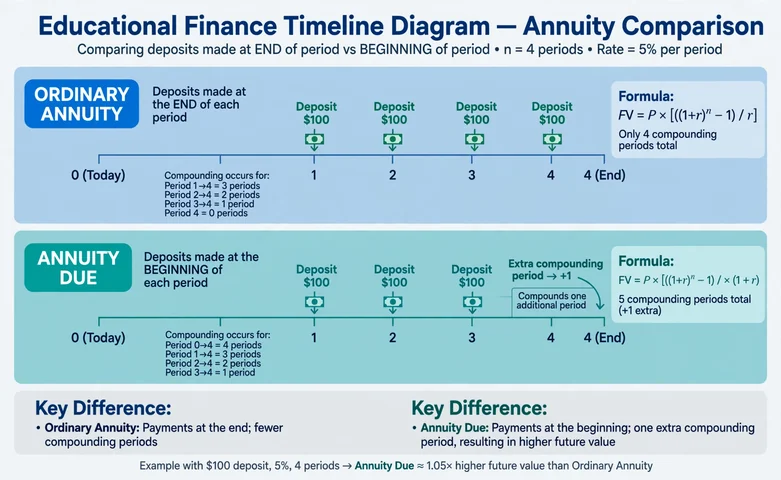
The one choice that changes the math is timing. An ordinary annuity adds money at the end of each period; an annuity due adds at the beginning. Beginning-of-period deposits earn one extra compounding period, so they always finish slightly ahead at the same rate.
The difference is exactly one period of interest on each deposit. Over 30 years at 7%, adding $500 monthly at the beginning instead of the end adds roughly one extra month of growth on every payment, worth several thousand dollars.
| Timing | Deposit earns interest | End balance |
|---|---|---|
| Beginning (annuity due) | From the day it is added | Higher: extra compounding period |
| End (ordinary annuity) | From the next period | Lower by one period of interest |
Worked Example: $500 a Month at 7%
The classic retirement-savings example: $500 deposited at the end of every month for 30 years at 7% annual interest. The monthly rate is 0.07/12, and 360 deposits each grow for their remaining months.
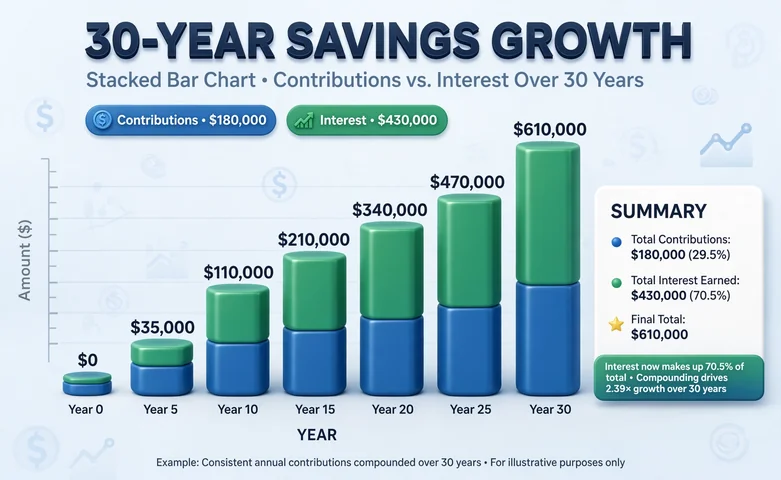
The future value is $500 x [((1 + 0.07/12)^360 - 1) / (0.07/12)], about $609,985. Total deposits are $180,000, so compound interest contributes roughly $430,000: more than two-thirds of the final balance. Try it above with starting principal 0, monthly addition 500, rate 7, 30 years, end timing. (Beginning-of-month deposits earn one extra month each and finish near $613,544.)
The Growth Rate on Contributions
Most savers do not contribute a flat amount forever; contributions rise with income. The annual growth rate models this: a 2% growth rate turns a $6,000 first-year addition into $6,120 in year two, $6,242 in year three, and so on.
Even a small growth rate compounds powerfully over decades because later, larger deposits still get years of growth. A 3% annual increase in contributions over 30 years adds roughly 40% more in total deposits than a flat schedule, and the interest on those extra deposits adds more still.
Annuity vs Lump Sum
A lump sum invested today beats drip-feeding the same total later, because every dollar gets the maximum time to compound. The annuity wins on realism: few people have the lump sum, and scheduled deposits enforce the saving habit.
| Approach | Strength | Weakness |
|---|---|---|
| Lump sum | Maximum compounding time | Requires capital up front; market-timing risk |
| Regular deposits | Builds the habit; averages entry prices | Later deposits compound less |
| Growing deposits | Matches rising income | Harder to sustain in downturns |
What the Projection Leaves Out
The projection assumes a constant interest rate, no fees, no taxes, and no missed deposits. Real annuities from insurers add contract fees and surrender charges, and the tax treatment depends on whether the money is qualified retirement funds.
Treat the result as a planning baseline, not a promise. For the payout phase, when the balance turns into retirement income, pair this with the retirement calculator to see how long the money lasts.
Frequently asked questions
What is an annuity?
A series of equal payments made at regular intervals. In the accumulation phase you deposit money that grows with compound interest; in the payout phase you receive scheduled payments.
What is the difference between an ordinary annuity and an annuity due?
An ordinary annuity pays or receives at the end of each period; an annuity due at the beginning. Beginning-of-period payments earn one extra compounding period, so they grow larger.
How is the future value of an annuity calculated?
Each deposit is grown forward at the interest rate for its remaining time and the results are summed. With monthly deposits at rate r for n months, FV = PMT x [((1+r)^n - 1) / r], adjusted for beginning or end timing.
Does the timing of deposits really matter?
Yes. At 7% over 30 years, $500 monthly at the beginning of each month finishes about $3,500 ahead of end-of-month deposits, from one extra month of compounding on every payment.
What does the annual growth rate do?
It raises the annual addition each year, modeling contribution increases with raises. A 2% growth rate turns a $6,000 addition into $6,120 the next year, $6,242 the year after.
Is this calculator for the payout phase too?
No. This covers the accumulation phase (saving and growth). Payout-phase math, turning a lump sum into scheduled income, is a separate calculation.
Why is most of the final balance interest?
Compounding accelerates: interest earned early starts earning its own interest. In the $500/month, 7%, 30-year example, about $430,000 of the $610,000 end balance is interest.