Days Alive Calculator
Find exactly how long you have been alive, down to the second. Enter your birth date, optionally your birth time for exact hours, minutes, and seconds, and see your age in days, weeks, months, hours, minutes, and seconds, plus your weekday of birth, countdown to your next birthday, and the dates of your upcoming round-number milestones.

Formulas verified against standard references. Calculator logic tested with verified worked examples. Last reviewed: October 2026. Our methodology
How Days Alive Is Counted
The calculator subtracts your birth date from the end date and counts whole calendar days, leap days included. Born March 15, 1996 and counting to October 31, 2026 gives 11,187 days. Every February 29 you have lived through is in that total automatically.
The day of birth counts as day 0 and the next day as day 1, the same convention age calculators use. Without a birth time, the count starts at midnight, so hours, minutes, and seconds are day-count multiples (× 24, × 1,440, × 86,400). Enter your birth time and they become exact, measured from that moment.
Why Birth Time Matters
Whole-day counts ignore hours, which is fine until you want the smaller units. Without a birth time, the seconds figure can be off by up to 24 hours of living: someone born at 3 PM shows 15 fewer real hours than the midnight-based count.
With a birth time of 15:00, the calculator measures from 3 PM on the birth date, and the hours, minutes, and seconds become exact. The day count itself never depends on the time. If you do not know your time, leave it blank; the day, week, and year figures are unaffected.
| Unit | Without birth time | With birth time 15:00 |
|---|---|---|
| Days | Exact | Exact |
| Hours | Days x 24 (approx) | Exact from 3 PM |
| Minutes | Days x 1,440 (approx) | Exact |
| Seconds | Days x 86,400 (approx) | Exact |
Milestones Worth Celebrating
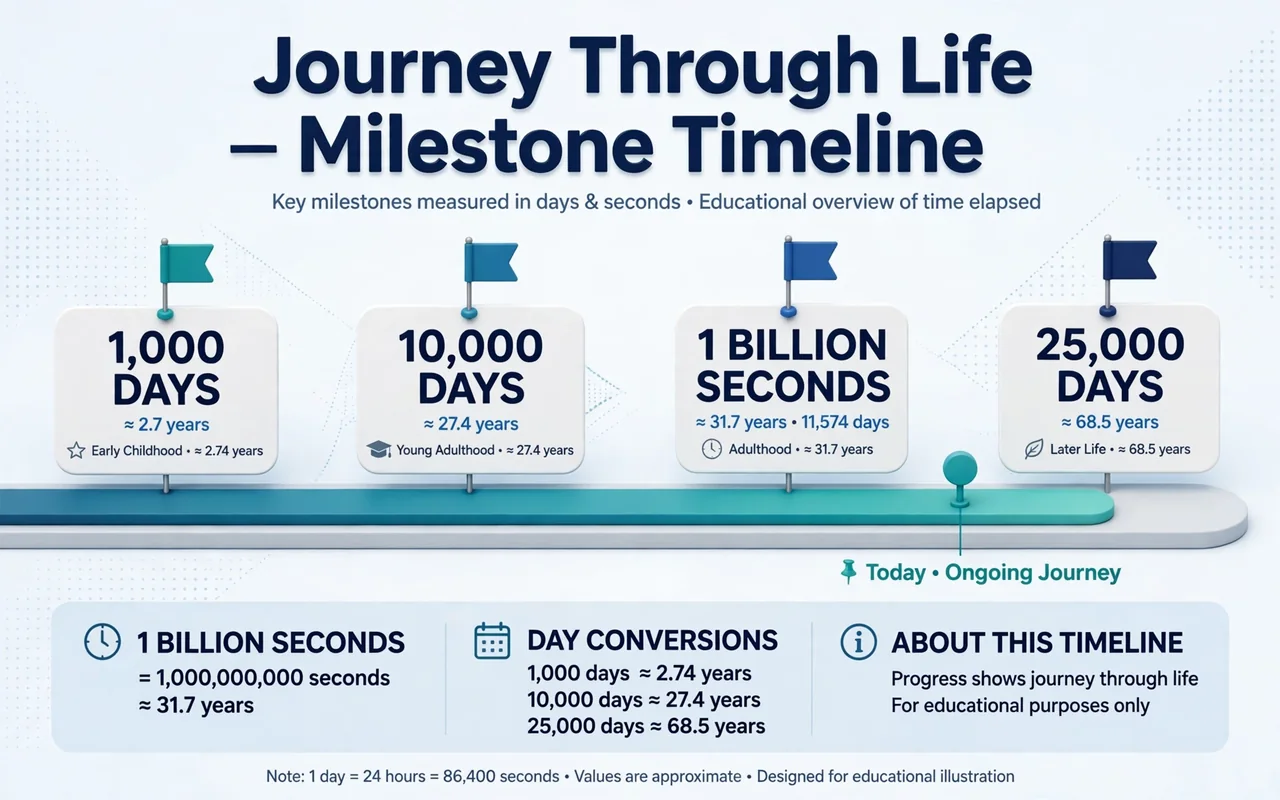
Round numbers make the abstract concrete. Your 10,000th day arrives around age 27 years and 5 months; 1 billion seconds lands around age 31 years and 8 months. The calculator lists your upcoming milestones, 1,000 through 50,000 days plus the billion-second mark, each with its calendar date and a live countdown.
These are the dates people actually celebrate: the 10,000-day birthday gets its own party in some families, and product teams joke about the billion-second deploy. Check yours and put the next one on the calendar.
Weekday of Birth and the Calendar Behind It
Everyone gets a weekday of birth: the calculator names yours. The Gregorian calendar repeats its weekday pattern on a 400-year cycle, and leap years are what keep birthdays drifting through the week instead of landing on the same day every year.
A date like February 29 only exists in leap years (divisible by 4, except centuries not divisible by 400), which is why leap-day babies celebrate on February 28 or March 1 in common years. The exact years-months-days age steps through this real calendar rather than dividing by averages, so month lengths and leap days are handled properly.
Days Alive vs Age Calculators
This tool and the birthday calculator answer different questions. The birthday calculator gives your traditional age and your next birthday; this one totals your whole life in days, hours, minutes, and seconds and tracks round-number milestones.
For the gap between two people's ages rather than one person's total, the age difference calculator breaks the difference into exact years, months, and days. Use each for its own question and the numbers stay consistent.

Counting Conventions and Edge Cases
Decide the convention before comparing two calculators: this one counts exclusive of the birth day (birth = day 0). Some counters call the birth day day 1, which gives exactly one more. Both are defensible; mixing them creates phantom off-by-one arguments.
Time zones and daylight-saving changes never shift whole-day counts, because days are counted on the calendar, not by subtracting timestamps across a DST switch. Date formats are the other trap: the date picker removes the US-versus-world ambiguity of 03/04/2026, so always check the month name in the result line.
Frequently asked questions
How many days have I been alive?
Enter your birth date above: the calculator counts whole calendar days from birth to today, including every leap day you have lived through.
Does it count leap years?
Yes. It counts real calendar days, so each February 29 in your lifetime adds one day automatically.
Why add my birth time?
Without it, hours, minutes, and seconds are day-count multiples from midnight and can be off by up to 24 hours. Your actual birth time makes every unit exact.
When is my 10,000th day?
Around age 27 years and 5 months. The milestone table shows your exact date and how many days remain.
When do I reach 1 billion seconds?
Around age 31 years and 8 months (31.69 years). The calculator gives your exact date if it is still ahead.
Is the birth day counted as day 1?
No. This calculator counts the birth day as day 0, matching age-calculator convention, so the day after birth is day 1.
What weekday was I born on?
The result line names it. The calculator derives it from the Gregorian calendar, leap years included.