Angle Converter: Degrees, Radians, Gradians and More
Enter an angle, choose its unit, and get the value in degrees, radians, gradians, turns, arcminutes, and arcseconds all at once.
Formulas verified against standard references. Calculator logic tested with verified worked examples. Last reviewed: October 2026. Our methodology
The Units of Angle
A full circle can be divided in several ways, and each way has its own unit. Degrees split the circle into 360 parts, radians measure the circle by its radius, gradians split it into 400 parts, and turns count whole revolutions. Arcminutes and arcseconds split a single degree into 60 and 3600 parts, for fine work in astronomy and surveying.
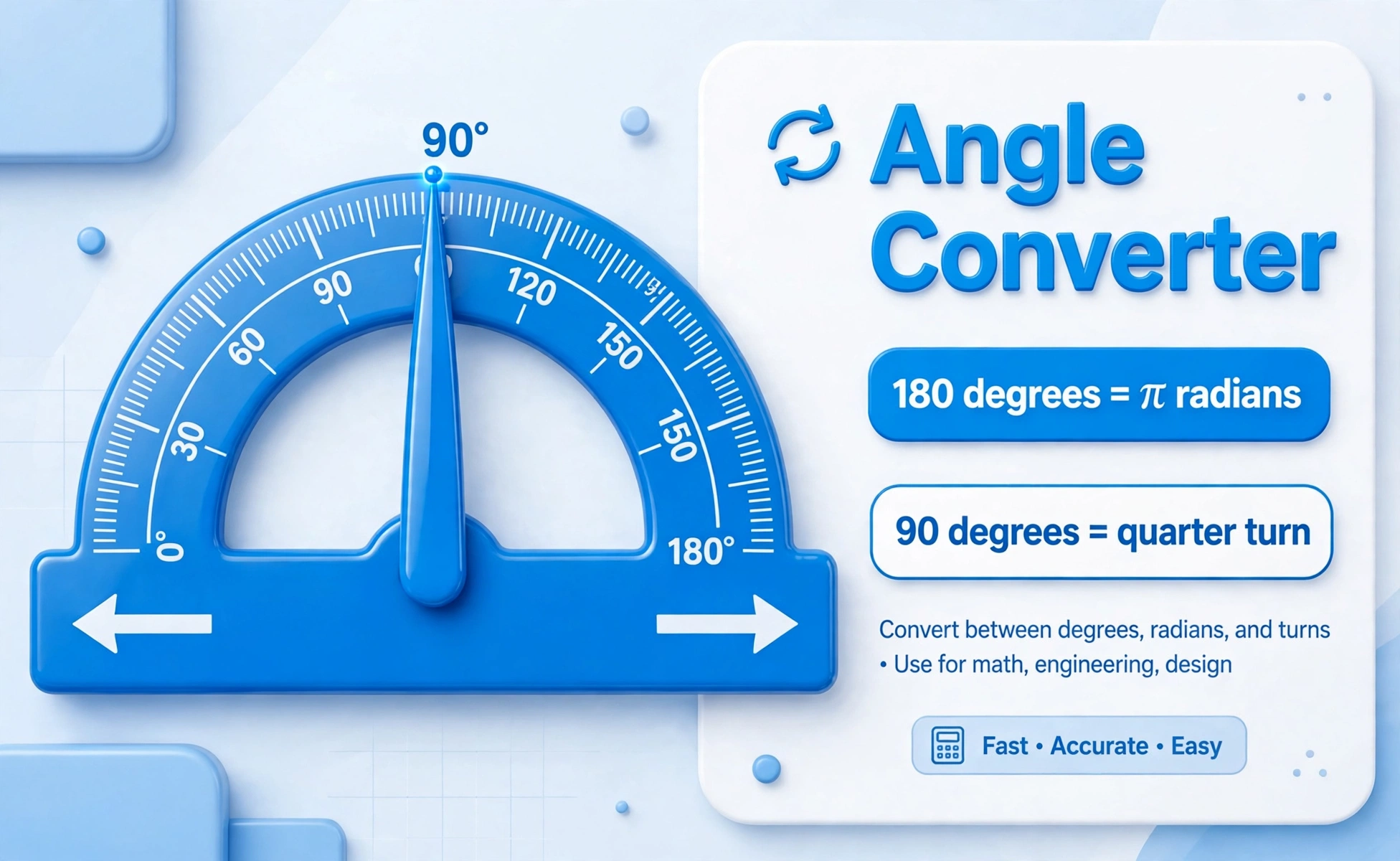
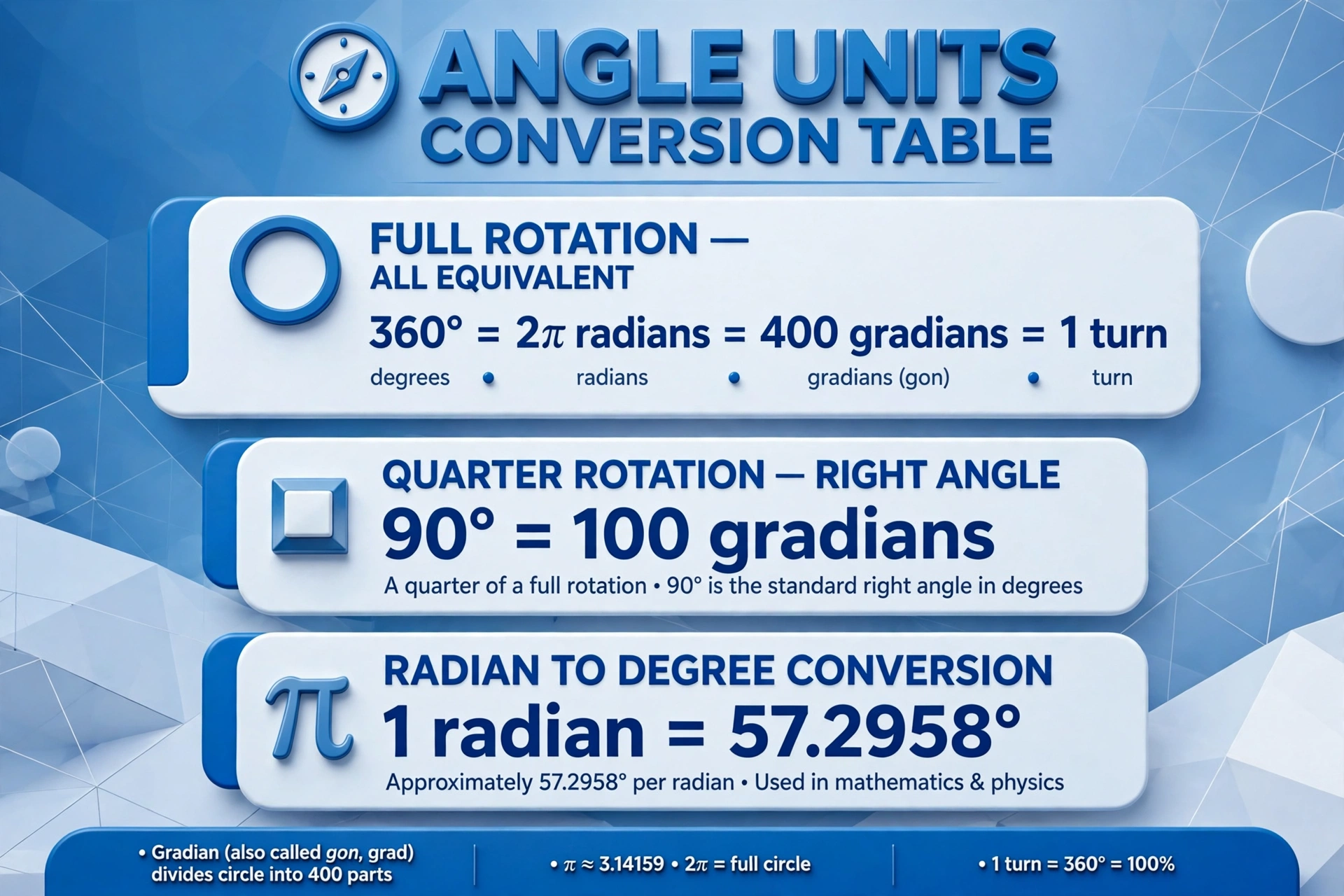
The anchor for all of them is the full circle: 360 degrees equals 2 pi radians, about 6.2832, equals 400 gradians, equals 1 turn. A right angle is 90 degrees, pi over 2 radians, 100 gradians, and a quarter turn. A straight angle is 180 degrees, pi radians, 200 gradians, and half a turn.
For triangles and right-angle problems, a triangle calculator works with sides and angles directly.
The Conversion Formulas
Degrees to radians: multiply degrees by pi and divide by 180. Radians to degrees: multiply radians by 180 and divide by pi. Degrees to gradians: multiply degrees by 10 and divide by 9, because 360 degrees equals 400 gradians. Degrees to turns: divide degrees by 360. Degrees to arcminutes: multiply by 60. Degrees to arcseconds: multiply by 3600.
The exact values matter more than the decimals. A radian is defined so that pi radians is exactly 180 degrees, so 1 radian is about 57.2958 degrees. Keeping pi in the answer, as in pi over 3 for 60 degrees, keeps the result exact, while the decimal 1.0472 is an approximation that is fine for most practical work.
| From | To | Multiply by |
|---|---|---|
| Degrees | Radians | pi / 180 (about 0.0174533) |
| Radians | Degrees | 180 / pi (about 57.2958) |
| Degrees | Gradians | 10 / 9 (about 1.1111) |
| Degrees | Turns | 1 / 360 |
| Degrees | Arcminutes | 60 |
| Degrees | Arcseconds | 3600 |
Worked Examples
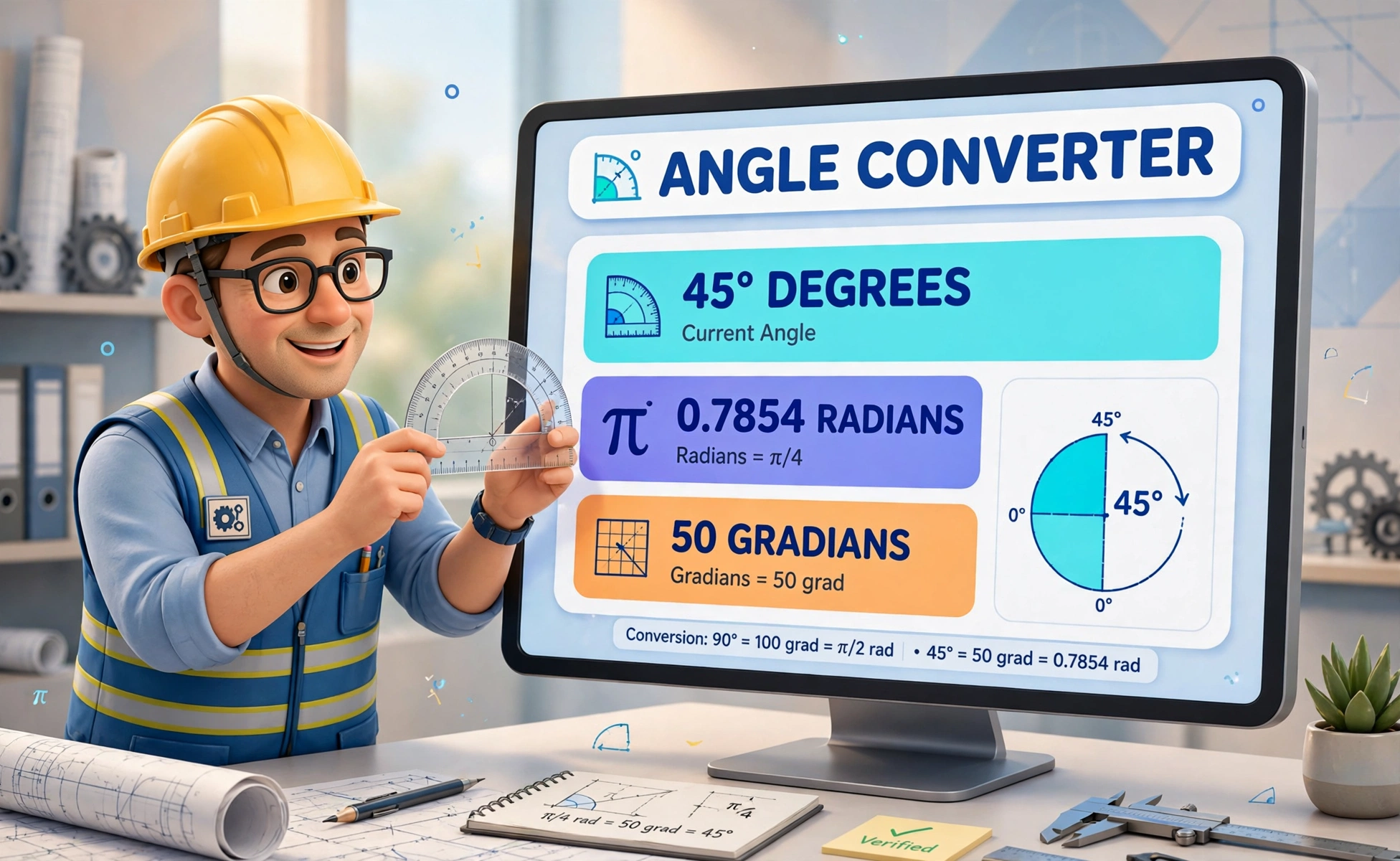
Example 1: convert 180 degrees. In radians that is pi, about 3.1416, in gradians 200, and in turns 0.5. Example 2: convert 90 degrees. That is pi over 2 radians, about 1.5708, 100 gradians, and 0.25 turns. Example 3: convert 45 degrees. That is pi over 4 radians, about 0.7854, 50 gradians, and 0.125 turns.
Example 4: convert 2 radians to degrees. Multiply 2 by 57.2958 to get about 114.5916 degrees. Example 5: convert 30 arcminutes to degrees. Divide 30 by 60 to get 0.5 degrees. Arcminutes and arcseconds appear in coordinates and telescope pointings, where a single degree is far too coarse.
| Angle | Degrees | Radians | Gradians | Turns |
|---|---|---|---|---|
| Straight angle | 180 | 3.1416 | 200 | 0.5 |
| Right angle | 90 | 1.5708 | 100 | 0.25 |
| 45 degrees | 45 | 0.7854 | 50 | 0.125 |
| Full circle | 360 | 6.2832 | 400 | 1 |
Degrees, Minutes, Seconds
An angle can also be written in degrees, minutes, and seconds, written as 45 degrees 30 minutes 0 seconds. That is 45.5 degrees, because 30 minutes is half a degree. To convert, divide the minutes by 60 and the seconds by 3600, then add: 30 degrees 15 minutes is 30.25 degrees, and 30 degrees 15 minutes 30 seconds is about 30.2583 degrees.
This notation survives in navigation, astronomy, and land surveying, where coordinates are quoted to arcseconds. For ordinary conversion work, decimal degrees are simpler, and this calculator uses them throughout.
| DMS | Decimal degrees | Radians |
|---|---|---|
| 45 degrees 30 minutes | 45.5 | 0.7941 |
| 30 degrees 15 minutes | 30.25 | 0.5279 |
| 90 degrees 0 minutes | 90 | 1.5708 |
Common Mistakes
The most common mistake is mixing radians and degrees in trigonometry: the sine of 90 degrees is 1, but the sine of 90 radians is about 0.8940, because 90 radians is many full turns. Always check which unit a calculator or a formula expects before entering an angle.
Another mistake is treating gradians as degrees: 100 gradians is a right angle, not a near-straight angle, because a full circle is 400 gradians. A third mistake is forgetting that negative angles and angles above 360 degrees are valid: negative 45 degrees is a clockwise turn, and 720 degrees is two full turns, not an error.
Where Each Unit Is Used
Degrees dominate everyday geometry, navigation, and school mathematics. Radians dominate calculus, physics, and engineering, because formulas for arc length and angular speed are simplest in radians. Gradians appear in surveying, especially in parts of Europe, because 100 gradians per right angle fits decimal arithmetic. Turns appear in rotation counts, motor speeds, and phase, where whole revolutions are the natural count.
For slope and right triangles, a Pythagorean theorem calculator connects sides and angles. Use this converter whenever a value arrives in one unit and a formula or a tool needs another.
Frequently asked questions
How many radians are in 180 degrees?
Pi radians, about 3.1416. The exact relation is 180 degrees equals pi radians.
How do I convert degrees to radians?
Multiply degrees by pi and divide by 180. For 90 degrees, that is 90 times pi divided by 180, which is pi over 2, about 1.5708.
How many degrees is 1 radian?
About 57.2958 degrees. Multiply radians by 180 and divide by pi to get degrees.
What is a gradian?
One four-hundredth of a full circle. A right angle is 100 gradians, and a full circle is 400 gradians. Gradians are also called gon.
What is a turn?
One full revolution: 360 degrees, 2 pi radians, or 400 gradians. A half turn is 180 degrees.
How many arcminutes are in a degree?
60 arcminutes, and each arcminute holds 60 arcseconds, so a degree holds 3600 arcseconds.
Can angles be negative or above 360 degrees?
Yes. Negative angles measure clockwise rotation, and angles above 360 degrees count multiple turns. This converter handles both as entered.